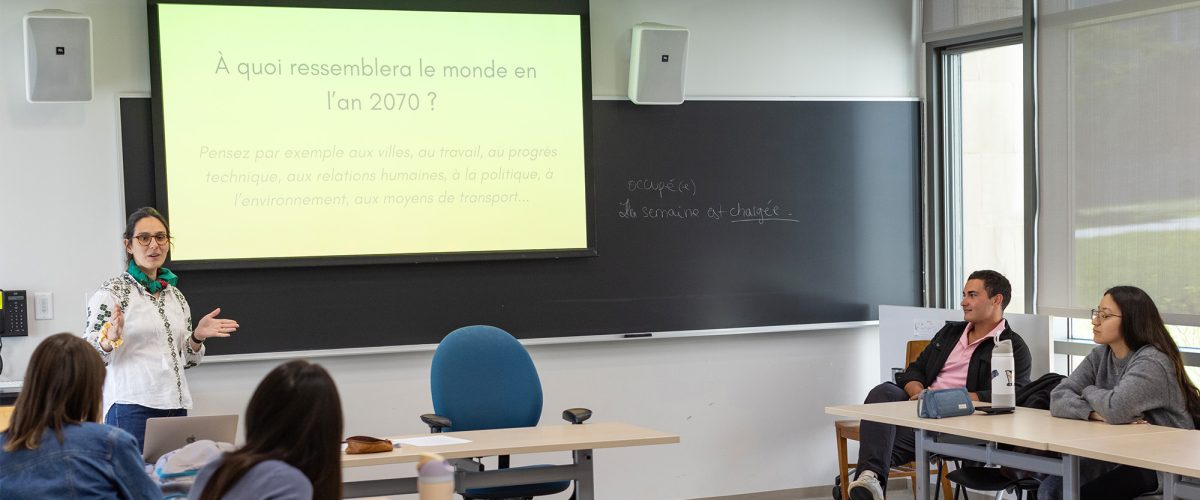
The French program offers a range of courses spanning language, literature, and culture. Taught entirely in French, our language courses accommodate all levels and are designed to help you improve your speaking, comprehension, reading and writing. Literature courses explore fiction, cinema, art, politics, and culture from the Middle Ages, Renaissance and Revolution to the present day, and from Francophone Europe and North America to North Africa and the Caribbean.
French Courses
RLFR 101 (F) SEM Introduction to French Language and Francophone Cultures This year-long course offers a complete introduction to the French language and is designed to help you become fully conversant in French by focusing on four fundamental language skills: listening, speaking, reading, and writing. Through daily practice, class activities, interactive discussion, listening exercises, written work, reading assignments, and active engagement with music, video, and film, you will quickly gain confidence and increasing facility with your abilities to speak and understand both spoken and written French. In addition, our study of grammar, vocabulary, and communication skills will be organized around an engaging and dynamic introduction to a variety of French-speaking cultures around the world, from France and Belgium, to Québec and Martinique, to Sénégal and Morocco. Conducted in French. Taught by: Brian Martin | Catalog details RLFR 102 (S) SEM Introduction to French Language and Francophone Cultures This year-long course offers a complete introduction to the French language and is designed to help you become fully conversant in French by focusing on four fundamental language skills: listening, speaking, reading, and writing. Through daily practice, class activities, interactive discussion, listening exercises, written work, reading assignments, video-observations, and film-viewing, you will quickly gain confidence and increasing facility with your abilities to speak and understand both spoken and written French. In addition, our study of grammar, vocabulary, and communication skills will be organized around an engaging and dynamic introduction to a variety of French-speaking cultures around the world, from France and Belgium, to Québec and Martinique, to Sénégal and Morocco. Conducted in French. Taught by: Sophie Saint-Just | Catalog details RLFR 103 (F) SEM Intermediate Studies in French Language and Francophone Cultures As a continuation of French 101-102, this dynamic first-semester intermediate course is designed to help you improve your French, while at the same time learning more about French and Francophone cultures, politics, literature, and film. Through the active study and daily practice of listening, speaking, reading, and writing in French, you will: continue developing your communication skills and learn to express your opinions and ideas; improve your command of spoken and written French through a revision of important grammatical structures; strengthen your reading and writing skills in order to prepare you for further study of literary texts; and develop an increased vocabulary and cultural appreciation of French-speaking cultures around the world. Taught by: Maïté Marciano | Catalog details RLFR 104 (S) SEM Intermediate French II: Advanced Intermediate Studies in French As a continuation of French 103, this course will help students gain greater fluency in French, through an exploration of French and Francophone literature, film, media, politics, and culture. With a focus on listening, speaking, reading, and writing, students will review advanced grammar expand their vocabulary, gain greater confidence, and both discuss and debate central questions in the social, political, and cultural landscape of French-speaking communities in Europe, Africa, and the Caribbean. Taught by: Maïté Marciano | Catalog details RLFR 105 (F) SEM Advanced French: Advanced Studies in French Language and Francophone Culture In this French course, we will read and examine literary texts from the twelfth to the 19th centuries, and films from the twentieth and twenty-first centuries. In order to analyze them, we will briefly situate them in their social and historical contexts. These works will help us better understand contemporary France and explore France’s colonial past. We will also learn how to write two short research paper in French in the form of an explication de texte. While the themes, authors, time periods will vary, our approach will remain the same. Three themes, love, fear, and France’s colonial past, will serve as the course’s organizing principles. A small section of the course will be devoted to grammar revisions in order to continue to improve our reading and language skills. Throughout the semester we will develop our writing skills in French. Conducted in French Taught by: Sophie Saint-Just | Catalog details RLFR 106 SEM Advanced French: Danger and Desire in French Film and Fiction Last offered Spring 2026 This is an advanced course in French language designed to help you improve your speaking, comprehension, reading, and writing, through the dynamic study of short literary texts and films focusing on danger and desire in nineteenth-, twentieth-, and twenty-first-century France and the Francophone World. Through active discussion and debate, textual and cinematic analysis, grammatical review, and careful writing and revision, you will improve your command of spoken and written French, strengthen your ability to express complex ideas, expand your vocabulary, and deepen your understanding of French and Francophone fiction, film, and cultures. This is an ideal course to prepare for study abroad or for more advanced coursework in French and Francophone literature and cinema. As a focus for improving your French, we will examine a broad range of texts and films on danger and desire in France, Québec, and Algeria from 1820 to 2025, with an emphasis on passion and ambition, infatuation and seduction, betrayal and vengeance, courage and cruelty, warfare and resistance. Works to include nineteenth-century texts by Chateaubriand, Duras, Balzac, Mérimée, Flaubert, Maupassant, Zola; twentieth-century texts by Colette, Camus, Sartre, Beauvoir, Duras, Ernaux, Guibert, Quint, Lindon, Vilrouge; and twenty-first-century films by Caron, Ozon, Ducastel, Martineau, Dercourt, and Becker. Conducted in French. Taught by: Brian Martin | Catalog details RLFR 202 SEM War and Resistance: Two Centuries of War Literature in France (1800-2015) Last offered Fall 2025 In 1883, Maupassant called on his fellow war veterans and writers to join him in speaking out against warfare and violence, crying “Let us dishonor war!” From the Gallic Wars against Caesar (during the first century BC) to more recent terrorist attacks in France (at the start of the twenty-first century), the French literary tradition is rich in texts that bear witness to war and speak out against its monstrous inhumanity. While war literature in France can be traced back to ancient and medieval texts on Vercingétorix, Charlemagne, William the Conqueror, and Joan of Arc, this course will focus specifically on literary representations of war during the nineteenth- and twentieth-centuries, from the Napoleonic Wars, to the First and Second World Wars, to the Algerian and Cold Wars, and the “War on Terror.” Discussions will examine the impact of war on soldiers and civilians, patriotism and pacifism, history and memory; the implications of war as invasion and conquest, occupation and resistance, victory and defeat; the relationship of war to gender, sexuality, and ethnicity; and the role of war in colonialism and genocide. Readings to include novels, short stories, and poems by Balzac, Stendhal, Hugo, Rimbaud, Daudet, Maupassant, Zola, Cocteau, Wiesel, Duras, Camus, and Fanon. Films to include works by Resnais, Renoir, Carion, Jeunet, Malle, Angelo, Pontecorvo, and Duras. Conducted in French. Taught by: Brian Martin | Catalog details RLFR 203 SEM Introduction to Francophone Literatures Last offered Fall 2016 What is the Francophone world comprised of? Who speaks French today and why? What does the idea of Francophonie really mean? Is this term really relevant? Why, how, and by whom is this idea being criticized? How does the littérature-monde manifesto fit within these interrogations? Is the French-speaking world merely a linguistic community or is it also a political, cultural, and economic project? Last but not least, why is the idea of Francophonie so important for France? We will answer these questions through the lens of literary and cinematic texts from Québec, Sénégal, Vietnam, France (l’hexagone), and Haiti among others. Taught by: Sophie Saint-Just | Catalog details RLFR 206 SEM The Outsider in French & Francophone Film Adaptations of Literary Texts Last offered Spring 2025 In this course students will examine the figure of the outsider (queer, black, woman, intruder, loner) in several French and Francophone literary texts and their film adaptations and will explore questions such as: how are such outsiders translated onto the screen? To what extent does outsider status help maintain, challenge, or reveal hegemonic discourse? In what ways do non-Western and Western filmmakers (re)cast power and privilege through the figure of the outsider in their film adaptations (of Western canonical texts)? Students will read original French and Francophone literary texts and apply theories of film adaptation to their analyses. Taught by: Sophie Saint-Just | Catalog details RLFR 213 (F) LEC Sounds of Paris in the Nineteenth Century If Paris was, as Walter Benjamin famously described it, the “capital of the nineteenth century,” why did the city (and, by extension, the entire nation) have such a crisis of musical identity during the nineteenth century? This course examines the social and historical contexts that affected the city’s fractured identities and thus shaped its musical practices and repertories. What factors shaped musical life, and what factors could be accepted as “French”? While some of these critical forces were purely musical, others were financial, social, aesthetic, or tied to the French state. Reaching beyond the nebulous question of public taste, this course examines the various cultural, musical, and aesthetic means by which the French capital shaped its soundscape; topics include the civic, aural, political, religious, gendered, global, and architectural means through which the Parisian intelligentsia and its everyday citizens labored–at times together and at others at odds–to craft a Parisian musical identity throughout the course of the nineteenth century. This course will be conducted in English. Taught by: Jennifer Walker | Catalog details RLFR 214 (S) SEM Francophone Mediterranean Cultures: Hospitality, Displacement, and Borders The Mediterranean is a world of seafarers, travelers, and migrants. A multicultural and multilingual space, it is often associated with hospitality and cosmopolitanism. Yet it is also a site of contested borders, forced displacement, criminalization, and danger. In this course, we will engage with questions surrounding the tensions, crossings, and cultures of the Francophone Mediterranean. Exploring works of theory, literature, and cinema, we will examine Mediterranean identities and cultures, tales of hospitality, and the “Mediterranean Dream.” We will then turn to challenging these visions and asking how the Mediterranean might also be a place of hostility. Using an ecocritical lens, we will consider the Mediterranean Sea as a site of intersecting crises: environmental, geopolitical, and humanitarian. Taught by: Maïté Marciano | Catalog details RLFR 216 SEM Women Behaving Badly: Deviant Women in Early Modern French Literature Last offered Spring 2025 Female deviance often implies resisting a dominant and oppressive patriarchal status quo embedded within cultural and historical backgrounds. This course explores female characters in early modern French literature who refuse to conform to established gender roles. Defying social constructs of femininity, through either judicious negotiations or more aggressive and violent behavior, is an important trope in the writings of both male and female authors of the seventeenth and eighteenth centuries. What constitutes deviant behavior, however, depends on social definitions of gender roles, which evolve over time. In this course, we will first examine women’s place within the historical and socio-cultural context of the Ancien Régime, which will lead to an examination of female behavior censured during the seventeenth and eighteenth centuries. We will then reflect on how we, as modern readers, perceive such deviancy at it relates to the past. Finally, we will discuss the relevance of studying deviant women in light of current events, such as the #MeToo movement, which has led to a new level of consciousness and empathy for the plight of marginalized groups. Potential readings to include Corneille’s Médée, Madame de la Fayette’s Princesse de Clèves, Laclos’s Liaisons dangereuses, and Isabelle de Charrière’s Lettre à Mistriss Henley. Taught by: Preea Leelah | Catalog details RLFR 218 (S) CON New Voices in French Stand-Up Comedy This course focuses on the rise, in the span of a generation, of a diverse and more inclusive French stand-up comedy scene that privileges multiple identities, and centers religion, race, class, and a wider range of gendered expressions. It examines how this new direction in French stand-up comedy serves as commentary, interrogate and amplify socio-political discourses, but also oscillates between (mis- and counter) representations of power, identity, citizenship, and belonging in contemporary France. Drawing from a wide range of material (editing volume Le Stand-up en France: discours, pratiques, enjeux (2025), guidebook Le Guide Ultime du Stand-up: du rire à la réussite (2023), Netflix limited series Drôle (2022),recent book chapters and academic articles, as well as curated excerpts from comedy specials by established and rising stand-up comedians on TV, streaming platforms or on social media), students will discuss the ethics and morals of punching up and punching down, how humorists use political and social commentary, the extent to which they parse, dispel and/or reproduce fraught representations and why. Taught by: Sophie Saint-Just | Catalog details RLFR 224 SEM Sexuality and Seduction in Nineteenth and Twentieth-Century France Last offered Spring 2019 In 1857, both Flaubert’s Madame Bovary and Baudelaire’s Les Fleurs du mal were put on trial for sexual indecency and “crimes against public morality.” In 1868, Le Figaro attacked Zola’s novel Thérèse Raquin as “putrid literature” for its depiction of adultery, murder, and scandalous sexuality in nineteenth-century Paris. A century later, Gide, Proust, Colette, and Duras continued to shock French readers with their extraordinary novels on male and female homosexuality, intergenerational lovers, and biracial relationships. In this course, we will examine a broad range of issues on sexuality and seduction in nineteenth- and twentieth-century French literature, including eroticism and desire, love and betrayal, marriage and adultery, prostitution and fetishism, gay and lesbian identities, cross-dressing and gender representation, exoticism and colonial (s)exploitation. Readings to include novels, shorts stories, and poems by Chateaubriand, Constant, Duras, Balzac, Flaubert, Baudelaire, Zola, Maupassant, Barbey d’Aurevilly, Gide, Proust, Colette, Duras, and Guibert. Taught by: Brian Martin | Catalog details RLFR 225 SEM Remembering the Great War: The First World War in Literature and Film Last offered Fall 2023 From 1914 to 1918, the First World War ravaged Europe and slaughtered millions of soldiers and civilians from across the globe. Known as the “war to end (all) war(s),” World War I set the stage for an entire century of military conflict and carnage. New technologies led to unprecedented violence in the trenches, killing and wounding as many as 41 million soldiers and civilians. Beyond the slaughter at the front, the Great War also led to the global influenza pandemic that claimed up to 50 million lives, and the Armenian genocide that presaged the later atrocities of the Holocaust. The war also led to massive political transformation, from the Irish Rebellion and Russian Revolution, to the collapse of the German, Russian, Austro-Hungarian, and Ottoman Empires, and the redrawing of national borders across Europe and the Middle East. Even the end of the war with the Treaty of Versailles lay the groundwork for new animosities that would lead to the Second World War just two decades later. However, the First World War also inspired great social change, from the emergence of the United States as a global leader and the founding of the League of Nations, to growing discontent with colonial rule in Asia and Africa, and greater power for women whose wartime labor influenced the post-war passage of their right to vote in countries across Europe and North America. In our study of the Great War, we will examine texts and films that bear witness to the suffering and courage of soldiers and civilians, and consider the legacy of the war in the twentieth- and twenty-first centuries. Readings to include memoirs and novels by Barbusse, Barker, Brittain, Cocteau, Graves, Hemingway, Jünger, Remarque, Wharton, Woolf; poetry by Apollinaire, Brooke, Mackintosh, McCrae, Owen, Sassoon; films by Attenborough, Boyd, Carion, Chaplin, Jeunet, Ozon, Renoir, Trumbo, Walsh, Weir; and archival materials on the roles of Williams students and faculty during the First World War. Readings and Discussions in English. Taught by: Brian Martin | Catalog details RLFR 226 SEM Black France/France Noire Last offered Spring 2020 On the eve of the new millennium, the year 1998 saw the emergence in France of “Black studies à la française” (Ndiaye). Inspired, in part, by the 150th anniversary of the 1848 abolition of slavery, the French black minority “made itself more visible” (Faes and Smith). This course examines a wide range of discursive practices through which athletes, artists, authors, politicians, activists, and scholars amplified their voices in the French hexagone. It retraces the rise of these discourses and how they assert, reframe, and establish blackness as a legitimate field of knowledge and a space of affirmation and contestation. Following a study of the interwar period (1918-1939), when the work of “negritude women” (Sharpley-Whiting) such as “afro-latinité” spurred the negritude movement, we will discuss publications, documentaries, and seminal moments of protest in the early twenty-first century. Course material may include works by Suzanne Césaire, Jane and Paulette Nardal, Aimé Césaire, Frantz Fanon, Achille Mbembé, Françoise Vergès, Pascal Blanchard, Nicolas Bancel and Sandrine Lemaire, Pap Ndiaye, Gaston Kelman, Rokhaya Diallo, Alice Diop, Léonora Miano, and Fabienne and Véronique Kanor. Conducted in French. Taught by: Sophie Saint-Just | Catalog details RLFR 228 SEM Introduction to French and Francophone Film Last offered Spring 2018 In this course, we watch and examine seminal French and Francophone films. Starting with early French cinema and silent movies of the end of the nineteenth century, we continue with landmark films from the 1920s, ’30s and ’40s. World War II serves as a point of rupture to explore how the advent of Francophone film parallels postcolonial theory. Throughout the semester, we discuss film as spectacle, the emergence of narrative forms, innovative technical practice and their connection to aesthetics. We also look at the role of film in addressing larger questions that include acts of rebellion, decolonization, the radical rejection of societal values, colonialism, dislocation, alienation, French collaboration during the German occupation, and the intersection of history and biography, as well as migration, in between-ness, and transnationalism. Films from the Lumière brothers, Méliès, Guy-Blaché, Vigo, Truffaut, Sembene, Mambety, Malle, Varda, Palcy, Peck, and Sissako. Conducted in French. Taught by: Sophie Saint-Just | Catalog details RLFR 229 Black Outside the U.S. Last offered NA This course explores multiple ways Black identity evolves, adapts and is experienced differently depending on location. Students analyze Black experience in the U.S., France and Senegal through a range of texts from books and social media to music and film. One key aspect of the course is a study abroad trip to Senegal, which increases cultural awareness through experiential learning. This combination of textual learning with experiential knowledge exemplifies how language, religion, gender, geography, and performance shape one’s racial identity. In the first section of the course, students investigate Black experience in the U.S., focusing on such topics as the one-drop rule, racial profiling and where mixed people fit within Black/White tensions. The second section highlights the politics of language in France. Students explore how words like “Black,” “noir” and “race” have strong political connotations in France and spur both resistance to and alliance with Black American civil rights history. In the third part of the course, students visit Dakar, Senegal, and analyze Blackness through their own observations and encounters. Their trip insights jumpstart the final focus of the course on Senegal. Students investigate the influence of French colonialism on Black identity in Senegal, which makes the two geographical experiences of Blackness very different but still forever linked. Taught by: TBA | Catalog details RLFR 232 SEM Liberté, Egalité, Fraternité ? Race, Gender, and Political Power in Eighteenth-Century France Last offered Spring 2023 The French Revolution of 1789 was, to a large extent, inspired by Enlightenment thinkers such as Voltaire, Rousseau, and Diderot who promoted ideas on individual liberty, scientific progress, religious freedom, and secularism. The Revolution brought with it promises of a society freed from the abuses of an absolute monarchy. Yet as feminist thinker Olympe de Gouges would note, when France redefined its notion of citizenship after 1789, it did not include women and people of color. This course examines Enlightenment ideas that led to the French Revolution, while analyzing how those ideas failed to bring true equality. Voltaire, Buffon, and Montesquieu all advocated for the abolition of slavery, but they also held racist and sexist views, justified by pseudoscientific discourse. By further juxtaposing these thinkers with feminist and abolitionist authors such as Olympe de Gouges and Claire de Duras, we will examine how eighteenth-century female authors advocated for the rights of women. Finally, we will analyze artworks such as Marie-Guillemine Benoist’s Portrait d’une négresse (1800) and discuss how France is using such works today to reckon with its history of discrimination. Taught by: Preea Leelah | Catalog details RLFR 236 SEM Québec Libre: Introduction to Québécois Literature and Film Last offered Spring 2026 Founded during the French Revolution in 1793, Williams College created an inaugural curriculum that required all students to study and speak French, under the guidance of the college’s first French professor, Monsieur Samuel Mackay, a native of Québec. In the next century, over half a million Québécois emigrated to New England, in search of work in lumber camps and mill towns like North Adams and Williamstown where, from the 1840s-1960s, French was spoken widely, both on and off campus. Amid this year’s celebration of the Williams tradition “On the Log,” we will examine the literary and cinematic history of Québec and the role of Québécois culture–from logging to literature–in shaping intellectual life at Williams and beyond. From Jacques Cartier’s initial exploration (1534) to Samuel de Champlain’s foundation of New France (1608), from the British Conquest (1759-60) to the Patriots Rebellion (1837-38), from the Quiet Revolution (1960s) to the movement for Québécois independence (1970s-2000s), Québec has been the vibrant nordic center of French America. Founded on the colonial fur trade and fueled by the massive lumber industry, Québec is known for its history of trapping and logging, fall foliage and winter snow, the French château charm of Québec City and the North American modernity of Montréal. Despite centuries of Anglophone exploitation and assimilation, Québécois writers and filmmakers have created a vast tradition of literature and film in French, documenting conflict and cooperation with Indigenous peoples, mythologizing frontier courage and lumber labor, inspiring social and political movements of cultural resistance, and celebrating the great diversity of Francophone identities in contemporary Québec. Taught by: Brian Martin | Catalog details RLFR 242 SEM Marseille: The Wicked City Last offered Spring 2026 Marseille, one of the oldest ports in Europe and France’s second largest city, has attracted migrants, refugees, and travelers from around the world, bridging the Orient and the Occident over millennia from its inception as a Greek colony to the present day. From the national anthem La Marseillaise through Alexandre Dumas’s Le Comte de Monte Cristo to contemporary French rap and hip hop from groups such as IAM, Marseille has marked French culture as a powerful counterpoint to Paris, in part due to its historical role facilitating centuries of global commerce and exchange. Often emphasizing its cosmopolitan identity, Marseille has offered a home for writers in exile and a window onto France’s former colonies. Nicknamed the “wicked city,” Marseille has also been associated with organized crime, drugs, and the troubled banlieues of the Quartiers Nord. What does it mean to tell the story of France from Marseille as opposed to Paris, and how does this perspective complicate French notions of universalism and identity while foregrounding France’s colonial past? Has Marseille’s famed cosmopolitanism evolved through time, and does this representation still hold today? Finally, what might the literary imaginary of Marseille reveal about French culture and its relationship with the world today? To answer these questions, we will examine various texts, artworks, films, and music from Marseille spanning from the eighteenth to the twenty-first century by Charles de Brosses, Casanova, Émile Zola, Alphonse Daudet, Joseph Méry, Albert Londres, Paul Valéry, Marcel Pagnol, Albert Cohen, Françoise Ega, Ousmane Sembène, Maylis de Kerangal, and films by Jean Renoir, Robert Guédiguian, Jean-Bernard Marlin, and Cédric Jimenez. We will focus on three key moments: Marseille as a colonial port city; Marseille between the wars as a place of exile; and post-war Marseille, focusing on questions of migration, belonging, and the musical culture of the banlieue. The class will be conducted in French. Taught by: Maïté Marciano | Catalog details RLFR 243 (F) SEM Narrating Health and Illness: French and Francophone Perspectives on Medicine and Care In the early 1960s, Michel Foucault published two works that revolutionized our understanding of medicine and psychiatry: Madness and Civilization and The Birth of the Clinic, in which he developed the concept of the “medical gaze.” He was deeply influenced by the physician Georges Canguilhem, who had redefined health and disease, challenging what it means to have a “healthy body.” Since then, philosophers such as Gilles Deleuze, Frantz Fanon, and more recently, Paul B. Preciado and Catherine Malabou, have continued to interrogate how we define illness and care within and outside the clinic, in metropolitan France, in colonial and postcolonial contexts, and across different bodies. Similarly, writers such as Annie Ernaux, Maylis de Kerangal, and Martin Winckler, and filmmakers Alice Diop and Nicolas Philibert, have documented and reimagined hospital spaces and care practices, examining how doctors, institutions, and societies care for and police bodies, enforce medical norms, and pathologize behaviors, as well as how technologies such as those used in organ transplantation continue to inform care practices today. Through literary and philosophical texts and contemporary films, this course explores theoretical understandings of health and disease, and examines how literature has represented medicine and the hospital throughout the twentieth and twenty-first centuries. Topics will cover issues ranging from mental illness, reproductive health, and organ transplants, to the evolution of medical regulations regarding different bodies and forms of exclusion. Throughout, we will ask how literature and film might illuminate questions of care and reimagine future worlds of health. Taught by: Maïté Marciano | Catalog details RLFR 260 (F) SEM Francophone Graphic Novels In this class we will read contemporary graphic novels and bandes dessinées from Côte d’Ivoire, Morocco, Guadeloupe, Lebanon, France, and Québec to analyze how they approach subjects such as colonial history, migration and discrimination, gender and sexuality, and representations of disability and the racialized body. We will pay particular attention to the visual form and the critical theory of the graphic novel to further understand why this hybrid genre has become so popular and widespread, and how it is shaping conversations about difference and power in the Francophone world. Conducted in French. Taught by: Katarzyna Pieprzak | Catalog details RLFR 261 SEM Haitian and French Caribbean Literatures and Films Last offered Fall 2016 Over the twentieth and twenty-first centuries, authors and filmmakers have questioned prevalent representations of the Creole and French-speaking Caribbean such as the idea of Haiti as the First Black republic and the poorest nation in the Western hemisphere and and of Martinique and Guadeloupe as the “French” Caribbean. They have also interrogated their forebears by reclaiming modernity, reframing History, and telling “intimist” stories (Ferly). This course focuses on the diverging paths by Haitian and French Caribbean literatures (short stories, play, poem, novels) and film (short, feature and documentaries) as critical interventions that bring into focus gender, slavery, identity, exile, migration, imperialism, culture, and (non) sovereignty. Taught by: Sophie Saint-Just | Catalog details RLFR 287 (S) SEM Creole Nations: [Francophone] Cultures Without Borders In mainstream narratives in the United States, the word creole often evokes regional, musical, and culinary imagery such as New Orleans or food like gumbo or étouffée. The word suggests a cultural blending of African and European traditions. Yet creole also has other powerful political and historical meaning(s). In the Francophone world, Caribbean islands such as Martinique and Guadeloupe are politically French but culturally Creole, with distinct histories and identities. What are Creole nations, how did they come into being and why do they matter in a global context? What can we learn from these societies and their history? Born out of a history of resistance, Creole cultures transcend racial boundaries. Beginning with the dark history of slavery and French colonialism, we will examine the cultural transformation of deterritorialized peoples who (speaking mutually unintelligible languages) created languages and cultures, distinct from the ones imposed by colonizing forces. We will then examine how creolization continues to shape music, food, ritual, and everyday life, and how contemporary global issues (such as environmental crises, economic inequality, and social justice movements) are transforming Creole societies today. Readings will include major Francophone voices from Creole-speaking cultures, including Frantz Fanon and Aimé Césaire (Martinique), Maryse Condé (Guadeloupe), Ananda Devi (Mauritius), and Jacques Roumain (Haiti). The course is conducted in French, with introductions to several Creole languages. Taught by: TBA | Catalog details Sophie Saint-Just | Catalog details RLFR 307 SEM Building Francophone Cities: Literature, Art and History Last offered Fall 2022 Through literature, visual art, and urban history, this class will engage with the remarkable histories, presents and imagined futures of five Francophone cities: Casablanca (Morocco), Algiers (Algeria), Kinshasa (Democratic Republic of the Congo), Fort-de-France (Martinique) and Port-au-Prince (Haiti). We will learn about their colonial foundations and postcolonial transformations while paying attention to how these urban spaces and their people and histories are represented and imagined by poetry, novels, and visual art. (Conducted in French) Taught by: Katarzyna Pieprzak | Catalog details RLFR 309 SEM Contemporary Short Stories from North Africa Last offered Fall 2017 Short stories are the vibrant center of the literary landscape in North Africa today. Written in French, Arabic and sometimes Amazigh languages, short stories provide timely interventions in political and social discourse. In this course, we will read short stories that use humor and satire to address the effects of globalization on local communities, that experiment with language to portray war and revolution, and that seek to create a new space for the discussion of gender. We will also analyze films, sociological texts and Moroccan, Algerian and Tunisian online newspapers in order to explore contemporary transformations of life in North Africa. Readings by Maissa Bey, Abdelfattah Kilito, Zeina Tabi, Mohamed Zafzaf, Ahmed Bouzfour, Soumaya Zahy and Fouad Laroui among others. Conducted in French. Taught by: Katarzyna Pieprzak | Catalog details RLFR 311 SEM L’art du crime: Francophone Detective Novels Last offered Fall 2025 The 2021 blockbuster TV series Lupin introduced viewers around the world to the work of Maurice Leblanc, but readers of French have long loved crime and mystery novels. In this class we will read French detective fiction that spans from the mid-19th century to the present day. We will also read detective novels from Francophone North Africa, West Africa and the Caribbean. Our central questions will include: Why are detective novels so satisfying to read? How do detective novels identify key social, political and cultural issues through their staging of crime, its tracking and resolution? How do detective novels stage and negotiate norms around what is considered rational, legal and/or just? And what work do detective novels do when the crime is colonialism, slavery and mass murder? Conducted in French. Taught by: Katarzyna Pieprzak | Catalog details RLFR 316 SEM Paris on Fire: Incendiary Voices from the City of Light Last offered Fall 2024 During the 1830s, Honoré de Balzac described Paris as a “surprising assemblage of movements, machines, and ideas, a city of one hundred thousand novels, the head of the world,” but also characterized the French capital as a “land of contrasts,” a “monstrous wonder,” a “moral sewer.” Similarly, writers from Victor Hugo to Émile Zola have simultaneously celebrated Parisian elegance and condemned the appalling misery of Paris’s urban poor. Since 1889, Paris has been fêted as the “City of Light” for its Enlightenment legacy, Eiffel Tower modernity, and luminous energy, captured in countless paintings, photographs, and film. However, Paris is also the site of revolution, resistance, and riots. From revolutionary revolt (1830, 1848, 1871), to wartime resistance (1870, 1914-18, 1940-44), to reformist and race riots (1968 and 2005), Paris has repeatedly sparked with incendiary passion and political protest. As fires raged during the 2005 riots, many heard the echo of Hitler’s 1944 question, “Is Paris burning?” and asked: why was Paris burning again at the dawn of the twenty-first century? Following the 2015 terrorist attacks, many wondered yet again what the future would hold for the City of Light. To answer these questions, we will examine the social, political, and literary landscape of Paris during the nineteenth, twentieth, and twenty-first centuries, from urbanization and modernization, to occupation and liberation, to immigration and globalization. Readings to include poetry, short stories, and novels by Hugo, Balzac, Baudelaire, Maupassant, Verne, Zola, Apollinaire, Colette, Duras, Perec, Rochefort, and Charef. Films to include works by Clair, Truffaut, Godard, Minnelli, Clément, Lelouch, Luhrmann, Kassovitz, Besson, and Jeunet. Conducted in French. Taught by: Brian Martin | Catalog details RLFR 318 (F) SEM Twentieth-Century French Novel: From Adversity to Modernity In his futurist novel Paris in the Twentieth Century (1863), Jules Verne envisions an era of technological superiority, complete with hydrogen cars and high-speed trains, televisions and skyscrapers, computers and the internet. But in Verne’s vision of modernity, technological sophistication gives way to intellectual stagnation and social indifference, in a world where poetry and literature have been abandoned in favor of bureaucratic efficiency, mechanized surveillance, and the merciless pursuit of profit. To contest or confirm this dystopic vision, we will examine a broad range of twentieth-century novels and their focus on adversity and modernity. In a century dominated by the devastation of two World Wars, the atrocities of colonial empire, and massive social and political transformation, the novel both documented and interrogated France’s engagement with race and ethnicity, gender and sexuality, colonialism and immigration. Within this historical context, we will discuss the role of the novel in confronting war and disease, challenging poverty and greed, and exposing urban isolation and cultural alienation in twentieth-century France. Readings to include novels by Colette, Genet, Camus, Duras, Ernaux, Guibert, Begag. Lectures to include discussions of Gide, Proust, Sartre, Beauvoir, Cixous, Foucault, Jelloun, Djébar. Films to include works by Fassbinder, Annaud, Lioret, Ducastel, Martineau, Téchiné, Charef. Conducted in French. Taught by: Brian Martin | Catalog details RLFR 320 SEM Transcending Boundaries: The Creation and Evolution of Creole Cultures Last offered Fall 2023 Born out of a history of resistance, Creole cultures transcend racial boundaries. This course provides a comprehensive framework for understanding the creation of Creole nations in various parts of the world. Beginning with an examination of the dark history of slavery and French colonialism, we will reflect upon the cultural transformation that took place when people speaking mutually unintelligible languages were brought together. We will then delve into the study of how deterritorialized peoples created their languages and cultures, distinct from the ones imposed by colonizing forces. As we journey from the past to the present, we will also explore how international events such as a worldwide pandemic, social justice, racism, and police brutality are currently affecting these islands. Potential readings will include prominent authors from different Creole-speaking islands, including Frantz Fanon and Aimé Césaire from Martinique, Maryse Condé from Guadeloupe, Ananda Devi from Mauritius and Jacques Roumain from Haiti. Conducted in French with introductions to different creoles. Taught by: Preea Leelah | Catalog details RLFR 330 TUT Unveiling Herstory: Heroines of the Francophone Enlightenment Last offered Spring 2025 On May 10, 2022, Paris unveiled the first statue of a black woman, Solitude, an emblematic figure of courage and resilience in the eighteenth-century fight against slavery in Guadeloupe. Against the backdrop of the contemporary French movement wherein statues of Enlightenment thinkers like Diderot, Rousseau, and Voltaire have been vandalized and sparked intense debates on memory and politics, Solitude’s recognition adds a profound dimension. Once revered as iconoclastic and progressive these male figures have in recent years been scrutinized for perpetuating ideals associated with white male hegemony, challenging conventional notions of freedom and equality. This tutorial invites students to reevaluate the Enlightenment movement, navigating beyond traditional narratives centered around male figures like Voltaire and Rousseau. It explores the transformative era post-French Revolution, shining a spotlight on the exceptional contributions made by women who defied societal norms within the eighteenth-century francophone world. Adopting a global perspective, the course not only examines events in France but also delves into its former colonies, particularly Haiti and Guadeloupe. By scrutinizing literary and ethnographic texts, as well as visual imagery, the course unravels the stories of remarkable women like Charlotte Corday, a key influencer during the Reign of Terror, and Sanité Belair, an active participant in the Haitian Revolution. The overarching goal is to underscore the significant roles and contributions of these women, often marginalized in historical narratives. Moreover, the course addresses the impact of archival gaps, shedding light on how the destruction of judicial archives by the French in their former colonies has shaped the remembrance of figures like Solitude and Belair. Course is offered either in French or in English. Taught by: Preea Leelah | Catalog details RLFR 360 SEM Repairing a Broken World: Intro to North African Contemporary Art Last offered Fall 2024 How do artists respond to a world in crisis? How does visual art engage violent histories, injured bodies, social injustice and ecological disaster? In this course we will explore the political and ethical concept of repair as it emerges in the work of contemporary North African visual artists. Repair is both a material and symbolic transformational practice of putting together something that is torn or broken. It is never complete, nor does it redeem a history of harm or violence. Rather repair is an invitation: a bringing of people, histories, objects, buildings, feelings and geographies into relation with one another in order to link worlds that have been splintered and separated. It is also a call to imagine other futures. North African contemporary artists have deeply engaged in this type of repair work, attending to colonial history, economies of extraction and environmental damage, race and slavery, housing inequity, gender identity and broken transmission of memory. We will dive into the work of individual artists as well as collectives while reading theoretical texts about broken-world thinking, reparative epistemology, alternative archives, and material reparations. Taught by: Katarzyna Pieprzak | Catalog details RLFR 378 SEM Proust’s “In Search of Lost Time” Last offered Spring 2024 In this seminar we will study Marcel Proust’s novel-sequence In Search of Lost Time, widely regarded as one of the most transformative works of 20th-century fiction. The first-person narrative chronicling the life of a fictional figure bearing a close relationship to Proust himself spans several decades from the late 19th to the early 20th century, centering on French high society as it enters the modern world, shaped by historical events such as the Dreyfus Affair and the First World War. Proust’s exploration of the consciousness of the protagonist, an aspiring writer, has led readers to see him as a philosopher of aesthetics, of the psyche, of time and memory, and of the nature of desire. His narrative ranges from meditations on such subjects to social satire to absorbing and sometimes soap opera-like plots exploring upward and downward social mobility and a wide array of sexual entanglements, straight and queer. Through his fluent prose, Proust renders the vicissitudes of desire, loss, and joy, of betrayal and emotional intransigence, and tests the power of memory and the imagination to recapture the past. Because of the length of In Search of Lost Time, the emphasis of the course will be more on reading (about 7 to 7½ hours per week) and less on writing (four or five 1½-page journal entries and a final paper of 8-10 pages) than the average 300-level course; and approximately one-third of the sequence will be bracketed as optional reading. Taught by: Stephen Tifft | Catalog details RLFR 384 SEM The Maghreb in Europe: Colonialism, Migration, and Racism Last offered Fall 2024 This interdisciplinary seminar introduces students to the multifaceted contemporary presence of the Maghreb in Europe. Themes covered include the socio-economic and cultural manifestations of the long durée of the European colonization of North Africa, and the political economy of the post-colonial labor immigration of North African workers to European countries like France, Italy, or Spain, for instance. Other key topics include the racialization of Maghrebian migrants and their descendants as Muslims. In this regard, we will discuss anti-Maghrebian racism and how it links to Islamophobia. To explore these themes, we will read a selection of theoretical texts by Franz Fanon, Abdelmalek Sayad, Pierre Bourdieu, Fatima Mernissi, Leïla Benhadjoudja, Nacira Guénif-Souilamas, and Hafid Bouazza, among others. We will also engage with a wide range of multimedia sources, including movies by Mahmoud Zemmouri and Leïla Sy, a selection of rap videoclips by various artists (Karima Khelifi, Saliha, Sorah, etc), the novel Hope and Other Dangerous Pursuits by Laila Lalami, and the graphic novel Burning Up the Strait: The Graphic Memoir of a Moroccan Migrant Child by Susan Plann and Ariel Lacci. In addition, we will examine current public debates and media analysis concerning the banning of the veil, the separatism law, the French concept of laïcité, and the representation of Maghrebian soccer players in the European national teams. All readings will be in English, but if a student is fluent in French, they will be provided with additional readings in French if they are interested. Taught by: Souhail Chichah | Catalog details RLFR 410 (S) SEM Senior Seminar: Movement and Migration How do movement and migration produce and disrupt constructions of identity, home, diaspora and the nation in a Francophone context? How is place is imagined, experienced and remembered? What are the relationships between movement and containment, flight and freedom? Over the course of the semester, we will examine literary texts, film and visual art from French-speaking communities that focus on: experiences of immigration and diaspora in France, the construction of a Francophone Atlantic identity, internal migration between rural and urban spaces, clandestine migration between Africa and Europe, population displacement due to war, and the possibility of creating portable or nomadic places of memory. Works by Chamoiseau, Glissant, Diome, Condé, Maffre, Ben Jelloun, among others. Conducted in French. Taught by: Katarzyna Pieprzak | Catalog details RLFR 412 SEM Senior Seminar: Nineteenth-Century French Novel: Desperate Housewives and Extreme Makeovers Last offered Spring 2025 In 1834, Honoré de Balzac wrote that “Paris is a veritable ocean. Sound it: you will never know its depth.” The same can be said of the French nineteenth-century novel and its boundless ability to echo the past and illuminate the present. From the Romanticism of Stendhal and Hugo, and the Realism of Balzac and Flaubert, to the Naturalism of Zola and Maupassant, the novel became a forum for examining illicit sexuality, institutional misogyny, social injustice, criminal passions, revolutionary struggles, and Parisian pleasures in nineteenth-century France. Characters such as the miserable housewife Emma Bovary, the reluctant revolutionary Jean Valjean, the social climber Julien Sorel, the ambitious undergraduate Eugène de Rastignac, and the domestically abused Gervaise Macquart became synonymous with France’s turbulent social and political landscape from the 1830s to the 1880s. As recent film adaptations make clear, these desperate housewives and extreme makeovers continue to haunt our twenty-first century present. Reinterpreted by such actors as Gérard Depardieu, Isabelle Huppert, Uma Thurman, Claire Danes, and Jennifer Aniston, the nineteenth-century novel continues to sound out the scandalous and sensational depths of our own century. Readings to include novels by Balzac, Stendhal, Hugo, Flaubert, Maupassant, Zola. Films to include adaptations by Clément, Berri, August, Arteta, Lelouch, Chabrol. Conducted in French. Taught by: Brian Martin | Catalog details RLFR 414 SEM Senior Seminar: Coming of Age: French and Francophone Childhood and Adolescent Film Last offered Spring 2026 Like the bildungsroman in literature, the coming of age story is a genre in itself in cinema. In this senior seminar, we will watch, discuss, and analyze French and Francophone childhood and adolescent narrative films whose protagonists bring into focus larger issues such as racial discrimination, class, gender, sexual identity, social mobility, repression from the state, regime change, delinquency, justice, bereavement, and human trafficking. We will watch seminal films by Euzhan Palcy, the Dardennes brothers, Céline Sciamma, Férid Boughédir, François Truffaut, Faiza Ambah, and Raoul Peck. Taught by: Sophie Saint-Just | Catalog details RLFR 415 (S) SEM Breaking the Silence: Women against Patriarchal Violence in the Francophone World Inspired by the French Revolution’s ideals of equality and a more just society for all, French women became increasingly politically active. In 1789, they led a successful march on Versailles, besieging the king’s palace to protest the high price of bread. Yet as the Revolution progressed and the monarchy was overthrown, women were increasingly excluded from political life and relegated to second-class citizenship. In 1791, a law was passed forbidding women from assembling, and their revolutionary participation was completely sidelined.
Beyond France, women also played crucial roles in anti-colonial struggles. During the Revolution in Haiti, figures such as Cécile Fatiman and Sanité Bélair played central roles in revolutionary resistance, as did many unnamed Vodou priestesses who were executed by the French army. Yet their stories have long been overshadowed by their male counterparts.
How does patriarchy both exploit and erase women’s bodies, voices, and labor? How have women resisted systems of silencing, colonial violence, and gendered racism in the Francophone world? In this course we will analyze works such as that of political activist Olympe de Gouges’ La Déclaration des droits de la femme et de la citoyenne (1791) challenging gender inequality in 18th-century France; Claire de Duras’ portrayal of the intersection of race and gender in 19th-century France; and Simone de Beauvoir’s challenge to traditional femininity and gender roles in 20th-century France. We will also explore other Francophone countries through Jean d’Amérique’s reflection on the politics of memory and female erasure, and Ananda Devi’s intimate portrayals of violence against women in postcolonial Haiti and Mauritius respectively. Taught by: TBA | Catalog details RLFR 493 (F) HON Senior Thesis: French French senior thesis; this is part of a full-year thesis (493-494). Taught by: Leyla Rouhi | Catalog details RLFR 494 (S) HON Senior Thesis: French French senior thesis; this is part of a full-year thesis (493-494). Taught by: Leyla Rouhi | Catalog details RLFR 497 (F) IND Independent Study: French French independent study. Taught by: Leyla Rouhi | Catalog details RLFR 498 (S) IND Independent Study: French French independent study. Taught by: Leyla Rouhi | Catalog details RLFR 511 LEC Intensive French Grammar and Translation Last offered Fall 2020 This course is designed to offer students a thorough and systematic review of sentence structures and grammar to develop a reading knowledge of French. Through this intensive study, students will learn to decipher the subtleties of the written language, and as they become more confident they will start translating a variety of short excerpts. Students are also expected to learn and develop a wide lexical range centered on art history and criticism, but not limited to it. Taught by: Pramila Kolekar | Catalog details RLFR 512 LEC Readings in French Art History and Criticism Last offered Spring 2021 This course is designed to provide Graduate Program students and interested others with knowledge of French acquired through translation and interpretation. The core of this course is based on the reading and translating of a variety of critical works covering different periods and genres in the field of art history. The material read will be analyzed in form and content, translated or summarized, in order to develop the skills and understand the techniques necessary for reading French accurately. Grammar will be reviewed in context. Taught by: Pramila Kolekar | Catalog details

Curriculum & Required Courses
Find the right course for you, whether you want to improve your French language skills, prepare for study abroad, or learn more about Francophone literary and cinematic traditions.