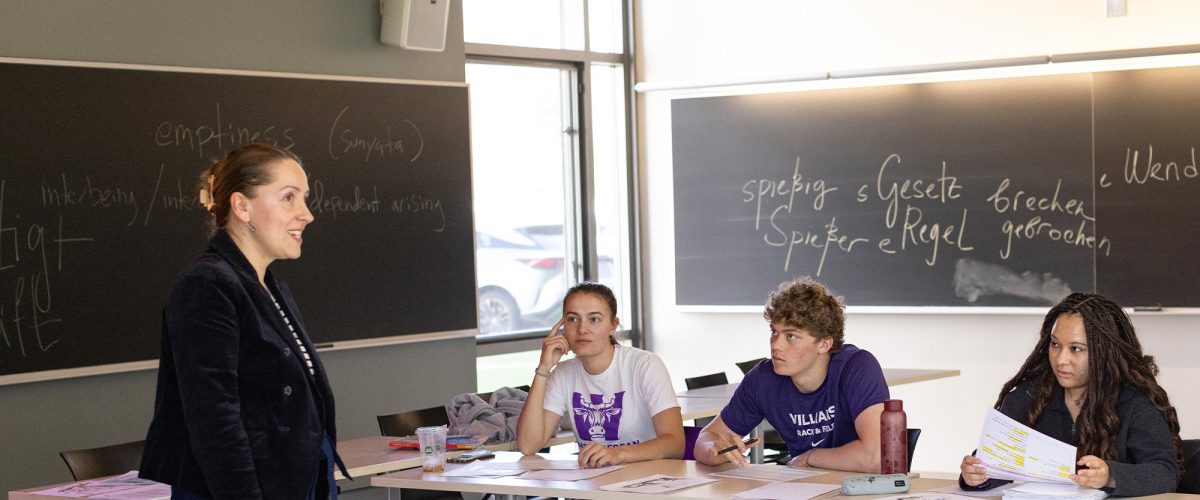
The Department of German offers an integrated approach to the study of language, literature, and culture. Explore the extraordinarily rich cultural traditions of those who speak German around the world by combining courses in German language and literature with other offerings across the college’s curriculum.
Why Study German?
As part of a vibrant community dedicated to rigorous studies of German language and culture, you’ll gain the speaking, writing, comprehension and analytical skills needed to engage meaningfully with virtually every aspect of the German-speaking world. Our course sizes are small, which allows for close student-faculty contact. Independent study courses and tutorials are also available on a regular basis for deeper exploration of the subject matter.

The Major
The major in German consists of a combination of language courses, upper-level courses in German, and electives taught in English. We offer five semesters of language courses, each providing a communicative approach that helps you to express your own thoughts and experiences while also encountering the cultural and social life of people in German-language regions.
- Our two-semester Elementary German (GERM 101, GERM 102) course prepares students to navigate straightforward day-to-day situations, to read simple texts, and to write short, basic paragraphs.
- Turbodeutsch (GERM 120) is a super-intensive Elementary German course in which especially committed students reach the proficiency level acquired in our two-semester sequence.
- Intermediate German I (GERM 103) focuses on solidifying the grammar and expanding the vocabulary that students have acquired in Elementary German, while providing more extensive reading, speaking, and writing opportunities.
- Intermediate German II (GERM 104) delves more deeply into cultural topics and enhances the complexity of student speaking and writing.
- Advanced German (GERM 201) provides students with practice in high-level grammar and style aspects of the language, and also gives students the opportunity to analyze, compare, and interpret authentic and unglossed cultural, social, and political materials..
The department also offers a range of upper-level courses entirely in German that treat topics in literature, film, visual culture, philosophy, and history. you may also receive credit toward the major through courses in history, philosophy, music and other related fields
Required Courses
If you start German at Williams, you are required to complete a minimum of 10 courses:
- German 101-102, 103, 104, 201, and one 200-level topics course
- Two 300-level German courses;
- And two electives from either German courses numbered above 202 or appropriate offerings in other departments.
For those who have acquired intermediate or greater proficiency in the language before coming to Williams, the minimum requirement is nine courses:
The Certificate
To enhance a student’s educational and professional profiles, the department offers the Certificate in German. It requires seven courses (three fewer than the major).
Required Courses
- German 101
- German 102
- German 103
- German 104
- German 201
- Two electives, at least one course on German cultural history (literature, art, drama, music) and another course on German intellectual, political, or social history (in German or English)
Students who enter Williams with previous training in German can gain the certificate with six courses, but they must demonstrate proficiency at the level of a B in German 104 or the equivalent.
Featured Courses
This course is a continuation of our language sequence with the goal of achieving at least solid B2 proficiency according to the Common European Framework of Reference for languages, with some reaching the C1 level.
The history of the Holocaust and the history of cinema are intimately intertwined. It was cinema that fueled fascist fantasies, spread propaganda, and amplified its effects. Yet it was also cinema that provided the evidence of the crimes, served as a site of commemoration and mourning, and a space to contemplate the limits of representation in the face of unimaginable horror.
This upper level seminar on soccer is designed to deepen students’ understanding of the key role this team sport has played in the history of post-war and post-reunification Germany and contemporary German culture.
Learning Objectives
German Studies at Williams is a vibrant community dedicated to rigorous study of the German language and critical analysis of the cultural, intellectual and socio-political life of the German-speaking world.
Following the Proficiency Guidelines of the American Council of the Teaching of Foreign Languages (ACTFL), we expect the following:
- Students who complete GERM 101-102 or GERM 120) should have achieved Novice High-Intermediate Low proficiency.
- Students completing GERM 103 should be at the Intermediate Mid level, after GERM 104 at the Intermediate High level.
At the end of GERM 201, students should understand, speak, read, and write at the Advanced Mid level. - Students wishing to study abroad should have completed GERM 104 (or have reached the equivalent proficiency level).
- In our upper-level content courses (from GERM 202 through all the 300-level seminars and tutorials), students are operating at the Advanced High-Superior level in all four skills.
Teaching Associates
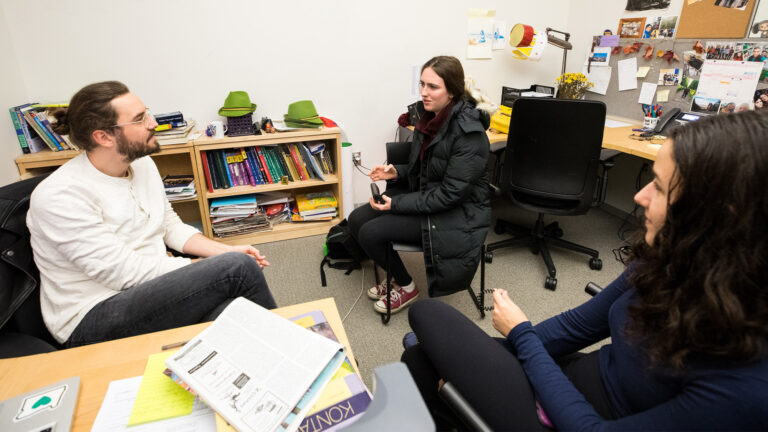
Teaching Associates from Germany and Austria join us every year to teach conversation sections of the language courses and run German-related activities and events, including cooking events, Film- or Serienabende, game nights, and lectures.
Study Away and Research Grants
We strongly encourage all our students to spend a semester or the entire junior year in a German-speaking country. Another great opportunity to enhance German proficiency is provided by Williams Fellowships that allow students to take intensive summer language courses, including the Wilmers and World Fellowships.
After graduation, too, students can continue their contact with German through fellowships facilitated by the Fellowships Office, including: