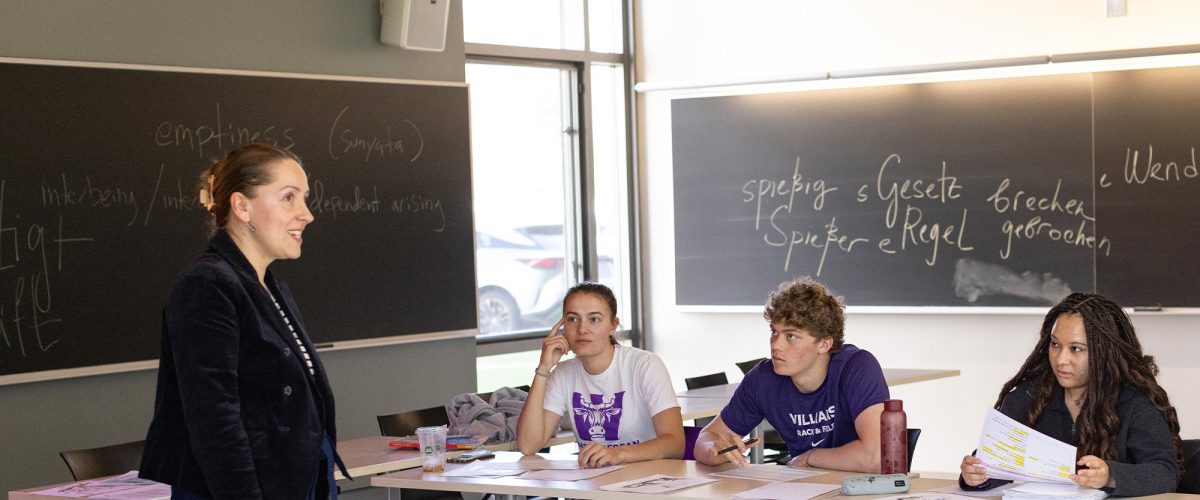
Through a wide variety of courses on German language, literature, history and culture in various formats—seminars, lectures and tutorials—of which many are taught exclusively in German, students who graduate with a major or certificate from the German program can engage at a high level with German-language culture in many communicative settings. You will understand native speakers of German from several regions and participate fully and effectively in conversations, texts, and media on a wide range of topics in formal and informal settings from both concrete and abstract perspectives.
German Courses
GERM 101 (F) SEM Elementary German German 101-102 is for students with no previous study of German. The course employs a communicative approach involving all five language skills: listening comprehension, speaking, reading, writing, and culture. We focus initially on practice in understanding the spoken language and then move rapidly to basic forms of dialogue and self-expression. It is strongly recommended that students continue with GERM 102 in the Spring semester immediately following, for which along with GERM 101, the Winter Study Sustaining course is a prerequisite. Taught by: Gail Newman | Catalog details GERM 102 (S) SEM Elementary German II German 102 is the continuation of German 101, and will provide you with a further introduction to the language and cultures of German-speaking countries. You will have the opportunity to practice listening, reading, writing, and speaking in German both through in-class activities and in homework assignments. During the semester, you will learn about various cultural perspectives of and everyday life in German-speaking countries. Some of the topics that will be addressed this semester include the following: housing; housework; geography and landscape; transportation; travel plans and experiences; food and drink; cooking and ordering food at restaurants; childhood and youth; fairy tales; health and family; community issues in a multicultural society; literature, music, and film. The use of short authentic texts and poems in the target language will also help to enhance reading comprehension. Active and dedicated participation including daily homework is expected. This course is taught exclusively in German. Taught by: Aleks Kay | Catalog details GERM 103 (F) SEM Intermediate German I In this course, students will further develop their German language skills by engaging with a variety of cultural topics and everyday experiences in the German-speaking world. Through extensive work on expanding vocabulary, reviewing major grammatical structures, conversation and composition exercises, students will strengthen their language skills and develop cultural competency. The course focuses on real communication in meaningful contexts and aims to develop and consolidate students’ speaking, listening, reading and writing abilities at the intermediate level. In addition to a textbook, the course will deploy a variety of media, texts, and genres to aid in the practice of and improvement of spoken and written German skills through in-class activities and homework assignments. Short authentic texts, poems, and comic books in the target language will help to enhance reading comprehension, and mandatory weekly conversation sessions with the German-speaking teaching associates will greatly contribute to enhancing the learners’ speaking and listening comprehension. This course is taught exclusively in German. Taught by: Aleks Kay | Catalog details GERM 104 (S) SEM Intermediate German II German 104 is the continuation of German 103 and a prerequisite to all advanced courses in German. In this course, students will further develop their German language skills by engaging with a variety of cultural topics and everyday experiences in the German-speaking world. Through extensive work on expanding vocabulary, reviewing major grammatical structures, conversation and composition exercises, students will strengthen their language skills and develop cultural competency. The course focuses on real communication in meaningful contexts and aims to develop and consolidate students’ speaking, listening, reading, and writing abilities at the intermediate high level. In addition to a textbook, the course will deploy a variety of media, texts, and genres to aid in the practice and improvement of spoken and written German skills through in-class activities and homework assignments. Authentic texts, poems, and comic books in the target language will help to enhance reading comprehension, and mandatory weekly conversation sessions with the German-speaking teaching associates will greatly contribute to enhancing the learners’ speaking and listening comprehension. The course is taught exclusively in German. Taught by: Aleks Kay | Catalog details GERM 120 (S) SEM Turbodeutsch: Intensive Elementary German An accelerated version of Elementary German, covering nearly all the material of GERM 101-102 in one semester. The course employs a communicative approach involving all five language skills: listening comprehension, speaking, reading, writing, and culture. Turbodeutsch requires significant initiative on the part of students in their own learning process. Best suited to very committed students who are highly motivated to learn German and have specific goals for their language proficiency. The course will meet every day, including three 50-minute periods on MWF and two 75-minute periods on TR, plus a required TA session at a time to be arranged. Taught by: Gail Newman | Catalog details GERM 201 SEM “Oida!” Living Language in Vienna Last offered Fall 2022 Language is a living being, varied, like identity itself, across cultures and across time. This course has as its thematic focus Wienerisch, the very special variety of German that has developed in the multi-linguistic metropolis of Vienna; listening and reading work will center on Viennese German. But the thrust of the course is honing the students’ own German. It will provide extensive study of German grammar and style, and intensive practice in speaking and writing idiomatically. Readings and discussion in German. Taught by: Gail Newman | Catalog details GERM 203 (S) SEM Hansestadt Hamburg “Wenn Du in Hamborger Hopn platt snacken kannst, dann geiht immer eine Dör mer auf”. Hamburg, the second largest city in Germany (with 1.8 million inhabitants), always had a particular significance within German cultural consciousness. Part of the Hanseatic League since the Middle Ages, the Free City of Hamburg quickly became an important commercial center in Northern Europe and a prosperous city of traders and merchants. Located on the river Elbe and in close proximity to the North Sea, the city-state Hamburg is still a major port city which has long benefited trading activities and fostered an exposure to other cultures. Called the gateway to the world (because the port was for a long time the gateway to the Americas) and the Venice of the North (the city is surrounded by water and features more canals, streams, and bridges than Amsterdam), later on completely destroyed by the World War II bombing raids, Hamburg is a city of contrasts: infamous for its dialect (Plattdeutsch) as well as its red light district (St Pauli), renowned for its journalism (Der Spiegel, Die Zeit) and culture scene, famous for its culinary specialties, (the burger might have been invented there) and its sports culture (soccer, handball, basketball), Hamburg has a rich past and a multicultural present that this course will examine. In order to gain a deeper insight into the geography, history, and culture of this fascinating city, we will read the autobiography by Hans-Jürgen Massaquoi, novels by Uwe Timm, short stories by Yoko Tawada and Siegfried Lenz, listen to songs by Hans Albers, Wolf Biermann, Udo Lindenberg, the Hip Hop band Fettes Brot, and watch movies by Fatih Akin, Sandra Nettelbeck, Christian Alvart, Özgür Yildirim, and Leander Haußmann. Taught in German. Taught by: Christophe Koné | Catalog details GERM 204 SEM Stranger Things: The German Novella Last offered Spring 2019 Goethe’s famous description of the novella as an “unheard of event” holds true to this day: scandals, murder, and the supernatural abound in this seminal German genre. Both meticulously structured and notoriously difficult to define, the novella as a form mirrors the paradoxes of its narratives. In this course, we will ask how form and content come together in the novella to engender strange occurrences that vacillate between everyday experiences and fever dreams. As we trace the development of the novella over the course of two hundred years of German literary history, we will explore how the eerie phenomena at the genre’s core reflect specific historic moments only to transcend them. What is it about the German novella that creates such a particular sense of unease, and how does this genre mediate modern experience? Taught in German. Taught by: Natalie Lozinski-Veach | Catalog details GERM 205 SEM (In)justice and Morals in German Literature Last offered Fall 2025 In this course students will develop their German reading, speaking and writing as they examine the intricate relationship between morals, (in)justice, and human behavior through creative works in the German tradition. We explore some works from different periods and literary movements, analyzing various moral dilemmas, ethics, and inquiries on values presented by selected German-speaking authors such as Brecht, Aichinger, Dürrenmatt, Grimm, Kafka among others.
Through close reading, interpretation and analysis of various parables, short stories and dramas, class discussions will focus on key themes such as individual conscience, societal norms, the questions of right and wrong, good and evil, and the consequences of moral choices.
This course places particular emphasis on gaining a deeper understanding of the language by helping students improve language skills in German through engagement with original texts, exercises in vocabulary and style, and discussion in German. Besides class meetings, the mandatory weekly conversation sessions with the German-speaking teaching associates will greatly contribute to enhancing the learners’ speaking and listening comprehension. Class conducted entirely in German. Taught by: Peter Ogunniran | Catalog details GERM 206 SEM Seh’n Se, det is Berlin Last offered Fall 2023 In the history of Germany, Berlin has always been a very important cultural and political center: it was successively the capital of the Kingdom of Prussia, the German Empire, the Weimar Republic, the Third Reich, and the German Democratic Republic, before becoming the capital of a reunited Federal Republic of Germany in 1990. In order to understand the fascination held by this metropolis before and after WWII and its increasing popularity today, it is crucial to gain an insight into the cultural and historical aspects of the capital of Germany throughout the 20th century. In order to do so, we will read texts by Erich Kästner, Kurt Tucholsky, Thomas Brussig, and Wladimir Kaminer, look at paintings by Ernst Ludwig Kirschner, Otto Dix and photographs by August Sander, watch movies by Fritz lang, Wolfgang Staudte, Hannes Stöhr, Detlev Buck, and Burhan Qurbani, listen to cabaret songs by Marlene Dietrich and Hildegard Knef, hip hop songs by Seed, Sido, and Bushido, and electronic music by Ellen Alien. We will also explore the multicultural facets of the German capital, such as Queer Berlin, Black Berlin, Turkish Berlin as well as the techno club scene. Active and dedicated class participation is expected.Conducted in German. Taught by: Christophe Koné | Catalog details GERM 207 LEC Vienna 1900-2000 and Beyond Last offered Spring 2013 Once the center of a vast empire, Austria has tended to be overlooked since the demise of that empire. In fact, though, its trajectory can usefully serve as a guide to the complex developments in Europe before, during, and after the Second World War. Contemporary Austria is indeed a laboratory of post-Cold War Europe: Its population is remarkably multicultural, in spite of resistances; its language is rich and dynamic, yet increasingly dominated by its more powerful neighbor to the north; its political attitudes encompass extreme nationalism, pan-Europeanism, and much in between. Austria’s capital, Vienna, will form the lens through which we examine the origins and quirks of this fascinating, sometimes paradoxical, culture. The course will employ a variety of written, video, audio, and cyber-materials to explore some of the issues facing contemporary Austria, and to continue the development of advanced reading, writing, and speaking skills begun in German 201. Conducted in German. Taught by: Gail Newman | Catalog details GERM 208 SEM Translation in Practice Last offered Spring 2024 When we’re learning a new language, we’re constantly told not to translate–“Don’t write in English and then translate into German!” “Don’t translate in your head, think in your own German!” The goal is to immerse yourself as deeply as possible in the target language so that you can engage with it idiomatically. Translation is a different kind of operation than language learning, but it presents its own challenges and joys in working with the language. In this course we will read literary and theoretical texts that engage with translation as a phenomenon, we will compare English translations of German and Austrian literature, and we will talk with some professional literary translators about their process. In addition, students will prepare their own translations of German into English and/or their native languages. Readings and discussion in German. Taught by: Gail Newman | Catalog details GERM 209 The Other Germans : Exploring Diversity in Contemporary German Literature & Culture Last offered NA This seminar examines the nuanced landscape of German society, going beyond mainstream narratives to uncover the multiple identities and complex histories that contribute to its cultural mosaic. This course offers an immersive exploration of the experiences of diverse communities — such as Afro-Germans, Turks, Vietnamese, LGBTQ among others — within Germany, including immigrant groups, marginalized communities, and diasporic populations.
Through a multidisciplinary approach encompassing historical analysis, cultural studies by immigrants, and personal narratives & literary texts by Theodor Michael, Marshall-Hügel, Ijoma Mangold, Olivia Wenzel, Hans -Jürgen Massaquoi, and films, students will gain a deep understanding of the complexities of identity and belonging in the German context. We will also examine the challenges, triumphs, and contributions of “Other Germans”, shedding light on their often-overlooked roles in shaping the nation’s collective identity.
By critically engaging with topics such as immigration, integration, intersectionality, and representation, participants will develop a nuanced perspective on Germanness that transcends stereotypes and embraces the diverse voices that have enriched German society. Through thoughtful discourse and exploration, participants will cultivate empathy, appreciation, and respect for the multitude of experiences that “Other Germans” represent in Germany. Class discussions and exercises, students will improve their language skills and vocabulary as we discuss contemporary issues. Taught by: TBA | Catalog details GERM 210 SEM The Other Germans : Exploring Diversity in Contemporary German Literature & Culture Last offered Spring 2025 This seminar examines the nuanced landscape of German society, going beyond mainstream narratives to uncover the multiple identities and complex histories that contribute to its cultural mosaic. This course offers an immersive exploration of the experiences of diverse communities — such as Afro-Germans, Turks, Vietnamese, LGBTQ among others — within Germany, including immigrant groups, marginalized communities, and diasporic populations. In the process of engaging with these crucial topics in contemporary Germany, students will develop their listening, reading, speaking, and writing skills in German through targeted discussion and practice.
Through a multidisciplinary approach encompassing historical analysis, cultural studies by immigrants, and personal narratives & literary texts by Theodor Michael, Marshall-Hügel, Ijoma Mangold, Olivia Wenzel, Hans -Jürgen Massaquoi, and films, students will gain a deep understanding of the complexities of identity and belonging in the German context. We will also examine the challenges, triumphs, and contributions of “Other Germans.” shedding light on their often-overlooked roles in shaping the nation’s collective identity.
By critically engaging with topics such as immigration, integration, intersectionality, and representation, participants will develop a nuanced perspective on Germanness that transcends stereotypes and embraces the diverse voices that have enriched German society. Through thoughtful discourse and exploration, participants will cultivate empathy, appreciation, and respect for the multitude of experiences that “Other Germans” represent in Germany. Taught by: Peter Ogunniran | Catalog details GERM 211 (F) SEM Advanced German Language This course is a continuation of our language sequence with the goal of achieving at least solid B2 proficiency according to the Common European Framework of Reference for languages, with some reaching the C1 level. Students will take a deep dive into advanced grammar constructions and stylistic intricacies of the German language, hone their listening and speaking skills, and begin the practice of writing short academic papers in German in preparation for our upper-level literature/culture courses. They will also gain insight into contemporary German-speaking cultures by examining short authentic written and audiovisual texts such as short stories, films or television series, and web-based materials. Assignments will include reading journals, short oral presentations in pairs or small groups, several short written assignments, and a final project. Taught by: Gail Newman | Catalog details GERM 212 SEM German Comics Last offered Spring 2026 The goal of this advanced course is to study language and culture through the exploration of German-language comics. Despite the boom in the production of comics since the reunification and the appearance of numerous talented artists in the German speaking world, German comics still remain fairly unknown abroad. This course seeks to introduce students to this rich, active genre and to deepen their understanding of it by allowing them to engage with its broad spectrum of subjects and styles.
The course will address a variety of recent comics ranging from graphic novels by Nora Krug, Olivia Vieweg to literary comics by Flix, Isabel Kreitz, as well as historical comics by Simon Schwartz and Reinhardt Kleist.
What are the recurrent themes in German comics? What kind of current political issues do these comics raise and what type of contemporary anxieties do they express? These are some of the questions the course seeks to raise.
This course is conducted entirely in German. Taught by: Christophe Koné | Catalog details GERM 213 (S) SEM Monster Mash: Myths, Movies and the Monsters in Our Midst The world is full of monsters. Some lurk in the shadows or confine themselves to the dark of night, like the titular creature in the 1922/2024 Nosferatu. Others walk in broad daylight (1992 Bram Stoker’s Dracula), traverse the globe (1931/2025 Frankenstein), and h(a)unt us across the vast reaches of outer space (1979 Alien). Their history is as ancient (1967 Viy, 1990 The Witches) as it is modern (1933 King Kong, 1954 Godzilla, 1998 The Ring), fueled by our deepest fears (1975 Jaws, 1982 The Thing) and darkest desires (1991 The Silence of the Lambs), a longing for transcendence and the painful experience of mortality as the ultimate limit of human existence (1964 At Midnight I’ll Take Your Soul). Monsters are the stuff of nightmares, yet they empower us to dream big and confront the demons that plague our guilty conscience (2006 The Host). This course will take you on an odyssey across the Movie Monsterverse, from the birth of classic cinema to lesser-known shadowy corners of cinematic imagination. Together, we will confront some of the most legendary beasts (both in practice–through formal film analysis, and in theory–the growing corpus of literature in monster studies), delve into their terror, and emerge transformed and triumphant. Or, in the words of T.S. Eliot, “We shall not cease from exploration / and the end of all our exploring / will be to arrive where we started / and know the place for the first time.” Taught by: TBA | Catalog details GERM 234 SEM Europe and the Black Diaspora Last offered Spring 2026 This course explores the historical relationships and interactions between the Black diaspora and the European continent from late 19th century until present times. Through a diverse selection of materials–including (auto)biographies, documentaries, literature, creative arts, and academic articles–we will examine how these connections (d)evolved over time. Focusing mostly on Central Europe, we will analyze the experiences of the Black diaspora, including Africans, African Americans, and Afro-Caribbeans in their engagements with European societies. Key themes include the impact of cultural contact on writers, artists, soldiers, and activists, as well as the factors shaping their relationships with Europe. Additionally, we will consider how these individuals influenced–or were excluded from–European cultural and intellectual life. The seminar will conclude by exploring contemporary debates surrounding the Black diaspora’s presence and contributions to Europe. We will examine works of Audre Lorde, Yinka Shonibare, May Ayim, Angela Davis, Ousmane Sembène, James Baldwin, Ama Ata Aidoo, David Adjaye among others. Reading and Discussion in English. Taught by: Peter Ogunniran | Catalog details GERM 243 SEM Rage against the Machines: The Technological Imaginary in Art and Film Last offered Fall 2025 Technological progress has always generated extreme excitement and intense anxiety. Will machines liberate the human race? Will they alter how we think, how we feel, how we relate to each other? Or will their tyranny destroy human civilization as we know it? Throughout the 19th and early 20th century, many prominent artists and art movements celebrated technological advancements, from German expressionism (Lang’s cine-epos Metropolis) and Italian futurism to Dadaism (photocollages by Hausmann, Heartfield, Höch), New Objectivity (paintings by Dix, Grosz) and Soviet constructivism (works by Lissitzky, Popova, Rodchenko, Tatlin). Some, like the proto-fascist poet and author of the Manifesto del Futurismo, glorified the violence of the machines as a “cure for the world” and a potent weapon against “museums and libraries,” “morality,” “feminism,” and other undesirables. Others, like the German film critic Siegfried Kracauer, issued stark warnings against technology’s destructive potential and the impending consequences of rapid mechanization. These debates about politics, ethics, and aesthetics were further complicated by wartime experience, mass destruction and genocide as much as peacetime myths of innovation and progress, politics of exclusion and domination–for technology is always an expression of power and a means of control. This seminar is designed as an exploration of the technological imaginary beyond its utopian potential or dystopian drive, as triggering fundamental questions about death, desire, and what it means to be human. Together we will look at artworks and artifacts, experimental documentaries (Vertov’s Man with a Movie Camera), sci-fi blockbusters (Wachowskis’ The Matrix), and animated features (Miyazaki’s Nausicaä of the Valley of the Wind) that have been instrumental in shaping our understanding of and our relationship with media and machinery, artificial intelligence and the mechanization of modern life. Discussion and readings in English. Taught by: Aleks Kay | Catalog details GERM 251 SEM Dolls, Puppets and Automatons Last offered Fall 2020 Since their origin, humans have always made anthropomorphic representations, first in the form of idols, fetishes, or statues for religious worship, later in the shape of puppets, dolls, or automatons for their entertainment qualities. And yet, these objects have always played multiple roles in human society; modernity in particular shows a great interest paired with great ambivalence towards dolls, puppets, and automatons, regarded both as uncanny Doppelgänger or threatening machines. In order to comprehend the scope of our modern fascination with these figures, we will explore their haunting presence in literary texts by ETA Hoffmann, Achim von Arnim, Theodor Storm, Felisberto Hernandez, discuss theoretical texts by Sigmund Freud and Heinrich von Kleist, look at paintings by Oskar Kokoschka and at photographs by Hans Bellmer & Cindy Sherman, watch a ballet by Andreas Heise and films by Fritz Lang and Alex Garland, and watch fashion shows by Alexander McQueen and Jean-Paul Gaultier. Conducted in English. Taught by: Christophe Koné | Catalog details GERM 252 (F) SEM Come and See: Holocaust Cinema and the Iconography of Genocide The history of the Holocaust and the history of cinema are intimately intertwined. It was cinema that fueled fascist fantasies, spread propaganda, and amplified its effects. Yet it was also cinema that provided the evidence of the crimes, served as a site of commemoration and mourning, and a space to contemplate the limits of representation in the face of unimaginable horror. As time passed, cinema also acted as a repository of memory in the face of collective amnesia, a vital educational tool, and a marketplace where lived experiences mingled with surrogate memories, sentimental success stories, and violent spectacles. This course invites you to investigate the conflicted history of Holocaust cinema–a cinema that functions, at once, as a witness and a culprit, an archive, an art form, and an industry. Examining films such as Alain Resnais’ haunting visual essay Night and Fog and Yael Hersonski’s forensic documentary A Film Unfinished, Steven Spielberg’s epic Hollywood drama Schindler’s List and Quentin Tarantino’s bloody revenge fantasy Inglourious Basterds, Roberto Benigni’s polarizing comedy Life Is Beautiful and Jonathan Glazer’s unsettlingly restrained The Zone of Interest, together we will explore the limits of the cinematic lens and interrogate its groundbreaking potential. Taught by: Aleks Kay | Catalog details GERM 271 SEM From Kleist to Kafka Last offered Spring 2016 Heinrich von Kleist (1777-1811) and Franz Kafka (1883-1924) wrote some of the most puzzling and intriguing work in European literary history. From Kleist’s drama Penthesilea, which culminates in the consumption of the hero by the heroine (literally!), to Kafka’s “A Hunger Artist,” profiling a man who starves for a living, the texts in the course attempt to access the most profound–and at times bizarre–regions of the human mind. Works we will read include Kleist’s dramas Prince Friedrich of Homburg, Amphitryon, and Penthesilea, and his short stories “The Marquise of O…,” “The Earthquake in Chile,” “The Foundling,” “St Cecilia and the Power of Music,” and “The Betrothal in Santo Domingo.” By Kafka we will study “The Judgment,” “The Metamorphosis,” “A Hunger Artist,” “In the Penal Colony,” “The Burrow,” “A Country Doctor,” and others. Literary readings will be supplemented by selected letters and essays by Kleist, and by excerpts from Kafka’s diaries. Readings and discussion in English. Taught by: Gail Newman | Catalog details GERM 276 TUT Black Europeans Last offered Spring 2020 This course explores the in/visibility of Black Europeans from the Enlightenment to the present with a particular focus on French, German, Austrian, Dutch, British, and Russian history. With the European Enlightenment as point of departure, the tutorial investigates the large presence of Blacks as objectified subjects in paintings and decorative artifacts of the 18th and 19th centuries while interrogating their century-long absence from European historiography until fairly recently. In this tutorial, we will start discussing the significance of the Code Noir (1685) as well as the major economic impact of the Atlantic Slave Trade on European countries such as Great Britain, France, and the Netherlands. We will read historical biographies about a handful of outstanding Black Europeans in France (composer Monsieur de Saint George), Germany (Prussian officer Gustav Sabac el Cher, philosopher Wilhelm Anton Amo), Austria (royal tutor Angelo Soliman), Holland (Prince Kwasi Boachi), and Russia (military leader Abram Petrovitch Gannibal) during the 18th and 19th centuries, study paintings and decorative artifacts of the 18th and 19th centuries depicting black servants–such as Hyacinthe Rigaud’s Portrait of Marquise de Louville (1708), Nicolas Lancret’s The Escaped Bird (1730), and Manet’s Olympia (1863) to name a few–and watch the biopic Belle by Amma Asante (2013), narrating the life of black heiress Dido Elizabeth Belle in 18th-century England. We will also do a quick survey of 20th-century European cinema, that has until now cast very few black actors in supporting and leading roles, and we will ponder the representation of black people in recent films that were commercially successful at the box office (such as Les Intouchables by Nakache/Toledano, France 2011). Finally, we will reflect on the deep roots of European colonialism that takes the form of national debates surrounding the naming of chocolate-coated treats and licorice sweets (Têtes de nègre, Mohrenkopf, and Negerkuss) or of a controversy around cultural identity resulting from the grotesque depiction of black men in folkloric tradition (like Zwarte Piet in the Netherlands). Taught by: Christophe Koné | Catalog details GERM 280 SEM Art at its Limits: Representing the Holocaust Last offered Fall 2019 The Holocaust poses unique challenges to art: it is an event that unsettles the very notion of representation while, at the same time, also demanding it. Art, after all, is a mode of witnessing as well as a form of commemoration; it allows survivors to record their testimony and later generations to remember. Yet the representation of suffering can all too easily become exploitative or aestheticizing, it can turn pain into entertainment and history into fiction. How, then, do writers, artists, and filmmakers navigate the representation of the Shoah if it resists comprehension and undermines traditional forms of narrative? In this course, we will ask if and how art can do justice to a catastrophe of such magnitude as the Holocaust by analyzing different forms of media from a variety of cultural backgrounds. What can poetry offer that remains foreclosed to prose? Was Art Spiegelman’s graphic novel Maus really in bad taste? How should documentaries approach the Shoah, and is there a place for Hollywood films in the archives of commemoration? Texts among others by Tadeusz Borowski, Tadeusz Ró’ewicz, Art Spiegelman, Paul Celan, Primo Levi, Sylvia Plath, Hannah Arendt, Theodor W. Adorno, Jacques Derrida, and Maurice Blanchot; films by Quentin Tarantino, Claude Lanzmann, Pawe’ Pawlikowski, and Steven Spielberg. Taught by: TBA | Catalog details GERM 300 SEM Mannweiber: Masculine Women in German Culture Last offered Fall 2017 The German word “Mannweib” is a literal translation of the Greek “androgynous” and is a derogatory term for a woman who acts in a masculine way. This survey course examines the recurrence of “masculine femininity” in German culture with a particular focus on literary texts, operas, paintings, and films, all crafted at turning points in German history. Why does the Mannweib emerge at times of major political and historical upheavals? How does this atypical masculine woman contribute to the construction of a German national identity? These are some of the key questions this course seeks to address.
We will read the Nibelungenlied epic, poems by Freiligrath, plays by Lessing, Schiller, Goethe, Kleist, and Dürenmatt, as well as short stories by Stifter, watch operas by Wagner, and films by Sternberg and Tykwer. In all these materials featuring a Mannweib as main protagonist, we will look at the way masculine femininity is construed as unnatural and literally constructed to serve either a patriarchal or a patriotic purpose.
We will also examine the misogyny underlying the artistic creation of these masculine women, either enshrined as allegories of virtue or perceived as dangerous agents of socio-political change, and ultimately doomed to rejection from the moment these misfits step out of their assigned role. Conducted in German. Taught by: TBA | Catalog details GERM 302 SEM Heimat: Identity, Belonging, and Home in German Literature Last offered Fall 2024 This course delves into the concept of “Heimat” in German literature, examining its multifaceted nature and its significance in shaping individual and collective identities. We will explore diverse representations of “Heimat” – encompassing notions of home, homeland, and belonging – across different media and historical periods.
Through a curated selection of works and novels by Nora Krug, Stefanie Zweig, Fatma Aydemir, films by Caroline Link and Israel Kaunatjike, and stories by German settlers and migrants around the world, we will analyze how the concept of “Heimat” is portrayed and interrogated in German cultural production. We will examine themes such as tradition, nostalgia, displacement, and the impact of historical and societal changes on notions of identity and belonging.
Through close analysis, discussions, and critical essays, we will gain insights into the cultural, historical, and philosophical dimensions of “Heimat” in German society. We will also reflect on how representations of “Heimat” intersect with questions of identity, memory, and the search for meaning in contemporary contexts, including the relevance of the notion in the contemporary political discourse.
By the end of the course, participants will have developed a nuanced understanding of “Heimat” and its significance in German cultural production, as well as honed their skills in critical analysis and interpretation. Intermediate- advanced knowledge of German, an openness to engaging with challenging ideas and cultural perspectives are required. Conducted in German. Taught by: Peter Ogunniran | Catalog details GERM 306 TUT Enlightenment and its Discontents Last offered Spring 2011 “Sapere Aude,” declared Immanuel Kant in his essay “What is Enlightenment?” (1784): “Have the courage to make use of your own capacity to reason.” Kant’s exhortation sums up the mood of the high Enlightenment, a trend in Western thought that gave birth to most of the ideals that we still hold dear: the primacy and universality of reason, the autonomy of the individual, the educative and restorative powers of the nuclear family. Today we are confronted daily with the tensions and gaps hidden inside Enlightenment thinking; in fact, the fissures in the edifice of the Enlightenment were subtly present from the beginning. This course will trace the development of Enlightenment assumptions through German literature and theory. Our reading will move through several stations of the development of Enlightenment thinking, from its most fervent proponents (Kant, Lessing), through those who put it to a severe test (Kleist, Hoffmann, Büchner), to the outright subversion of its premises (Nietzsche, Freud, Kafka). Readings and discussion in German for those who know German, in English for those who do not. Taught by: Gail Newman | Catalog details GERM 313 SEM The Mediation of Nationalism in Germany (1871-1918) Last offered Spring 2024 The German unification of 1871 was a fusion of different kingdoms, grand duchies, duchies, principalities and free cities that created a shared cultural identity. This course examines how nationalism was mediated to create, achieve, and sustain a German identity in the German Empire from 1871 until 1918 when it ended. This course surveys the role of the mass media, public art, and other forms of cultural expression in maintaining a sense of German community and resolving the tensions between different geographical, cultural and religious identities while also simultaneously mediating and juxtaposing a collective German identity against non-Germans. Our materials include literature, magazine publications, paintings, monuments and popular culture in the Empire. Some specific themes we will address include the aims of the agents and “architects” of nationalism and the roles of religion and geography in nationalism and of national heroes and legends, and the definition of national identity in opposition to a perceived Other (France and Africans). The course will proceed thematically, focusing on the relationship between nationalism and public figures, nationalism and the Other, as well as nationalism and visual culture. We also touch on the intersection between nationalism and children’s literature and some opposition to nationalism in the German Empire. We will conclude by considering how the nationalism of the German Empire still informs politics today. Reading and Discussion in German. Taught by: Peter Ogunniran | Catalog details GERM 314 SEM Underground Berlin: Art, Performance, and Film, 1980s to Present Last offered Spring 2022 Subsequent to the National Socialist suppression of sexual expression, the intersections of politics and art in the post-World War II era reflected an organic embeddedness within the context of the city of Berlin. This course reflects upon this history to understand Berlin’s present, its contradictory mix of new and old, “deep history” and nostalgia. Often described as an island moored within the communist territory of East Germany during the years of the Berlin Wall, West-Berlin became the city towards which many queer artists, musicians, and activists gravitated in order to avoid the involuntary conscription in the Bundeswehr, as an unexpected outcome of the government’s plan to boost population in the former capital. We will focus on the excavation and recognition of inter/cultural positions that challenge German nationalism, at the same time that the country reestablished itself as a world power. Over the semester, we will rethink Berlin with respect to the once nascent geopolitics of the European Union, and the city’s social fluctuations and periods of migration as registered through audiovisual and performative forms in advance of and in the decades following the fall of the wall in 1989. Focusing on art, performance, and film, we will examine the architectural, discursive, and cultural spaces in which these forms of creative and political expression take shape–from art museums and theater houses to occupied buildings, from independent publishing imprints and collaborative nonprofit organizations to night clubs. This course will examine the changing city with respect to activism, collectivity, alienation, solidarity, and belonging. Taught by: Alena Williams | Catalog details GERM 315 (S) TUT Kafka “It’s so Kafkaesque!” We love to use the name of the most famous Austro-Hungarian-Czech-Jewish writer of all time to characterize puzzling and dispiriting situations. But close examination of Franz Kafka’s work and life reveals a multi-dimensional world that goes far beyond the cliché. Jewish in an increasingly anti-Semitic environment, German-speaking surrounded by Czech-speakers, deeply alone in a family that didn’t understand him, Kafka produced texts that simultaneously demand and refuse to be interpreted. In this tutorial we will begin with intensive readings of selected short stories and parables, then move on to an exploration of the Kafka’s own words from diaries and letters, as well as secondary sources. The course will conclude with discussions of how Kafka’s texts and their contexts might relate to contemporary conditions and/or to students’ own lives and thoughts. This will be a modified tutorial, with six groups of three students apiece. Students may take the tutorial in either German or English; groups will be formed accordingly. Taught by: Gail Newman | Catalog details GERM 316 SEM “Wer ist wir?”: Recent Debates over Multiculture in Germany Last offered Spring 2019 German chancellor Angela Merkel controversially claimed in 2010: “Multikulti ist gescheitert.” (Multiculturalism has failed in Germany). We will investigate different perspectives on Germany’s integration of minorities. In the 1960s, government labor contracts brought large numbers of foreign workers into the country and facilitated the “economic miracle.” How did the newcomers adapt to life in Germany and what did they hold on to from their home cultures? How did subsequent generations experience life in Germany? What were the major political shifts that took place regarding citizenship and participation in the public sphere? How do popular media portray minorities? How do members of minority groups portray themselves?
We will read texts by: Zafer Senocak, Hatice Akyün, Yoko Tawada, Marica Bodrozic, Navid Kermani, Wladimir Kaminer, view feature films and documentaries, and discuss a wide range of social commentary and analyses across the political spectrum from right wing populists to left liberals: Thilo Sarrazin, Kirsten Heisig, Astrid Geisler and Christoph Schultheis, Wilhelm Heitmeyer, Alexander Häusler, Freya Klier, Mark Terkessidids, Rita Süssmuth and others. Taught by: Helga Druxes | Catalog details GERM 317 SEM The New Woman in Weimar Culture Last offered Fall 2025 This course explores the figure of the New Woman, a professional, political, independent, and modern woman, that rises in Germany right at the end of World War I and thrives during the Weimar Republic. Acclaimed as the epitome of Weimar Modernity, the New Woman is nevertheless greeted with great ambivalence: whether a liberated and emancipated woman for some, or a dangerous and promiscuous woman loathed by others, she is perceived as threatening to the patriarchal order. A closer look at some artworks by Otto Dix, Christian Schad, and Hannah Höch, films by Georg Wilhelm Pabst and Josef von Sternberg, poems by Gottfried Benn, Else Lasker-Schüler, and Kurt Tucholsky, novels by Erich Kästner, Vicky Baum, and Irmgard Keun, as well as plays by Frank Wedekind and Bertolt Brecht will provide a more precise picture of the New Woman’s various incarnations, ranging from actresses (Marlene Dietrich), singers (Margo Lion and Claire Waldorf), and dancers (Anita Berber) to prostitutes, and suggest that the New Woman serves as the vessel of male anxieties and represents the contradictions of modernity. Taught in German. Taught by: Christophe Koné | Catalog details GERM 318 SEM Paranoid Nation: Angst and Anxiety in German Film Last offered Spring 2026 There are many ways of telling the (hi)story of “German” cinema, from the ominous silent feature The Student of Prague (1913) — a Faustian tale about evil Doppelgängers — to the 2025 Academy Award nominee The Seed of the Sacred Fig, a tense political thriller shot in secret by the exiled Iranian filmmaker Mohammad Rasoulof. This course invites you to explore the transnational history of German film as a story of angst and paranoia, panic and anxiety, delusion and deception in the face of uncertainty, political turmoil, and the human condition. What are the links between paranoia and cinema, fear and filmmaking, optical illusions and the optical unconscious, we ask? How paranoid are German movies, and why? In what ways do films like Fritz Lang’s serial killer drama M – A City Searches for a Murderer (1931) or Ilker Çatak’s classroom thriller The Teachers’ Lounge (2023) help curb paranoid tendencies — or do they spawn suspicion and prejudice even further? And what can we as viewers learn from their filmic diagnosis of the state of the nation? These are some of the questions we aim to address throughout the semester. Together, we will also practice formal film analysis and visual literacy, we will experiment with film criticism and symptomatic reading, and debate the limits of cinematic representation and the paranoid imagination. All discussions and (most) readings in German. Taught by: Aleks Kay | Catalog details GERM 320 SEM German Romanticism Last offered Spring 2020 German Romanticism is a multifaceted, even contradictory phenomenon. Its earliest practitioners Novalis (Friedrich von Hardenberg) and Friedrich Schlegel could be seen as enacting a culmination of Enlightenment optimism about the emancipatory potential of the human mind, with their advocacy of an “aesthetic revolution,” equality for women and Jews, and a holistic relationship to nature. Later, some of the first feminists (Caroline Schlegel-Schelling, Bettina Brentano von Arnim) worked side-by-side with authors who essentialized women into primal lures and primal threats (Ludwig Tieck, Joseph von Eichendorff). One of the most famous Romantics of all, E. T. A. Hoffmann, combined high irony and a penchant for the irrational in his fascinating works. This course will explore the paradoxes of German Romanticism through close readings of aphorisms, stories, fairy tales, poetry, essays, and music. Taught by: Gail Newman | Catalog details GERM 321 SEM Lust, Liebe und Gewalt Last offered Spring 2022 In this course, we will reflect on the intimate relationship between love, lust, and violence, examining how love and lust do not exclude violence, but rather include—if not provoke—it. In order to gain a better understanding of the dynamics formed by this fascinating triangle, we will read novels by Goethe and Schnitzler, short stories by Kleist, Hoffmann, Mann, plays by Büchner, Hauptmann and Wedekind, and watch films by Faßbinder, Haneke and Muskala. Conducted in German. Taught by: Christophe Koné | Catalog details GERM 323 TUT Reason, Unreason and Anti-Reason from the Enlightenment to the Third Reich Last offered Spring 2014 From its inception in the eighteenth century, modern German art and thought have probed the nature of human reason. At every turn, the celebration of rationality as triumphing over the irrational has brought with it a resistance to the rational: Lessing’s Enlightenment dramas find their counterpart in those of the Sturm und Drang movement; Kleist’s preoccupation with reliable justice and predictable happiness can’t hide an unblinking knowledge of life’s randomness; Freud’s search for ultimate knowledge is constantly shadowed by the unknowable; in the acts and “theories” of the Nazis, we see the ultimate horror of rationality reduced to rigid mechanics, in the service of the unthinkable. The course will involve reading closely and writing intensively about texts by, among others, Lessing, Goethe, Kleist, Büchner, Nietzsche, Freud, Kafka, and the Nazi propagandists.
Offered in English or German: Reading, discussion and writing will be in German for German-speakers, in English for non-German speakers. Taught by: Gail Newman | Catalog details GERM 331 TUT Silence, Loss, and (Non)Memory in Austria 1900-the Present Last offered Fall 2018 One hundred years after the fall of the Austro-Hungarian Empire at the end of World War I, Austria is a tiny fragment of its former self. Since that signal loss, Austria’s identity has been closely tied to its ghostly past, for better or for worse. Think of Austria and glittering Klimt paintings come to mind, or the majestic Alps of The Sound of Music, or perhaps a melody from Mozart or Strauss plays in the ear. And no wonder: tourism is one of the largest industries in Austria; the nation lives on being seen and heard. But a great deal is invisible and inaudible to the tourist in Austria. In this course we will explore the hidden core of Austrian culture from 1900 to the present. We’ll begin with the tremendous intellectual ferment surrounding Sigmund Freud’s elaboration of the unconscious at the turn of the century, from Hofmannsthal’s paralysis of language through Schnitzler’s streams of consciousness to Kafka’s carefully crafted renderings of inner worlds. Then we will turn to an examination of the phenomenon of loss at the end of World War I: loss of empire, loss of relevance, loss of hierarchical certainty. Stefan Zweig documents this phenomenon timelessly. The second half of the course will focus on the driver of Austrian identity from 1938 on, the so-called Anschluss (annexation) by the Nazis, and the (non)memory of the horrors that ensued. We will probe the idiosyncratic mixture of trauma and guilt that characterizes Austria today through the work of contemporary authors and filmmakers. Psychoanalytic theory, especially recent discussions of the transgenerational transmission of trauma and perpetrator guilt, will provide a conceptual framework for the literary works. Austria will serve as a case study of the psychology of right-wing populism and the resistance against it in the early 21st century; at the end of the course, we will compare the situation there with the United States. Taught by: Gail Newman | Catalog details GERM 333 SEM Literature as Resistance Last offered Fall 2025 This seminar examines literature as a powerful tool of resistance and resilience in the face of oppression and injustice. Through a diverse range of creative works–including novels, films, poetry, and music–alongside theoretical texts, we will explore how writers and artists from various cultural and historical contexts challenge dominant narratives, reclaim agency, and construct alternative visions of identity and belonging. Authors and artists discussed will include Bertolt Brecht, Bob Dylan, Bob Marley, Audre Lorde, Frantz Fanon, and Fela Kuti.
Our discussions will focus on the power of words, art, and storytelling as both acts of defiance and means of survival, with particular attention to literary and artistic traditions from African, German, and American contexts, among others. We will analyze works that engage with colonial resistance, diasporic identity, racial injustice, gendered oppression, and political upheaval, considering how literature functions as both a space for protest and a source of healing.
Key questions include: How do art, language, form, and narrative structure resist hegemonic power? In what ways does literature foster resilience within oppressed communities? What tensions exist between literature as activism and literature as art?
By the end of the course, students will develop a nuanced understanding of theoretical perspectives on resistance and gain insight into literature’s capacity to confront historical injustices and inspire social change.
Discussion entirely in English. Taught by: Peter Ogunniran | Catalog details GERM 335 SEM Afro-Germans: History, Culture, and Literature Last offered Spring 2023 Even though Afro-Germans have been a part of Germany for centuries and have undergone efforts at establishing themselves as an organized cultural group, their culture and literature have been often dismissed, relegated at the margins of dominant white German culture. In the aftermath of the Black Lives Matter movement in Germany, the country’s belated debate about German colonialism, and its recent reckoning with race and racism, Afro-Germans have lately gained an unprecedented visibility in the German public sphere. Through their work, Afro-German journalists, writers, activists, and artists are all contributing to questioning and redefining German identity, culture, and history. Focusing primarily on Afro-German history, culture, and literature of the twentieth and twenty-first centuries, this upper-level seminar starts by examining acts of racist violence in German history (the Herero and Namaqua genocide in Namibia in 1904, the “schwarze Schmach” campaign in 1920’s, the killing of Black French soldiers by the Wehrmacht in 1940). We will address issues of race, bi-racialism, and racism in a post-war context in West as well as East Germany through the poems by May Ayim, the essays by Aubre Lorde and Alice Hasters, the memoirs by Hans-Jürgen Massaquoi, Theodor Michael, Lucia Engombe, Stefanie Lahya-Aukongo, and Ika-Hügel Marshall, the novels by Harald Gerunde, Noah Sow, Sharon Dodua, Olivia Wenzel, Ijoma Mangold, the documentary films by Nadja Ofuatey-Alazard, and the artworks by Marc Brandenburg. Taught by: Christophe Koné | Catalog details GERM 336 (F) SEM Fussballnation Germany: the Role of Soccer in Post-War & Post-Reunification Germany This upper level seminar on soccer is designed to deepen students’ understanding of the key role this team sport has played in the history of post-war and post-reunification Germany and contemporary German culture. Students will analyze the full display of the Federal Republic of Germany as a powerhouse on an international stage during the 1974 and 2006 FIFA world cups when Germany was a host country, as well as the rebirth of national pride and redefined German patriotism. In addition to men’s soccer, students will also examine women’s soccer and particularly the surge in its popularity, and its evolution from a bastion of masculinity into a sport of female empowerment. They will also investigate the various public outrages recently caused by German soccer players: the 2018 controversy provoked by midfielder Mesut Özil’s decision to quit the German national team over racism, the 2021 public debate sparked by midfielder Joshua Kimmich’s refusal to get vaccinated against Covid-19, or the 2024 controversy ignited by striker Kevin Behrens’ homophobic slur upon refusing to autograph a Pride jersey. Students will look at films, plays, novels, essays, newspaper articles, TV interviews, fashion magazines, and artworks to come to grips with the impact soccer has had on German history and culture and Germany as a nation. This course is taught in German. Taught by: Christophe Koné | Catalog details GERM 366 TUT Reason and “Unreason” in the German Tradition Last offered Spring 2025 “I am proud of my heart alone, it is the sole source of everything, all our strength, happiness and misery. All the knowledge I possess everyone else can acquire, but my heart is all my own.” So spoke Johann Wolfgang Goethe’s young Werther in his groundbreaking novel from 1774, The Sorrows of Young Werther, which exposed the fault lines of the Enlightenment, with its emphasis on rationality, on universal human values, and on optimism about the future. Throughout the nineteenth and twentieth centuries in Germany and Austria, challenges arose to what was touted as the triumph of objective, scientific thought, often leading to alienation and despair for the writers and thinkers who explored the deepest recesses of the mind. These challenges led to some of the most creative cultural production in Western history, but the concatenation of reason and “unreason” also contributed to one of its biggest catastrophes. This course will explore and complicate the relationship between reason and those forces that throw it into question. Specifically, we will focus first on the moments around 1800 and 1900 when the tectonic plates of reason and supposed unreason converge and collide most forcefully, reading authors like Kant, Goethe, Novalis, Kleist, Büchner, Hoffmann, and Freud, then turn to the mid-twentieth century, when both forces combine to create the disaster of the “Third Reich” and the difficulties of its aftermath (Hitler, Harlan, Bachmann, Haneke). Finally, we will look at the complex ways in which rationality triumphs and is challenged in our current time by engaging with the debates around science that roil German and Austrian society. Students with German proficiency at the 300-level will do primary readings and discusssion in German (with some background readings in English); for students without knowledge of German all readings and discussions will be in English. Taught by: Gail Newman | Catalog details GERM 377 TUT Austria and its Borders Last offered Fall 2023 For centuries, Austria was characterized not just by the sheer expanse of its territory, extending from the Adriatic Sea to the South to Ukraine in the North, from Switzerland in the west to nearly Turkey in the east. Its identity was also closely associated with the many porous internal borders among its various ethnic groups: German, Polish, Romanian, Slavic, Italian, etc.. The first World War put an end to this multiethnic, multilingual identity, leaving a primarily ethnic-German “Rest-Österreich” whose fatal passivity in the face of German expansionism led to the erasure of the nation altogether. After World War II, Austria expended far too much energy cordoning off its own past as a perpetrator, creating through willful ignorance a psychic and political boundary that only began to open with the election of a former Nazi to the symbolic office of president in the mid-eighties. Austria’s entrance into the European Union in 1995 coincided with an influx of refugees from the Balkan Wars; it would seem that Austria was on its way back to expansive borders. But the 2000s have seen a two-track development: on the one hand rapidly increasing ethnic, linguistic, and cultural diversity and on the other a ferocious defense of ostensibly “Austrian” identity. This course will trace the Austrian relationship to its internal and external borders by examining literature, history, and popular culture surrounding key touchpoints: 1918, 1945, 1987, and 2015. Taught by: Gail Newman | Catalog details GERM 493 (F) HON Senior Thesis: German German senior thesis; this is part of a full-year thesis (493-494). Taught by: Gail Newman | Catalog details GERM 494 (S) HON Senior Thesis: German German senior thesis; this is part of a full-year thesis (493-494). Taught by: Gail Newman | Catalog details GERM 497 (F) IND Independent Study: German German independent study. Taught by: Gail Newman | Catalog details GERM 498 (S) IND Independent Study: German German independent study. Taught by: Gail Newman | Catalog details
Curriculum & Required Courses
Find the right course for you, whether you’re exploring German through an elective, a certificate program or declaring your major.