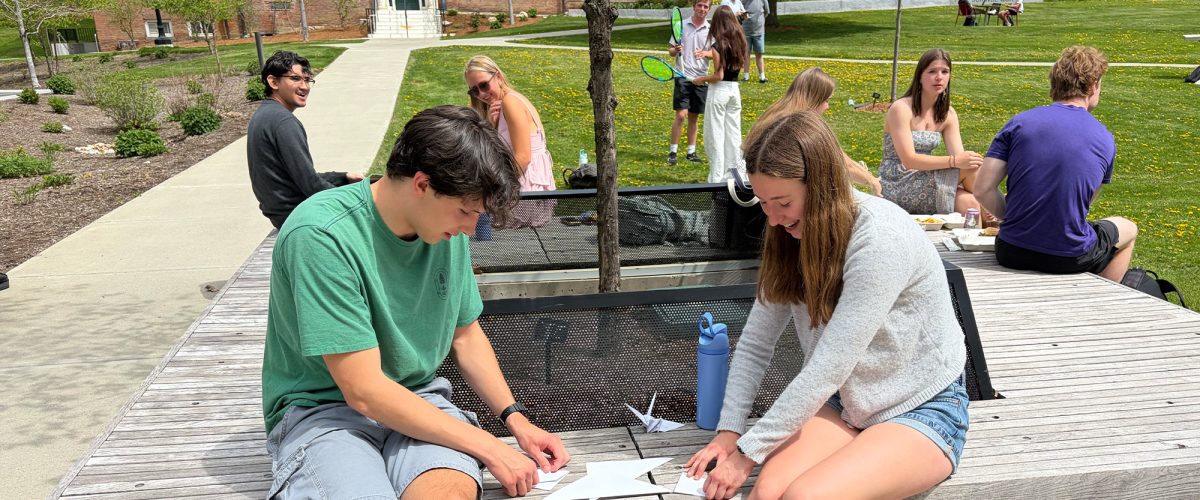
The Program
The main emphasis of the Program in Teaching is placed squarely on your liberal arts studies. The Program in Teaching does not offer a major or concentration. Instead, educational guidance is offered to students seeking to explore the field of education. Not only will you thus acquire the specific knowledge necessary to teach a particular subject but equally vital, you will have first-hand encounters with the kinds of experiences you must engender in your future students.
Why Study Education?
The Program in Teaching is open to any student interested in K-12 education and offers opportunities for all levels of interest. You can take one course, attend some of the events, or immerse yourself in the program’s offerings as a way of framing your whole course of study at Williams. No specific major is required, and we can help you create links across Williams’ curriculum so that you can see the vital connections between what you study as an undergraduate and teaching those topics to elementary and high school students.
Coupled with the liberal arts emphasis is our belief that students who want to become teachers need to cultivate the habit of reflective practice. To help students with this, we offer a wide variety of group and individual forums in which students can think about their experiences as learners and teachers and begin to develop strategies for reflecting on their teaching and using their insights as a basis for change and improvement.
Featured Courses
This course introduces students to a broad range of theories and research on education. What can developmental research tell us about how children learn? What models of teaching work best, and for what purposes?
This course examines social psychological theories and research concerning stereotypes, prejudice, and discrimination, as well as on group dynamics.
This advanced seminar will give students an opportunity to connect theory to practice. Each student will have a teaching placement in a local school, and participate in both peer and individual supervision.
Courses
Core Courses
- PSYC 272 The Psychology of Education
- PSYC 372 Advanced Seminar in Teaching and Learning. (You’ll teach in local elementary, middle, or high schools and discuss and reflect on your experience in seminar discussions.)
300-level Courses
300-level courses in the Psychology department often involve an empirical lab component and the opportunity to collect data or teach in local schools. These courses have 200-level prerequisites according to the subfield of psychology under which they fall.
- PSYC 338 Inquiry, Invention, and Ideas
- PSYC 332 Children’s Mathematical Thinking and Learning
- PSYC 327 Cognition and Education are among the offerings.
- Psych 372 Advanced Seminar in Teaching and Learning
Winter Study
If you think you might want to teach after Williams, we suggest you complete a supervised teaching practicum for at least one semester and Winter Study period. Winter Study courses such as CLIA 24: Class of 1959 Teach NYC Urban Education and PSYC 11: Local Education Policy and Practice are both three-and-a-half week immersions in the life of a school.
Coordinate Courses with Other Academic Departments
Our program offers coordinated clusters of courses in other subfields of psychology and in other liberal arts disciplines, such as philosophy, economics, history, comparative literature and women’s, gender and sexuality studies. These teaching-related courses supplement the core teaching sequence and explore issues like school interventions, children’s literature, early childhood investment and the finance of higher education.
Beyond the Classroom
Williams is committed to the idea that many of our students will choose careers for which a deep and textured understanding of educational issues is essential. Public policy, academia, government, and arts administration are a few examples. Students may participate in a variety of ways, ranging from taking one course to a sustained in-depth study of teaching and learning geared to those who want to become teachers or educational psychologists.
Independent Study
Independent study projects, theses or psychology research during the semester or summer may stem from the empirical projects you’ve explored in 300-level teaching sequence courses. Particular attention is given to research projects working with children to bridge theory and application.
Experiential Learning
Aside from coursework, you can take advantage of fieldwork, volunteer and paid outreach opportunities offered by the Center for Learning in Action in local school districts. CLiA’s Education Outreach has wide-ranging programs integrated with Berkshire schools—teaching hands-on science to elementary students, coaching high school students in writing in study skills, providing classroom help, working with a lead teacher and more.