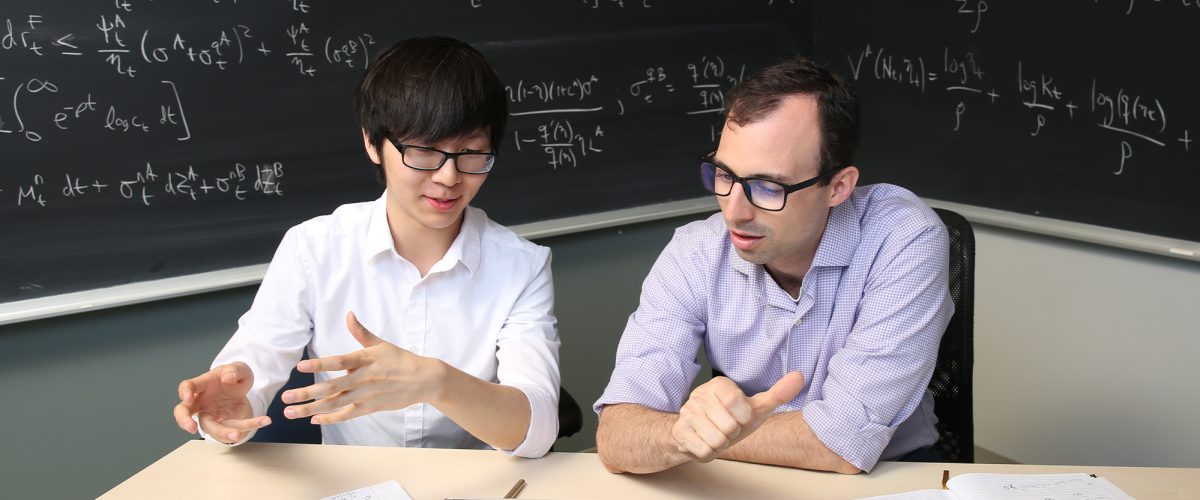
As an economics major, you’ll develop an understanding of how individuals, organizations and societies meet their material needs. In introductory courses, you’ll learn fundamental principles that apply to a wide range of social and policy issues, while theory courses provide a more rigorous grounding in the tools used in analyzing individual choice, the functioning of markets, and the behavior of output, employment and inflation. You’ll then apply these skills to gain a richer understanding of specific economic behaviors and public policy in a range of elective courses.
Why Study Economics?
Economics is the most popular major at Williams, and we are considered a leader among U.S. college economics departments. You’ll learn to address issues that are central to our daily lives, such as our standard of living, poverty, inequality, unemployment and inflation. You’ll gain insights into how public policy can increase social well-being and distribute it fairly. Our graduates pursue research and policymaking, conduct financial and data analysis, and model consumer trends for start-ups, technology companies, investment management firms, academic institutions, the Federal Reserve and more.
Major Requirements
As an economics major, you’ll begin with the study of individuals, the economy as a whole, and the statistical methods to analyze issues before applying these methods to specialized topics in elective courses that align with your interests.
The department offers a wide variety of courses, including introductory classes designed to serve the needs of potential majors and non-majors alike; core courses in economic theory and econometrics; numerous lower-level and upper-level electives; tutorials; and senior seminars with a significant research and writing component. Elective offerings are flexible and designed to serve the teaching and scholarly interests of faculty members as well as the interests of students.
Given the hierarchical structure of the economics major, students considering an economics major should try to start with ECON 110 during their first year. Since ECON 255 requires a prior statistics course (STAT 161, 201 or 202), prospective economics majors should complete the statistics requirement relatively early in their college careers.
Placement Test
All students with prior economics background from high school (or elsewhere) are required to take our departmental economics placement test to determine your recommended first course in economics. This includes any students who have taken a high school economics course, such as AP, IB, or A-level courses, regardless of whether they took a standardized test. After completing the placement test, a student’s placement test score will be considered—in conjunction with their prior economics background, and performance on other standardized tests such as the AP exam, if applicable—to determine whether they receive advanced placement credit for the introductory courses.
Required Courses
Nine courses are required for the economics major:
- Two introductory courses on the principles of microeconomics and macroeconomics
- Three core courses on price and allocation theory, macroeconomics, and econometrics
- Four electives at the 200-level or higher. At least two must be advanced electives numbered 300 to 398. At least one must be a seminar numbered 400-490. A second seminar may be taken in lieu of a 300-level elective.
Graduate courses offered by the Center for Development Economics are open to undergraduates who have taken the prerequisites, although in most cases, permission of instructor is also required. Unless otherwise specified in the course description, these courses can substitute for electives numbered 300-398 in the major.
Honors
The honors program is an opportunity for motivated and qualified senior economics majors to conduct sustained, independent research on a topic of your interest. You can choose a full-year thesis or one semester in either the fall or spring of your senior year.
Beyond Williams
Preparation for Graduate School
Graduate study in economics requires considerably more mathematical training than that necessary for the economics major. We advise students who are considering pursuing a Ph.D. to take at a minimum MATH 150 or 151, MATH 250, MATH 350, MATH/STAT 341, and MATH 309. We also advise students to consider electives such as ECON 451, 471, 472, 474, or 475 that present advanced perspectives on contemporary economic theory or econometrics. As graduate schools look for evidence of research aptitude, we also encourage those interested in graduate school to pursue the Honors program.
The Economics Major and Business Careers
The analytical and critical thinking skills taught in economics classes are useful for many careers, including business. The major is not designed to provide pre-professional training in business or management, however. Students from a wide variety of majors, including the sciences and humanities, have gone on to successful business careers. We therefore advise those interested in business to acquire a broad exposure to the arts, social science, and natural sciences, and to major in a subject that engages their interest even if that subject is something other than economics.
Learning Objectives
- To gain an understanding of core economic principles and how they apply to a wide range of real-world issues.
- To master the theoretical and applied tools necessary to critique and create economic research.
- To learn how to articulate pragmatic, principles-based policies to enhance economic well-being and promote social justice.
- To become familiar with salient developments in the world economy, in both present-day and historical contexts.
Political Economy
The Political Economy program offers the oldest interdepartmental major at Williams, combining courses and faculty expertise from the departments of Economics and Political Science. Majors acquire a substantial mastery of economics, broad knowledge of the American and international political context, an understanding of the economic and moral stakes in key current public policy issues, and the opportunity to analyze policy for themselves.