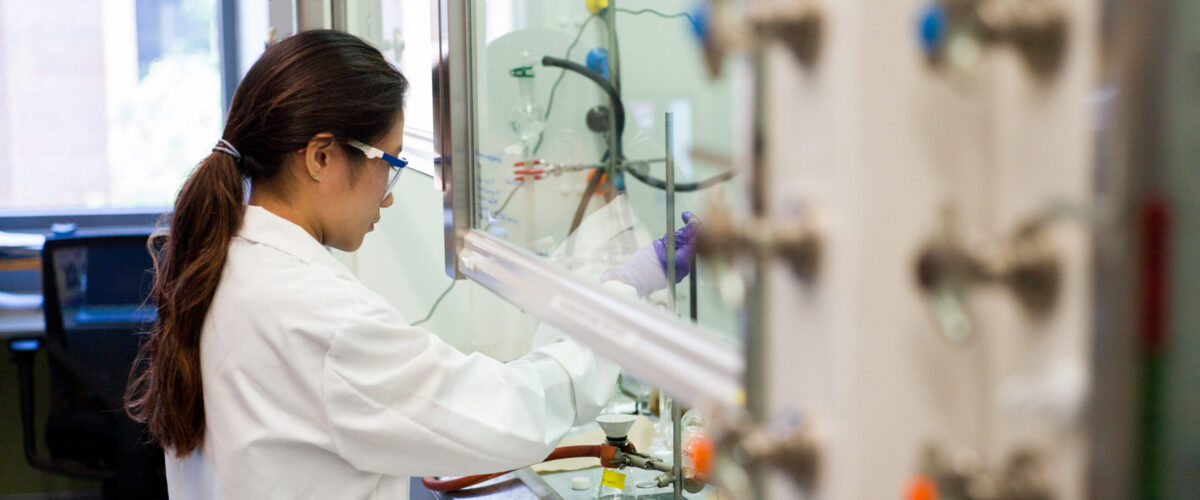
A student wearing a white lab coat working with equipment in a lab

The Major

Learn to see the world like a chemist. You’ll master the methods of chemical investigation, understand its key results and recognize their deep impact on science and society, both locally and globally. Through scientific reasoning and quantitative analysis, you’ll learn how chemical principles are applied to address current problems across a variety of industries.

Why Study Chemistry?

The chemistry major provides excellent preparation for graduate study in chemistry, biochemistry, chemical engineering, environmental science, materials science, medicine, and the medical sciences.
Declaring the Major

A major in chemistry can be achieved in several ways, preferably beginning in your first or second year at Williams. Building on a foundation in general chemistry, organic chemistry, and physical chemistry, you can elect additional advanced courses to complete a major that is consistent with your background in other sciences, interests, and goals.

An example program might emphasize biochemistry, organic chemistry, or physical chemistry, with additional courses available in analytical chemistry, inorganic chemistry, and materials science. If you’re considering a major in chemistry, consult with a member of the department as early as possible in order to plan a program that best suits your interests and background.


Learning Objectives

Approved by the American Chemical Society, the Chemistry Department of Williams College provides opportunities to explore the nature and significance of chemistry—an area of important achievement in our quest for knowledge about ourselves and the world around us. Through studies in all of the fundamental fields of chemistry as part of a liberal arts education, the department prepares you for advanced studies in various scientific fields and offers many opportunities for undergraduate research and mentorship with highly engaged faculty. This is what you’ll gain in our program:

  • Apply chemical concepts to solve qualitative and quantitative problems. Gain proficiency in logical deduction skills through written problems and laboratory work. Identify problems and generate hypotheses, develop and implement experimental methods to test your hypotheses, and analyze and interpret the resulting data.

  • Learn the ways in which new scientific knowledge is created by experiencing how chemists interpret chemical and physical phenomena through experimental investigation. Develop and apply the appropriate lab skills and instrumentation to solve chemical problems, while recognizing the uncertainties and error in experimental measurements. Understand the concepts of safe laboratory practices: learn how to dispose of waste appropriately, how to comply with safety regulations and how to recognize and minimize hazards in the laboratory.

  • Use chemical databases and retrieve peer-reviewed scientific literature. Evaluate critically chemistry-related information from a variety of sources.

  • Gain facility in written and verbal communication. Present information in a clear and effective manner, write reports in a scientific style, and use appropriate technology in your communication. Work effectively in a diverse group to solve scientific problems.

  • Access a broad education in chemistry, including the opportunity to complete a major approved by the American Chemical Society. Understand how chemical principles are applied to address current problems in a variety of fields, and have the background to understand the impact of chemistry on society both locally and globally. Understand ethical scientific behavior, including its application to their own work as proscribed by the College’s Honor Code.

Required Courses

Our chemistry courses lead you through a variety of secondary school science backgrounds into advanced levels—providing a foundation and perspective for research activities and an awareness of contemporary chemistry across disciplines.

Completion of a Chemistry major requires the equivalent of nine semester chemistry courses. Only one course designated as pass/fail may be counted towards the major. Most students will begin their study in the department in Chemistry 101 (Concepts of Chemistry), which may be taken in the fall or the spring semester. For students with little or no high school chemistry, we offer Chemistry 100 (Chemistry Matters) in the fall semester as preparation for Chemistry 101 in the spring semester.

Beyond the four core introductory courses (101, 200, 201, and 242), four 300-level courses are required, including at least three having a laboratory component. The specific courses selected will depend on each student’s future plans and interests, and can be determined in consultation with the chair or major advisor. There are suggested course groupings for Biochemistry, environmental chemistry, inorganic chemistry, materials chemistry, organic chemistry and physical chemistry.

All students interested in taking Chemistry 100 or Chemistry 101 must complete a brief departmental survey to help determine the best first-semester placement.

Browse our chemistry courses

Pathways

1. Students with little or no high school chemistry
CHEM 100 →
(fall)
CHEM 101
(spring or fall)
CHEM 200
(spring)
CHEM 201
(fall)
CHEM 242*
(spring)
and/or
ELECTIVE COURSES
OR
CHEM 100 →
(fall)
CHEM 101
(spring or fall)
CHEM 201
(fall)
CHEM 200
(spring)
CHEM 242*
(spring)
and/or
ELECTIVE COURSES
2. Students with one or more year(s) high school chemistry
CHEM 101 →
(spring or fall)
CHEM 200
(spring)
CHEM 201
(fall)
CHEM 242*
(spring)
and/or
ELECTIVE COURSES
OR
CHEM 101 →
(spring or fall)
CHEM 201
(fall)
CHEM 200
(spring)
CHEM 242*
(spring)
and/or
ELECTIVE COURSES

*Required for Chem majors

Required courses by level

    • Most students will begin their study in the department in Chemistry 101 (Concepts of Chemistry), which may be taken in the fall or the spring semester.
      • For students with little or no high school chemistry, we offer Chemistry 100 (Chemistry Matters) in the fall semester as preparation for Chemistry 101 in the spring semester.
    • After Chemistry 101, students will take Chemistry 200 (Advanced Concepts in Chemistry) and Chemistry 201 (Introduction to Organic Chemistry), in either order.
      • After completing these courses, students can move into Chemistry 242 and upper-level electives.
    • Beyond the four core introductory courses (101, 200, 201, and 242), four 300-level courses are required, including at least three having a laboratory component. Among these, the Department’s quantitative requirement must be met by completing one of the following: Chemistry 361, 363, 364, 366, or 367.
      • The ninth and final major course requirement can be satisfied in one of three ways: 1) by taking Chemistry 100; 2) by taking an additional 300-level course; or 3) by taking two approved courses from adjacent sciences (those with significant chemical and/or quantitative content) from Biology, Computer Science, Environmental Studies, Geosciences, Mathematics, Physics, or Statistics.

Opportunities

All members of the faculty are available to students for assistance and guidance regarding their progress and their plans for the future. 

  • The department has a number of “Independent Research Courses” (including thesis research) which, while they do not count toward completion of the major, provide a unique opportunity to pursue an independent research project under the direction of a faculty member. 

    Chemistry students have worked on biology, physics, mathematics, environmental science, and geoscience research projects on campus during the academic year and summer, as well as on off-campus projects throughout the world.

    Learn more about chemistry research opportunities → 

  • The Degree with Honors in Chemistry provides the opportunity to undertake an independent research project under the supervision of a faculty member, and to report on the nature of the work in two short oral presentations and a written thesis.

    Chemistry majors who are candidates for the Degree with Honors take the following in addition to the courses listed for the major:

    493-W031-494: Senior Research and Thesis

    The principal considerations in admitting a student to a program of independent research will be mastery of fundamental materials and skills, ability to pursue independent study successfully, and demonstrated student interest and motivation. In addition, to enroll in these courses leading to a Degree with Honors, a student must have a B- average in all chemistry courses or the permission of the chair. At the end of the first semester, the Department will review the student’s progress and determine whether the student is a candidate for a Degree with Honors. 

    The designation of a Degree with Honors in Chemistry or a Degree with Highest Honors in Chemistry is based primarily on a departmental evaluation of the accomplishments in these courses and on the quality of the thesis. Completion of the research project in a satisfactory manner and preparation of a well-written thesis will usually result in a Degree with Honors. In cases where a student has demonstrated unusual commitment and initiative resulting in an outstanding thesis based on original experimental results, combined with a strong record in all of his or her chemistry courses, the Department will award a Degree with Highest Honors in Chemistry.

  • Students who wish to complete a chemistry major (or fulfill the chemistry requirements for pre-medical study) and study abroad during their junior year are encouraged to begin taking chemistry in their first semester at Williams, and should consult with department faculty as early as possible.