Courses
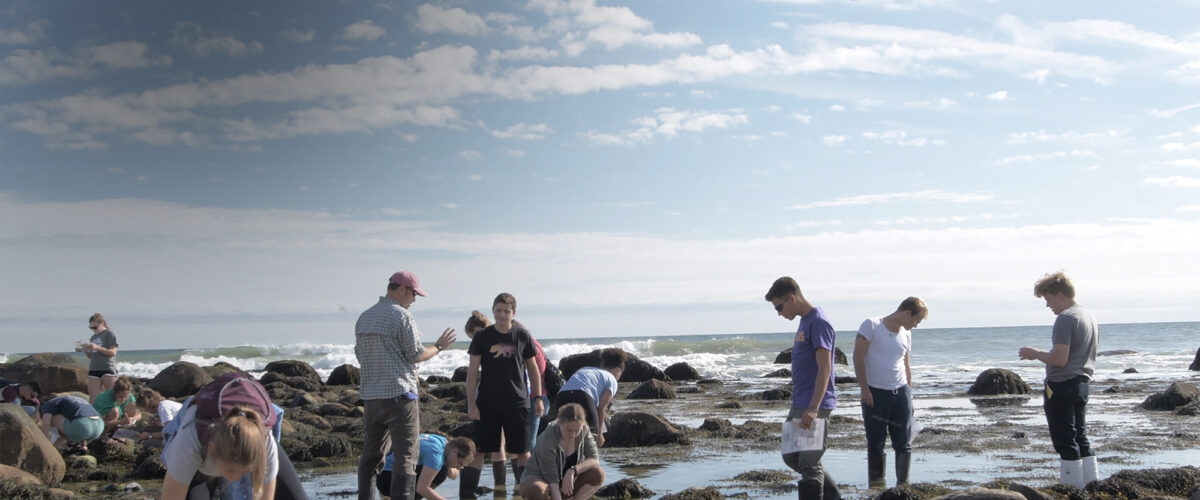
Candidates for the concentration in Coastal and Ocean Studies must complete a minimum of seven courses: the four Williams-Mystic courses (which cover history, literature, science, and policy of the coasts and oceans); an oceanography course, an elective, and a 400-level Senior Seminar. The Williams-Mystic courses are taken at our Mystic CT campus, during a semester away at the Williams-Mystic Program in sophomore or junior year, and the remainder of the concentration is completed on campus.
Coastal and Ocean Studies Courses
CAOS 100 LEC Introduction to Weather and Climate Last offered Spring 2024 How is it that we have such a hard time predicting if it’s going to rain next week, but we can be confident in projections of future climate change decades from now? This course will explore how fundamental laws of physics determine why air moves and changes, creating the wind, clouds, precipitation, and extreme events that form our weather. Building off of our understanding of the atmosphere, we’ll look at longer time scales to develop an understanding of earth’s climate system, global heat and moisture transport, climate change, and the ways that humans can change our planet. We will use weather and climate models to learn how scientists and meteorologists predict future conditions. Labs include benchtop experiments, data analysis projects, and self-scheduled meteorological observations. Taught by: Alice Bradley | Catalog details CAOS 104 (F) LEC Oceanography The oceans cover three quarters of Earth’s surface, yet oceanography as a modern science is relatively young: the first systematic explorations of the geology, biology, physics and chemistry of the oceans began in the late 19th century. This introduction to ocean science includes the creation and destruction of ocean basins with plate tectonics; the source and transport of seafloor sediments and the archive of Earth history they contain; currents, tides, and waves; photosynthesis and the transfer of energy and matter in ocean food webs; the composition and origin of seawater, and how its chemistry traces biological, physical and geological processes; oceans and climate change; and human impacts. Taught by: Mea Cook | Catalog details CAOS 110 LEC Oceans and Society Last offered Fall 2023 Oceans impact society in many ways: they provide much of our protein, they hide untapped mineral wealth, their circulation regulates global climate, they transport and accumulate our plastic garbage, marine storms batter coastal infrastructure, and sea-level rise threatens communities. However, despite the oceans’ importance throughout history–for trade, as a source of food, and because of their unpredictable dangers–we know shockingly little about them. More than 6000 people have reached the summit of Everest, Earth’s highest elevation; but only 22 have visited Challenger Deep, the deepest point below the ocean surface. We have mapped the surfaces of Mars and Venus in far more detail than the topography of Earth’s ocean basins. New marine organisms are discovered regularly. And we still don’t fully understand the complex details of how ocean and atmosphere work together as the planet’s climate engine.
In this course, you will examine ocean science themes with direct societal relevance that are also at the forefront of scientific investigation. Topics will be selected based on current events, but are likely to include deep sea mining, meridional overturning, sea level rise, atmospheric rivers, and aquaculture. By taking focused dives into a range of subjects you will learn about the evolution and operation of the ocean as a physical and geological system as well as investigating the intersections between ocean functions, climate change, and human societies. Exercises and discussions will foreground active learning. A field trip to the Atlantic coast will integrate experiential investigation of the intersection between coastal change, extreme weather, and communities. The aim is to have energised interdisciplinary discussions about topics of pressing societal relevance, to understand some of the fundamentals of ocean science, to develop expertise in gathering and distilling information by researching new topics, and thereby to improve critical and analytical thinking. Taught by: Rónadh Cox | Catalog details CAOS 12 Policy Advocate, Scientist, or Lawyer? Career Choices for Reclaiming Environmental Protection Last offered NA This course is designed for students interested in climate and environmental protection, considering whether law school, graduate school, or policy advocacy is the right route for them, and what different careers look like. Students will have the unique opportunity to meet and learn from high-profile invited guest speakers, including two governors, two appellate court judges, a United States Senator, and a former Deputy Administrator of NOAA and acting director of the U.S. Climate Change Science Program. The course will be taught by an attorney with over thirty years of experience who served as a counsellor to each of these decision-makers. Several voluntary days in Mystic, CT, for supplementary experiences will be offered. Environmental protection requires informed science, thoughtful advocacy, skillful lawyering, and authentic leadership. We will discuss the different roles that lawyers, scientists, and policy advocates play in developing laws and policies; the attributes of leadership and advocacy that are essential to be effective; and how students can develop both leadership and advocacy skills in themselves and identify them in others for whom they may seek to work. We will survey how the federal government has retreated from environmental protection and how this can be countered. Throughout the course, these distinguished speakers will model bi-partisan leadership and share practical advice on effective advocacy and choosing a career. Taught by: TBA | Catalog details CAOS 134 (F) LEC The Tropics: Biology and Social Issues Biology and Social Issues of the Tropics explores the biological dimensions of social and environmental issues in tropical societies, focusing specifically on the tropics of Africa, Asia, Latin America, Oceania, and the Caribbean. Social issues are inextricably bound to human ecologies and their environmental settings. Each section of the course provides the science behind the issues and ends with options for possible solutions, which are debated by the class. The course highlights differences between the tropics and areas at higher latitudes while also emphasizing global interconnectedness. It begins with a survey of the tropical environment, including a global climate model, variation in tropical climates and the amazing biodiversity of tropical biomes. The next section focuses on human population biology, and emphasizes demography and the role of disease particularly cholera, malaria, and AIDS. The final part of the course covers the place of human societies in local and global ecosystems including the challenges of tropical food production, the interaction of humans with their supporting ecological environment, and global climate change. This course fulfills the DPE requirement. Through lectures, debates and readings, students confront social and environmental issues and policies from the perspective of biologists. This builds a framework for lifelong exploration of human diversity in terms of difference, power and equity. Taught by: Joan Edwards | Catalog details CAOS 206 LEC Marine Biology Last offered Fall 2025 The oceans impact almost all life and processes on Earth. In this course we will explore the astounding diversity of life in the world’s oceans, from the smallest photosynthetic microbes on the planet to the largest animals that weigh almost 200 tons. Using an integrative approach that spans from the molecular to the organismal to the ecological levels, we will focus on the biology of marine organisms, and their interactions and interrelationships. Topics including primary production, reproduction, acclimation to stresses, adaptation, and evolution will be discussed in the context of environments such as the open oceans, coastal waters, rocky intertidal zones, coral reefs, and the deep sea. We will emphasize how recent scientific advances have revolutionized our understanding of marine organisms and explore solutions to global challenges, including climate change and ocean acidification, pollution, sustainable fishing and aquaculture, and habitat conservation. Taught by: Claire Ting | Catalog details CAOS 210 (F, S) LEC Oceanographic Processes Part of the Williams-Mystic Coastal and Ocean Studies Program, Oceanographic Processes examines the science of coastal and open ocean environments, and provides an introduction to oceanography. As you critically examine and discuss subjects such as sea-level rise, land loss, global climate change, coastal processes, carbon and nutrient cycling, pollution, ocean acidification, and ocean circulation, you will continue to pinpoint how these topics inform the human relationship with the sea. You will also be able to contextualize modern oceanography with paleoceanography – illustrations of past oceans and climate that we can learn from the geological record. Central to Oceanographic Processes is a curiosity to how fundamental physical, geological, chemical, and biological processes interact to create the ocean environments that we experience. Independent research forms the core: students design their own projects, conduct fieldwork, and investigate the ocean across a variety of dynamic coastal and nearshore environments near Mystic, including Atlantic beaches, intertidal mudflats, salt marshes, Fisher’s Island Sound, and the Mystic River Estuary. These research projects allow students to develop their skills in original data collection, data analysis, and scientific writing. Williams-Mystic field seminars and field trips are a crucial complement to the course: we observe and discuss issues related to coastal oceanography and global climate with communities along the New England coast and on the Mississippi River Delta. This course is in the Oceans and Climate group for the Geosciences major. Taught by: Lloyd Anderson | Catalog details CAOS 212 (F) LEC Paleobiology The fossil record is a direct window into the history of life on Earth and contains a wealth of information on evolution, biodiversity, and climate change. This course investigates the record of ancient life forms, from single-celled algae to snails to dinosaurs. We will explore how, why, when, and where fossils form and learn about the major groups of fossilized organisms and how they have changed through time. In addition, we will cover a range of topics central to modern paleobiology. These include: how the fossil record informs our understanding of evolutionary processes including speciation; the causes and consequences of mass extinctions; how fossils help us tell time and reconstruct the Earth’s climactic and tectonic history; statistical analysis of the fossil record to reconstruct biodiversity through time; analysis of fossil morphology to recreate the biomechanics of extinct organisms; and using fossil communities to reconstruct past ecosystems. Laboratory exercises will take advantage of Williams’ fossil collections as well as published datasets to provide a broad understanding of fossils and the methods we use to study the history of life on Earth, including using the programming language R (no previous experience is required). We will also view a diversity of fossils in their geologic and paleo-environmental context on our field trip to Eastern New York. This course is in the Sediments and Life group for the Geosciences major. Taught by: Phoebe Cohen | Catalog details CAOS 213 (F) LEC Introduction to Environmental and Natural Resource Economics We’ll use economics to provide one perspective on reasons humans harm the environment and overuse natural resources, and what we can do about it. We’ll study climate change, pollution in general, cost benefit analysis, environmental justice, natural resources (like fisheries, forests, and fossil fuels), and energy. We’ll talk about how economists put a dollar value on nature and ecosystem services (as well as human health and life!), and the concerns people may have about doing so. We will take an economic approach to global sustainability, and study the relationship between the environment and economic growth. Consideration of justice and equity will be woven throughout the whole semester. Taught by: Sarah Jacobson | Catalog details CAOS 215 LEC Climate Changes Last offered Spring 2026 Paleoclimatology is the reconstruction of past climate variability and the forces that drove the climate changes. The Earth’s climate system is experiencing unprecedented and catastrophic change because of anthropogenic emission of greenhouse gases and land use change. Paleoclimatology allows humans to put modern climate changes into the context of the history of this planet, and shows how and why it is unprecedented and catastrophic. Each climate event we study from Earth’s past teaches us lessons on why the climate system responds to anthropogenic perturbations, what climate changes we’re committed to in the future, how long-lasting they will be, and what climate consequences we can avoid if we take action and reduce greenhouse gas emissions sooner. In this course, we will discuss the major mechanisms that cause natural climate variability, how climate of the past is reconstructed, and how climate models are used to test mechanisms that drive climate variation. With these tools, you will analyze and interpret data and model simulations from climate events from Earth’s history, and apply these findings to anthropogenic climate changes happening now and that are projected to happen in the future. Laboratories and homework will emphasize developing problem solving skills as well as sampling and interpreting geological archives of climate change. This course is in the Oceans and Climate group for the Geosciences major. Taught by: Mea Cook | Catalog details CAOS 216 (F) LEC Globalization This course explores the determinants and consequences of globalization, with a specific focus on trade, immigration, foreign direct investment, and offshoring. Using economic principles, theoretical models, and empirical tools, we will critically analyze how these global forces shape domestic economic outcomes. Additionally, the course examines the recent global shift towards protectionism and will evaluate the welfare implications of rising tariffs. Taught by: Will Olney | Catalog details CAOS 218 (S) SEM Capital and Coercion This class will introduce students to games of trust and incentives to analyze global economic mechanisms in the past. We will focus on the difference between trade and theft, between freedom and coercion, and the role of violence. Case studies span the 13th to the 20th century and include: the spice trade in the Indian Ocean before and after European disruption, early capital markets in Amsterdam, enslavement on the West African coast and in Brazil, and colonial control in Java and in Kenya. Readings will be based on primary historical records: business letters, court transcripts, and diaries. Taught by: Ashok Rai | Catalog details CAOS 225 (S) TUT The Oceans and Climate The oceans are a fundamental part of Earth’s climate system. Ocean currents redistribute heat and water vapor around the globe, controlling temperature and precipitation patterns. Marine phytoplankton blooms and air-sea gas exchange modulate the atmospheric carbon dioxide concentration. The dynamic interaction of the atmosphere and the sea surface results in multi-year climate variations such as the El Niño-Southern Oscillation. This course will examine gradual and abrupt climate shifts from Earth’s history and the ocean’s role in driving, amplifying or dampening the changes, the ocean’s response to anthropogenic greenhouse gas emissions, and the projected impacts of continued emissions and climate change on the ocean in the coming decades and millennia. We will analyze articles from the scientific literature that lay out the theory on the ocean’s influence on climate, reconstruct past climate and ocean changes, test the mechanisms responsible for those changes, and with that knowledge, project the consequences of continued anthropogenic greenhouse gas emissions. Topics may include the climate effects of opening and closing seaways with plate tectonics, ocean feedbacks that amplify the intensity of ice ages, the instability of ocean circulation during ice-sheet retreat, the evolution of the El Niño-Southern Oscillation, ocean heat and carbon dioxide uptake during the last century and into the future, and carbon dioxide removal as a climate mitigation strategy. This course is in the Oceans and Climate group for the Geosciences major. Taught by: Mea Cook | Catalog details CAOS 226 TUT Climate Data Analysis Last offered Spring 2022 In this tutorial, students will learn how to access and work with the datasets that show how our climate is changing. The course introduces a series of analytical methods used in climate science, and students then apply those ‘recipes’ to data of their choosing to research parts of the climate system. Over the course of the term, a student might investigate the seasonality of global atmospheric carbon dioxide levels, maps of sea level anomalies, and the impact El Niño patterns have on Western US rainfall. Students will present their findings, and their insights into the particular aspect of the climate system, at weekly tutorial meetings. Analytical approaches covered in the class include climatologies, time series analysis (trends, periodicity, and autocorrelation), anomaly maps, composites, and zonal/meridional averaging. As for regions and climate systems students can explore: the sky is the limit. This course is in the Oceans and Climates group for the Geosciences major. Taught by: Alice Bradley | Catalog details CAOS 231 (F, S) SEM Global Ocean Literature The ocean, and human relationships with it, have been central features of literatures and cultures around the world for more than a thousand years. But since literary study is typically based around authors’ homelands, careful examination of the oceanic experience is often pushed to the periphery–an “empty space” to be crossed between nations, a “vast darkness” antithetical to human life, or a mirror for land-borne concerns. Increasingly, however, scholars and readers are centering the sea and stories about it as a means stepping outside human frameworks of space and time, situating the complex emotions and narratives inspired by the ocean into a complex network of geologic history and teeming other-than-human life. This course examines a wide range of texts and perspectives on the ocean and human relationships with it. Doing so will help us consider how literature both plays into and subverts dominant viewpoints of the ocean. Through texts that consider 19th-century whaling, the Middle Passage, the postcolonial Caribbean, and islands throughout the Pacific Ocean, we will explore a range of questions, including: What can we learn from examining efforts to write about the ocean? How do ocean stories help individuals understand themselves, their communities, and their place in global environments? What can the range of cultural and literary perspectives on our “single, global ocean” reveal about the ways different people are both connected with and profoundly distant from each other? Most importantly, we will practice, as a classroom community, different strategies for carefully reading texts while connecting them to cultural traditions, surrounding environments, and personal experiences. Taught by: Ned Schaumberg | Catalog details CAOS 244 TUT Environmental Ethics Last offered Spring 2026 What ethical standards should guide our individual and societal choices when those choices affect current and future environmental conditions? This course will introduce students to fundamental concepts, methods, and issues in environmental ethics. Initial tutorial meetings will focus on theoretical materials that will background later discussions and will include classic readings from the environmental ethics literature, among others. Most sessions will pair readings about key concepts with specific cases that raise complex ethical issues, including the concept of moral standing and, e.g., people who do not yet exist, non-human individuals, species, and complex living systems; the concept of moral responsibility and complicity in environmentally damaging practices; the legitimacy of cost-benefit analysis as an environmental policy tool; and the valuation of human lives. Taught by: Julie Pedroni | Catalog details CAOS 255 LEC Environmental Observation Last offered Fall 2024 To study the environment, we need to observe and measure it. We collect data–numbers that represent system states–and analyze them to create understanding of the world we live in. Advances in technology create more opportunities to discover how the planet works. Through a survey of observational approaches (including weather stations, direct sampling, remote sensing, community-based monitoring, and other techniques), this course will investigate the process of turning a physical property in the environment into a number on a computer and then into meaningful information. We will explore both direct field measurements and remote sensing techniques, diving into how to choose the appropriate sensor for a scientific question, how sensors work, analysis approaches and statistical methods, and how to interpret the resulting data. We will also learn how to mitigate measurement bias through a combination of lab experiments and field work and how to make interpretations of measurements that accurately reflect what is being measured. The course will focus on the near-surface environment, including the atmosphere, water, and biosphere. Students will carry out a research project using observation techniques covered in class to explore a scientific question of interest. This course is in the Oceans and Climate group for the Geosciences major. Taught by: Alice Bradley | Catalog details CAOS 269 (F) LEC Environmental Law and Policy This course provides an introduction to environmental law and policy in the United States. Though a comparatively young discipline, environmental law is already an enormous — and enormously important — field that impacts every other area of law and policy. It also grows more controversial by the day. Understanding the role of environmental law & policy as well as the fraught discourse it inspires requires a familiarity with the laws and concepts underpinning the environmental legal regime. Towards that end, we will survey key environmental statutes, the regulatory process that administers them, and key court cases that interpret them. We will also examine what it means to “think like a lawyer” and explore whether and how thinking like a lawyer aids or undermines the quest for effective environmental protection. Taught by: David Cassuto | Catalog details CAOS 279 SEM Islam on the Indian Ocean Last offered Spring 2024 While colonial and Eurocentric geographies speak in terms of continental separation, historically the continents of Africa and Asia have been connected to one another through a dual link: Islam and the Indian Ocean. Indian Ocean trade and travel have historically connected East Africa, the Arabian Peninsula, South Asia, and South East Asia, shaping the lives of people and communities who lived not only along the coasts but also inland. This course focuses on these transregional connections, looking at the Indian ocean as a connective space that binds people and regions together rather than separating them. The course will also examine the role of Islam as a religious, economic, social and political force that brought together Muslim communities throughout the regions along the Indian ocean. In exploring these connections, the course will cover a broad historical period, from the 7th century with the rise of Islam to European colonialism and the emergence of a global economy in the nineteenth century. Taught by: TBA | Catalog details CAOS 309 (F) LEC Modern Climate What will happen to the Earth’s climate in the next century? What is contributing to sea level rise? Is Arctic sea ice doomed? In this course we will study the components of the climate system (atmosphere, ocean, cryosphere, biosphere and land surface) and the processes through which they interact. Greenhouse gas emission scenarios will form the basis for investigating how these systems might respond to human activity. This course will explore how heat and mass are moved around the atmosphere and ocean to demonstrate how the geographic patterns of climate change arise. We will also focus on climate feedback effects–like the albedo feedback associated with sea ice and glacier loss–and how these processes can accelerate climate change. In labs we will learn MATLAB to use process and full-scale climate models to investigate the behavior of these systems in response to increasing greenhouse gasses in the atmosphere. This course is in the Oceans and Climate group for the Geosciences major. Taught by: Alice Bradley | Catalog details CAOS 311 (F, S) LEC Marine Ecology We have explored only a fraction of the ocean, with about 10% of marine species classified and 20% of the ocean mapped. Many discoveries remain to be made, and marine ecology is one technique to uncover new insights. The field of marine ecology, rooted in the theory of evolution, describes the mechanisms and processes that drive the diversity, abundance, and distribution of marine organisms. The goal is to document natural patterns and make predictions about how species will respond to environmental changes by investigating the relationship between the abiotic environment and biotic interactions. This course will take a deep dive into the unique challenges to life in the ocean. You will compare and contrast different marine ecosystems, such as coral reefs, kelp forests, and the deep sea. You will also practice a marine ecologist’s skillset as you design, carry out, and analyze your own research project, which will improve your scientific writing, data analysis, and communication skills. Importantly, you will connect your research and course topics to larger marine conservation issues and broader societal impacts. Taught by: Tim Pusack | Catalog details CAOS 323 SEM Law and Politics of the Sea Last offered Spring 2025 Can international law save the seas? That is one current bet. The sea law regime centers on the United Nations Convention on the Law of the Sea (UNCLOS), which gathers into one place what most countries consider to be scattered ancient laws about piracy, transit through other countries’ territorial waters, fishing, jurisdiction over ships, and so forth. It also creates ocean zones, with rules for each, and a system for taxing firms that it licensed to exploit minerals on the high seas, and sharing the proceeds with developing countries. It seeks to mitigate conflicts among countries and companies as they energetically compete to exploit the seas. In 2023, UNCLOS launched a follow-on treaty, the Agreement on the Conservation and Sustainable Use of Marine Biological Diversity of Areas Beyond National Jurisdiction (BBNJ), which adds areas in the high seas that all nations commit to protect. This course explores the politics and practices that arise from UNCLOS and BBNJ. We engage with the agreements’ history, content, and exclusions, examine the incentives they provides states and criminals, and assess the way that geopolitical and climate collapse create new opportunities and constraints for states, firms, international organizations, and activists. Topics include piracy, naval officers’ guidelines, conflict in the South China Sea, bonded labor, refugee quarantine on islands, marine genetic resources, Arctic transit, and ocean pollution. This is a way to understand major deals regarding the oceans; it is also a way to understand what it means to consider an international legal agreement a solution to something. Taught by: Cheryl Shanks | Catalog details CAOS 327 LEC Coastal Processes and Geomorphology Last offered Fall 2025 Can people live safely along the coast? Recent events like SuperStorm Sandy and the Tohoku Tsunami have shown us how the ocean can rise up suddenly and wreak havoc on our lives and coastal infrastructure. Only educated geoscientists can evaluate the risks and define informed strategies to prevent future coastal catastrophes. Currently almost half the global population lives within 100 km of the coast, with a large percent of those living in densely populated cities (e.g., New York, New Orleans, Los Angeles, Shanghai, Hong Kong, Cape Town, Sydney, Mumbai). Despite the growing risks and challenges associated with climate change and rising sea levels, the coastal population continues to grow rapidly. To help ensure these growing populations can live safely along the coast requires a detailed understanding of the processes that shape the coastal zone. These processes act across a variety of scales, from deep-time geologic processes that dictate coastal shape and structure, to decadal-scale processes that determine shoreline position and evolution, to weekly and daily processes such as storms and tides. This course will provide an in-depth look at the forces–wind, waves, storms, and people–that shape the coastal zone, as well as the geologic formations–sandy beaches, rocky cliffs, barrier islands, deltas, and coral reefs–that are acted upon and resist these forces. Coastal dynamics are strongly affected by human interventions, such as seawalls, dredged channels, and sand dune removal, as well as by sea level rise and changes in storm frequency and magnitude associated with climate change. Finally, the course will provide students with a perspective on how the U.S. seeks to manage its coastal zone, focusing on sea level rise and coastal development. This class will include a quantitative lab that will use MATLAB software to model and evaluate various coastal processes. Students will gain a basic understanding of MATLAB functionality, and will be asked to independently apply what they have learned to various data sets provided by the instructor. Taught by: Alex Apotsos | Catalog details CAOS 351 (F, S) SEM Marine Policy Coastal communities are home to nearly 40% of the U.S. population, but occupy only a small percentage of our country’s total land area. Intense population density, critical transportation infrastructure, significant economic productivity, and rich cultural and historic value mark our coastal regions as nationally significant. But, coastal and ocean-based climate-induced impacts such as sea level rise, ocean warming and acidification pose extraordinary challenges to our coastal communities, and are not borne equally by all communities. This seminar considers our relationship with our ocean and coastal environments and the foundational role our oceans and coasts play in our Nation’s environmental and economic sustainability as well as ocean and coastal climate resiliency. Through the lens of coastal and ocean governance and policy-making, we critically examine conflict of use issues relative to climate change, climate justice, coastal zone management, fisheries, ocean and coastal pollution and marine biodiversity. Taught by: Linsey Haram | Catalog details CAOS 352 (F, S) SEM American Maritime History: A History of American Coastal and Ocean-Going Communities This course explores the people who lived along America’s coasts, who sailed its waters, and whose labors on land and sea shaped their community’s lives and livelihoods. We cover centuries (seventeenth-twentieth) and oceans as we delve into these experiences, and in doing so discuss issues ranging from colonization, dispossession, and war, to food, healing, and sexuality. We will also consider the strategies scholars use to explore these experiences, including those whose lives left scant “traditional” primary sources behind. The water creates a unique space for the formation of new communities and identities, while also acting as an important, and often exploited, resource. We will sample from different fields of inquiry including labor, environmental, cultural, and political history to gain a deeper understanding of diverse people’s complex interactions with the oceans and seas. Taught by: Sofia Zepeda | Catalog details CAOS 361 SEM The Atlantic World: Connections, Crossings, and Confluences Last offered Fall 2024 This course considers the Atlantic World as both a real place and a concept: an ocean surrounded and shaped by diverse people and communities, and an imagined space of shared and competing affiliations. Moving from “time out of mind” to the early nineteenth century, it examines ecological, cultural, political, economic, intellectual, and spiritual transits as well as exchanges among Indigenous/Native American, African and African American, Asian and Asian American, and Euro-colonial people. It introduces conceptual dimensions of this Atlantic paradigm and case studies that illuminate its human subtleties, with the goal of examining “early American” histories through transnational and transoceanic lenses. The course takes an interdisciplinary approach to these intertwined histories, and reckons with how the very construction of “history” has, at different turns, affected what is shared, known, valued, and commemorated–or overwritten, denied, or seemingly silenced. Attentive to the structures of power that inflect every part of Atlantic histories, it offers specific ethical frameworks for approaching these topics. Blending methods grounded in oral traditions and histories, place-based knowledge systems, documentary/written archives, songs, archaeology, material culture, and other forms of expression and representation, it invites class members to revisit the nature and meanings of these connected spaces. The course consistently connects historical experiences with the twenty-first century, and how communities today are grappling with the afterlives and ongoing effects of these Atlantic pasts through calls to action for reparations, repatriation and rematriation, Land Back, climate justice, and other forms of accountability. The course also provides an opportunity to engage with original materials pertaining to Atlantic World histories in the Williams College Archives/Special Collections and Art Museum. Taught by: Christine DeLucia | Catalog details CAOS 387 LEC Economics of Climate Change Last offered Fall 2025 This course introduces the economic view of climate change, including both theory and empirical evidence. Given the substantial changes implied by the current stock of greenhouse gases (GHGs) in the atmosphere, we will begin by looking at impacts on agriculture, health, income, and migration. We will consider the distribution of climate damages across poor and wealthy people, both within and across countries. Next we will study adaptation, including capital investments and behavioral changes. We will examine the sources of climate change, especially electricity generation and transportation, and think about optimal policies. Throughout the course we will discuss the limits of the economic approach, pointing out normative questions on which economic theory provides little guidance. Taught by: Matthew Gibson | Catalog details CAOS 391 SEM When India was the World: Trade, Travel and History in the Indian Ocean Last offered Spring 2021 What do Ibrahim Ben Yiju, a Jewish merchant from 11th century Yemen, Ibn Batutah, a Muslim scholar from 15th century Morocco and Captain Kidd, a 17th century English pirate have in common? All three men travelled and lived in the Indian Ocean region! This course explores the history of one of the world’s oldest maritime highways that has connected the diverse cultures of Asia, Africa and Europe for millennia, thus making it a vital element in the birth of globalization. Moving away from conventional land-centric histories, we will focus instead on understanding the human past through oceanic interactions. South Asian ports and port cities remained the fulcrum of the Indian Ocean world throughout its history; traders, travellers, nobles, scholars, pilgrims and pirates from all over the world travelled to the Indian coast in search of adventure, spices, knowledge and wealth. Thus we will primarily focus on India’s role in the Indian Ocean roughly from the rise of Islam in the seventh century CE through the expansion of various European communities in the region and the subsequent rise of the global economy and colonialism in the nineteenth century. Rather than following a strict temporal chronology we will concentrate on themes such as travel and adventure; trade and exchange; trust and friendship; religion and society; pilgrimage; piracy; the culture of port cities; and food across time. Taught by: Aparna Kapadia | Catalog details CAOS 394 SEM The Nature of Nature Last offered Fall 2025 “Nature” is one of the commonest words in English. And yet what does it mean? Is it primarily descriptive (all living things), or normative (“natural” foods, “human nature”)? This course will consider the richly incoherent ways we think about the living world, paying particular attention to the difficulty of narrating processes that are too big, too small, too quick, or too slow for direct human apprehension. We’ll explore the way popular nature writing mingles scientific reporting with implicit and explicit judgments about human identity, and take up the insoluble problem of our proper relation to animals. Considerable attention will be paid to the ethical dimensions of contemporary environmental consciousness and unconsciousness.
Writers studied will include Elizabeth Kolbert, Descartes, William Cronon, and Charles Darwin. Taught by: Shawn Rosenheim | Catalog details CAOS 397 (F) IND Independent Study: Coastal and Ocean Studies Coastal and Ocean Studies independent study. Taught by: Rónadh Cox | Catalog details CAOS 398 (S) IND Independent Study: Coastal and Ocean Studies Coastal and Ocean Studies independent study. Taught by: Rónadh Cox | Catalog details CAOS 405 SEM Geochemistry: Understanding Earth’s Environment Last offered Fall 2025 Rocks, water, air, life: what comprises these interconnected components of the Earth system? How do they interact today, and how did these interactions differ in the past? In this course we will study how chemical elements are distributed in the Earth, cycle through the Earth system, and act together to produce a planet that is habitable. As Earth’s landscapes and oceans, and the life they harbor, have evolved through time, they have left an imprint in the geological record that we can read using geochemical tools such as molecular fossils, elemental ratios, and stable and radioactive isotopes. Topics include the synthesis of elements in stars, the formation and differentiation of planet Earth; radiometric dating; the major constituents of the atmosphere, rain, rocks, rivers and the ocean; how they’re linked by chemical weathering and biological activity; and reconstruction of past environments and ecosystems. Students will explore these topics through lecture; reading and discussing articles from the scientific literature; and collecting, analyzing and interpreting data from environmental samples. This course is in the Oceans and Climate group for the Geosciences major. Taught by: Mea Cook | Catalog details CAOS 410 (S) LEC The Cryosphere The Earth’s climate system is often described in terms of its spheres, including the atmosphere, biosphere, lithosphere, oceans, and the cryosphere. The cryosphere is the naturally occurring ice on Earth in all its many forms: snow, glaciers, ice sheets, sea ice, frozen lakes and rivers, and permafrost (frozen soil). These parts of the climate system may seem remote, but have implications for climate and weather around the world. Melting glaciers and ice sheets have already contributed to sea level rise, and are projected to do so even more in the future. This course will explore the cryosphere, including snow, sea ice, permafrost, and glaciers through lectures, hands-on and data analysis labs, reading journal articles, and a final project.
As a 400-level seminar, this capstone course is intended to build on and extend knowledge and skills students have developed during previous courses in the major. Taught by: Alice Bradley | Catalog details CAOS 414 (S) SEM Life at Extremes: Molecular Mechanisms All organisms face variability in their environments, and the molecular and cellular responses to stresses induced by environmental change often illuminate otherwise hidden facets of normal physiology. Moreover, many organisms have evolved unique molecular mechanisms, such as novel cellular compounds or macromolecular structural modifications, which contribute to their ability to survive continuous exposure to extreme conditions, such as high temperatures or low pH. This course will examine how chaperonins, proteases, and heat- and cold-shock proteins are regulated in response to changes in the external environment. We will then consider how these and other molecular mechanisms function to stabilize DNA and proteins- and, ultimately, cells and organisms. Other extreme environments, such as hydrothermal vents on the ocean floor, snow fields, hypersaline lakes, the intertidal zone, and acid springs provide further examples of cellular and molecular responses to extreme conditions. Biotechnological applications of these molecular mechanisms in areas such as protein engineering will also be considered. Class discussions will focus upon readings from the primary literature. Taught by: Claire Ting | Catalog details CAOS 438 SEM Species Interactions Under Global Change Last offered Fall 2024 Anthropogenic changes to the world’s ecosystems often have clear effects on the abundance and distribution of species. These effects, however, do not occur in a vacuum: changes in any given species’ presence, abundance, or behavior can cascade into large and surprisingly context-dependent effects on the interactions of other organisms. In this course we will examine competitive, mutualistic, and antagonistic interactions in the Anthropocene from the species pair to community scale. We will explore the ecological and evolutionary mechanisms underlying the outcomes of these interactions, examining patterns including phenological mismatch, species invasions, and anthropogenic land use change. Classes will focus on critical evaluation of evidence from the primary literature, drawing on examples from community ecology, disease dynamics, and global change biology. Taught by: TBA | Catalog details CAOS 460 SEM Communicating Climate Change Last offered Spring 2025 Long-term, probabilistic thinking about scary scenarios is hard. When the relevant time frames extend to centuries and millennia, it is really hard. And when the degree of scariness is determined by sciences that few people understand, it is really, really hard. Such is the challenge of climate change communication. No matter what your interests or career paths might be, you will need to be able to communicate effectively about environmental problems, often with people who see them very differently from you. It is difficult to communicate about any problem across social, political, and cultural divides. But environmental problems present special challenges. For one thing, they typically involve complicated, contested science. For another, their effects are often difficult to perceive yet potentially devastating in their consequences, especially for future generations and marginalized people. For yet another, their solutions often seem hopelessly difficult to implement. And for yet another, they are thoroughly entangled with almost every other problem we face, from pandemics to racism to wealth inequality. How do we communicate clearly, persuasively, and responsibly about something so complex? What does climate change really mean? This seminar brings together students with interests in the humanities, arts, social sciences and sciences to seek answers to this fundamental question. Drawing on insights from the qualitative social sciences and environmental humanities, we will develop a theoretical and methodological tool kit that can be applied to concrete, practical problems. Over the course of the semester, each student will pursue a major independent project that allows them to put these tools to use while exploring a topic of personal significance. Taught by: Nicolas Howe | Catalog details CAOS 465 Solutions to the Biodiversity Crisis Last offered NA The biodiversity crisis is one of the greatest challenges of our century. Faced with climate change, persistent pollution, and habitat fragmentation, species are declining locally and globally. In this upper-level seminar we will integrate knowledge from the natural sciences, social sciences, policy, arts, and the humanities to design and implement biodiversity interventions. Through readings, discussions with experts, and applied projects, we will learn how biodiversity conservation and restoration can be socially just; how spaces can be designed to promote the flourishing of life; and how much local environmental management can alter global trends. We will also envision what the biotic world might look like in 10, 100, and 1000 years and consider who gets to decide which species live and which die, and who should decide. Taught by: TBA | Catalog details CAOS 477 (S) SEM Economics of Environmental Behavior A community maintains a fishery; a firm decides whether to get a green certification; you choose to fly home or stay here for spring break: behaviors of people and firms determine our impact on the environment. We’ll use economics to model environmental behavior and to assess how policies can help or hurt the environment. Topics we may study include: common pool resources, voluntary conservation, social norms and nudges, discrimination and justice, rationality, firm responses to mandatory and voluntary regulation, voting and public opinion, and international environmental agreements. We’ll also build familiarity with the main methodologies of modern economic research: theoretical modeling, empirical analysis of observational data, and experiments. Taught by: Sarah Jacobson | Catalog details CAOS 480 (S) SEM Critical Perspectives in Planetary Health Planetary health is the interdisciplinary field that examines how human-driven changes to Earth’s natural systems shape the health and well-being of human populations, and this senior seminar explores those links from mechanism to policy. We will investigate major environmental transformations–including climate change, land-use change, overfishing, pollution, and resource extraction–and their cascading consequences for biodiversity, food systems and nutrition, infectious disease risk (including debates such as the dilution effect), and the emergence of social-ecological traps that can intensify vulnerability and inequity. Organized as weekly deep dives into foundational and cutting-edge scholarship, the course traces ecological and biological processes through proximal and distal health outcomes, while analyzing underlying economic and political drivers, downstream social consequences, mitigating factors, and reinforcing feedback loops. Students will have the opportunity to critically evaluate study design, statistical inference, and conceptual frameworks across diverse areas of inquiry, assess the strength of evidence for competing explanations to human-environment relationships, and interrogate the feasibility, equity, and likely effectiveness of proposed interventions and policy solutions. Taught by: Nicholas Joseph Arisco | Catalog details CAOS 493 (F) HON Senior Thesis: Coastal and Ocean Studies Coastal and Ocean Studies senior thesis. Taught by: Rónadh Cox | Catalog details CAOS 494 (S) HON Senior Thesis: Coastal and Ocean Studies Coastal and Ocean Studies senior thesis. Taught by: Rónadh Cox | Catalog details
Curriculum & Required Courses
Find the right course for you, whether you’re exploring Coastal and Ocean Studies through an elective or declaring your concentration.