Courses
The Africana Studies major begins with AFR 200 (Introduction to Africana Studies), which offers an introduction to the content and contours of the field, told through guest speakers, field trips, lectures, and interdisciplinary work in the performing arts. From there, you can explore a wide range of courses taught by Africana Studies faculty in the disciplines of American Studies, anthropology, sociology, history, English, political science, religion, women’s, gender, and sexuality studies, and the visual and performing arts.
Africana Studies Courses
AFR 104 (S) TUT Race and a Global War: Africa during World War II This course highlights African experiences of World War II. Although most histories have excluded Africa’s role in the war, the continent and its people were at the center of major developments during in this global conflict. In fact, many Africans remember the Italian invasion of Ethiopia in 1935 as the start of the war. African servicemen fought alongside the Allied and Axis forces on major warfronts in Europe, Africa and Asia. African communities and individuals also established war charity campaigns to collect funds, which they sent to war ravaged societies in Europe. Indeed, African economies, despite their colonial statuses, kept European imperial nations afloat in their most hour of need. At the same time, African colonial subjects faced severe food shortages, the loss of working-age men to labor and military recruiters, and dramatically increased taxes. We will examine the impact of these and other wartime pressures on different African communities. How did African societies meet such challenges and how did they view the war? In this course we will examine the roles that women played during the war, and the various other ways that African communities met wartime demands. Other topics we will explore include the role of African women; colonial propaganda; political protest against the war; race and racial thought in the wartime era; war crimes; African American support for the liberation of Ethiopia; and the war’s impact on decolonization across the continent. We will further study how Africans and outsiders have differently conceptualized the continent’s role in the war by analyzing a variety of sources, including scholarly writings, archival materials, films, former soldiers’ biographies, and propaganda posters. Taught by: TBA | Catalog details AFR 105 LEC Art, Space, and Visual Culture in Africa from Past to Present Last offered Fall 2019 This course introduces students to the power and diversity of expressive forms that have characterized the arts, spaces, and visual cultures of Africa from prehistory to the present. In the context of this course, students will not only study a wide array of objects, images, and structures that have been produced within this vast geography, but will also consider how such forms have used materials, ideas, and aesthetics to function variously as tools of divine manifestation, political intervention, social commentary, and identity construction. Taught by: Michelle Apotsos | Catalog details AFR 107 (F) SEM Dancing in the Streets (Strange Fruit) There is a reason why collective activism and impulses toward revolution are called “movements.” Movements have bodies, actions, rhythms, voices, and stories. They are embodied, and they create change through this embodiment. During the summer of 1964, the Motown anthem Dancing In the Street (D.I.T.S.) became a joyful expression of the desire to take up space, in tune with the powerful political and social justice movements of the time. D.I.T.S. continues to be sung by contemporary artists as an expression of celebration and as a call to action, highlighting the cyclical nature of time and experience. What brought people into the streets in communities across the globe in 1964, in 2020, and beyond? With this question in mind, we will examine, discuss, and respond to the ways in which artistic expression can document lived experiences, and deploy similar tactics to explore and document our present lives. How have artists documented and driven forward major themes in social justice, both in the past and in our current times?
A primary focus of consideration will be the anti-lynching movement across time, which has given rise to the art and aesthetics of the Civil Rights, Black Lives Matter, and Say Her Name Movements. Grounding this work will be a deep exploration of “Strange Fruit,” an artistic tour de force that began life as a poem in response to a photographic image and grew to encompass dance, visual art, theatre, media, and music–particularly the enduring and repeating renditions by artists like Billie Holiday, Pearl Primus, and Nina Simone.
The course trajectory will be deeply affected by the students who take part, offering their own stories and experiences in conversation with the work of influential creative practitioners. Inspired by our own origin stories and the roll call of cities heard in D.I.T.S., we will consider the ways in which dance, music, theatre, visual art and other forms of creative expression are made to be shared, causing culture and experiences to bear witness and become meaningful beyond the boundaries of origin. Course meetings will include viewings and discussions of creative expression in various media and formats through an ethnographic performance studies lens, further examining the role of the artist as witness/documentarian, activist, and agent of change. This work will serve as a catalyst in the production of original performance offerings (solo and group-based) that will be shared with a public audience. Taught by: Sandra Burton | Catalog details AFR 110 SEM Television, Social Media, and Black Women ‘Unscripted’ Last offered Fall 2025 Nene Leaks, Issa Rae, Zendaya, Oprah Winfrey, Lavern Cox and Joy Reid have become common household names. Whether from the television shows they star in, the TV shows they have created, or the social media presence they have developed–these women continue to influence and shape popular culture. In this course we will situate Black women as creators and contributors to popular culture as a whole, but specifically through television (scripted and “unscripted”) and social media. We will begin by covering the history of Black women in television. This historical approach will then lead us to examine selected TV episodes, and investigate social media pages of Black actresses, television producers, and the fans of these shows. The aim of this course is to analyze the ways in which Black women continually shift the popular culture paradigm and how they serve as key players determining what is indeed popular. Taught by: VaNatta Ford | Catalog details AFR 111 SEM Afro-Modern Dance I: Theory & Practice (Dunham Technique) Last offered Fall 2025 Modern African diasporic dance creates a conversation between the past and the present; it brings forth memories of the African “homeland” and of the dispersal of African bodies around the world, while simultaneously engaging the current joys, pains, challenges, and cultural growth of Black people. Through movement and rhythm, dancers experience the embodied knowledge of previous generations, while connecting to contemporary cultural, political, and economic realities. Katherine Dunham devoted her life to exploring and exposing the multiple layers and complexities of the African diasporic experience through her ethnographic dance choreographies, her dance technique, her schools, her music, and her writing. Dunham’s work as a dance anthropologist, artist, educator, and humanitarian is manifested in Dunham Technique; the technique is a fusion of African diasporic dance, ballet and modern dance, and functions as an embodied medium for cultural communication. The technique is considered “a way of life” as it uses theory and philosophy to engage participants in a holistic experience that is not only physical, but also intellectual, emotional, and spiritual. Through this combination of physicality, history, theory, and philosophy, Dunham Technique is a tool to understand one’s inner self and place oneself within a historical and cultural framework.
In this course, students will explore the history, theory, and philosophies of Dunham Technique and Katherine Dunham, while actively participating with the technique’s movement concepts and vocabulary. Students will engage in the fundamentals of a Dunham Technique movement class through center floor work, barre exercises, progressions, and choreography. The course will combine the studio experience of the physical technique with lectures and discussions. Students will learn about the three theories of Dunham Technique (Form and Function, Intercultural Communication, and Socialization through the Arts) and its three philosophies (Self-Examination, Detachment, and Discrimination) while also learning the history and historical context of the technique and its creator. Taught by: Saroya Corbett | Catalog details AFR 113 LEC Musics of Africa Last offered Fall 2023 This course introduces musical traditions spanning the geographical breadth of continental Africa. We will prioritize hands-on experience and musical practice, critical listening, and deep social and political contextualization as strategies of musical engagement. Following an introductory exploration of overarching aesthetic and social trends in African musical practice, the course will then focus on 3-4 geographically rooted case studies, allowing us to discuss how different musical practices and subcultures (featuring traditional, contemporary, and popular forms) interrelate in a musical soundscape. The geographical focus of the case studies may vary but previous case studies have included: Ghana, Zimbabwe, Ethiopia, Egypt, Mali and the Democratic Republic of Congo. Taught by: Corinna Campbell | Catalog details AFR 122 Black Sounds in the Age of AI Last offered NA In 1929, legendary Spanish poet, playwright, and flamenco aficionado Federico García Lorca traveled to Harlem. While there, he took classes at Columbia, and socialized with key figures in the Harlem Renaissance, who took him out to bars and clubs to hear jazz and the blues. In this music, he recognized something familiar–the spirit of duende through which flamenco performers in his native Spain are able to express the inexpressible. In subsequent decades, African American writers and musicians such as Langston Hughes, Ralph Ellison, and Miles Davis traveled to Spain, and recognized in flamenco something familiar: the feeling or soul they thought differentiated African American musical forms like the blues and jazz from many other genres. Is there something that unifies all these different forms of music? According to one flamenco singer, “All music that has black sounds has duende.” In this tutorial, we will explore the meanings of blackness and black sounds in the transatlantic world, both in terms of race, and in relation to cultural, historical, religious, and mythic ideas that predate the conquest of the Americas and the modern conceptions of race that came in its wake. From the nineteenth century, when the nascent recording industry began defining and segregating musical genres and their markets, to our contemporary moment where YouTubers employ generative AI to create deepfaked Kendrick Lamar songs, black sounds have played a key role in how the line between the human and nonhuman is defined in American culture. We will draw on work in American Studies, Ethnomusicology, History, and Religious Studies to better understand the aesthetic power of artists whose work embodies black sounds, from blues icon Bessie Smith to flamenco legend Camarón de la Isla. Taught by: TBA | Catalog details AFR 128 TUT James Baldwin’s Song Last offered Spring 2026 “It is only in his music [. . .] that the Negro in America has been able to tell his story. It is a story which otherwise has yet to be told and which no American is prepared to hear,” wrote James Baldwin in Notes of a Native Son in 1955. In this course, we strive to listen more closely to racialized experience through James Baldwin’s musical literature. Through analysis and creation of music, we hope to better understand cultural difference and collective humanity. In this course, we closely analyze James Baldwin’s use of song names, creation of musician characters, and replication of musical elements in his writing. Baldwin’s musical word play crosses historical and genre boundaries. So we will explore texts from his early to late career, such as the gospel music of his youth in the semi-autobiographical novel Go Tell It on the Mountain, the metaphor of the blues in the play written during the civil-rights movement Blues for Mr. Charlie, the jazz musician protagonist in “Sonny’s Blues” written after World War II in Paris, and his only musical recording in A Lover’s Question set down near the end of his life. In addition to closely analyzing James Baldwin’s attention to music throughout his literature, students will learn basic music writing and production skills. The tutorial will draw on a range of musical resources, including playlists, music workshops, guest lectures and performances. All of these resources will guide students to a more attuned hearing not only of music but also of the African American experience it reflects. By the end of the course, students will have written several short 1-2 page close analysis essays and song lyrics. For their final project, students will produce an original song based on key insights from the course. No musical experience is required, though an openness to learn and practice songwriting is expected. Taught by: Rashida Braggs | Catalog details AFR 130 (F, S) SEM To See & Be Seen What does it mean to be seen? Does sight entail recognition? What is the relationship between visibility and invisibility? There is much to learn about the material and psychological implications of sight from those who have historically been looked upon as problems, not people, spectacles rather than subjects. Accordingly, this course will take up questions of sight through the lens of black cultural production; including, essays, novels, plays, photography, and film. We will engage the works of canonical figures in the African American literary and artistic tradition, like W. E. B. Du Bois, Ralph Ellison, Toni Morrison, Gordon Parks, Carrie Mae Weems, Suzan-Lori Parks, and Spike Lee. Taught by: Katherine Ponds | Catalog details AFR 132 SEM Contemporary Africana Social and Political Philosophy Last offered Spring 2022 This introductory seminar investigates the relationship between three major schools of thought in contemporary Africana social and political philosophy: the African, Afro-North American, and Afro-Caribbean intellectual traditions. We will discuss a range of thinkers including Dionne Brand, Aimé Césaire, Angela Davis, Édouard Glissant, Kwame Gyekye, Paget Henry, bell hooks, Katherine McKittrick, Charles Mills, Nkiru Nzegwu, Oyèrónke Oyewùmí, Ngugi wa Thiong’o, Cornel West, and Sylvia Wynter. A primary goal of the course is to provide students with the intellectual resources to decipher problems central to philosophical discourse and to allow students an opportunity to apply what they learn to critical issues in current geopolitics. Taught by: Neil Roberts | Catalog details AFR 135 SEM Queen Sugar and Black Study Last offered Spring 2026 This seminar will explore the critically acclaimed and award-winning television series, Queen Sugar. An adaptation of the eponymously named 2014 novel by Natalie Baszile, the show follows the Bordelon family as it struggles to hold on to its ancestral land. This seminar, specifically designed for first-year students, will treat the series as an epic text alongside scholarship on key topics offered in Williams’ Africana Studies curriculum: the afterlives of enslavement, plantation regimes, global sugar production, land dispossession, the carceral state, Black gender and sexualities, kinship, activism, and Afro-diasporic spiritualities. Taught by: James Manigault-Bryant | Catalog details AFR 140 LEC Black Autobiography Last offered Spring 2018 Autobiography–whether slave narrative, memoir, or semi-fictional life account-has served as a primary form of writing for people of African descent. Although primarily understood as a textual means for articulating selfhood, Black autobiographies also ask other questions like: How do Black reflections on the self necessitate critiques of society and culture? How have Black autobiographies been utilized for political mobilization? And, what might a collective analysis of Black autobiographies reveal about changes in conceptions of Black selfhood over time? We will explore these concerns by reading autobiographies across time and space by authors like Ottobah Cugoano, W. E. B. Du Bois, and Alice Walker. Taught by: TBA | Catalog details AFR 150 (F) TUT Black Atlantic Yogas In contemporary culture, yoga primarily denotes a series of physical postures that strengthen and tone the body. Practitioners embrace yoga–or what is sometimes called “transnational Anglophone yoga”–for personal wellness, self-improvement, and increasing labor productivity and efficiency. Now the center of a billion-dollar industry, yoga is commercialized through studios, virtual courses and podcasts, teaching curricula, professional guilds, and even fashion. This tutorial, “Black Atlantic Yogas,” will approach yoga from the historical perspective of Africana Religious Studies, as one of many spiritual practices Black people across the globe have adapted to reorient the self for survival in the modern world. Five central concepts have appeared most prominently in Black yogas–1) asana; 2) pranayama; 3) dhyana; 4) ahimsa; and 5) satyagraha. We will review interdisciplinary readings and podcasts that consider the application of these concepts across space and time, as well as whether and how they fit together as a coherent yogic system. Taught by: James Manigault-Bryant | Catalog details AFR 151 LEC A History of Jazz Last offered Spring 2011 “There are only three things that America will be remembered for 200 years from now when they study the civilization: The Constitution, Jazz Music and Baseball. These are the three most beautiful things this culture’s ever created.”–(Gerald Early) Jazz is the most common name for a great African American Art form that still defies definition. Over the past century this elastic tradition has laid down firm roots for numerous other American and World musics, while itself in the throes of a seemingly permanent identity crisis. Jazz is perennially declared dead or dying yet consistently summoned by advertisers to lend vitality and sex appeal to liquor or automobiles. By any name and regardless of its health status, jazz has a rich history of conservative innovators, at once restless and reverent, who made fascinating leaps of creativity out of inspiration or necessity. This “listening intensive” class will look at the past century of jazz music through ideas, “what-if” questions and movements that changed the way the music was created, presented and perceived. Both musical concepts (such as syncopation and cross instrumental-influence) and cultural connections (through the lenses of identity, technology and economy) will be examined, giving us freedom to link similar kinds of musical thought across disparate settings and decades. Our inquiry will include (but not be limited to) the lives and music of Louis Armstrong, Mary Lou Williams, Duke Ellington, Charlie Parker, Thelonious Monk, Dizzy Gillespie, Art Blakey, Miles Davis, John Coltrane, Wynton Marsalis, and Esperanza Spalding Taught by: Bill Lowe | Catalog details AFR 158 (F) SEM North of Jim Crow, South of Freedom This course analyzes the freedom struggle in the North during the twentieth century. Whereas black northerners drew from broader campaigns and traditions of black resistance, we will explore territorial distinctions in the region that otherwise have been flattened within the long history of civil rights discourse. To accomplish this aim, we will engage the following themes: black culture and radicalism; community formation and residential segregation; demographic and migratory transitions; deindustrialization and the war; gender and respectability politics; labor tensions and civil rights unionism; northern racial liberalism; and the influence of world affairs–all with an eye toward scrutinizing the freedom struggle in its northern variety. Taught by: Tyran Steward | Catalog details AFR 159 (S) TUT Crossing the Color Line: A History of Passing In June 2015, Rachel Dolezal emerged as a media spectacle and the subject of national scrutiny after her white parents stated publicly that Dolezal is a white woman passing as black. Their insistence that Dolezal is white came in the wake of her reports to local news media and police that she had been the victim of several hate crimes. To critics, Dolezal is a fraud who has committed cultural appropriation. Yet, for her supporters, Dolezal’s racial identification as a black woman is authentic and indisputable, since race is not based on biology but rather is a social construction. For both groups as well as impartial observers, many wondered curiously why a white woman had chosen to pass as black, especially given that historically it has been African Americans who opted to become white. Inspired by the controversy surrounding Dolezal, this tutorial will explore the history of passing in the United States. Whereas our attention will primarily be focused on black-to-white passing, we will expand our understandings of passing by emphasizing the variety of ways that identities have been shaped through the crossing of boundaries–class, ethnic, gender, intellectual, political, religious, and sexual. To accomplish our goals, we will read and cross-examine fictional and nonfictional as well as primary and secondary historical accounts of boundary-crossers. We will also screen several films that engage the theme of passing. Taught by: Tyran Steward | Catalog details AFR 170 LEC What is Race in Black Studies? Last offered Spring 2026 Black/Africana Studies has offered much on the study of race, though race is not its sole focus. The goal of this course is to study theoretical perspectives and interrelated schools of thought on race in disciplines including and adjacent to Africana Studies. These perspectives include critical race theory, the Black radical tradition, whiteness studies, and decolonial theory. Our goal is to begin to notice the ways in which race — far from being a singular or uniformly understood mode of difference — can be theorized through a range of approaches. The course will explore questions including: What is at stake in various perspectives on race? What sort of redress is made possible using the framework of “race,” and what transformative possibilities are foreclosed? How does the twentieth century trajectory of the concept shape the twenty-first century racial politics? How does the state-form structure the concept of race? Taught by: Atiya Husain | Catalog details AFR 200 (F, S) LEC Introduction to Africana Studies This course introduces students to the content and contours of Africana Studies as a vibrant field of knowledge. Through exploration of the genealogy, disciplinary diversity, and evolution of the field, we will examine the depth and range of experiences of African-descended peoples throughout the Americas, the Caribbean, Europe, and Africa. We will also give some attention to how members of the Diaspora remember and encounter Africa, as well as their diverse responses to the history of enslavement, colonialism, apartheid, racism, and globalization. Through materials that embrace both historical and contemporary perspectives, we seek to help students develop critical frameworks for understanding African diasporic experience while simultaneously illumining disjunctures and challenges for the field. This course features two pedagogical strategies: 1) a rotational, interdisciplinary approach that includes the expertise, methods, and specializations of Africana faculty; and 2) the incorporation of aesthetic materials–film, photography, music, dance, performance, and artwork–to enhance student ability to draw ongoing connections between visual and textual sources covered in the course. Close textual analysis, vibrant debate, and engaging discourse are expected. Taught by: Armond Towns, James Manigault-Bryant | Catalog details AFR 201 (F) STU African Dance and Percussion We will examine two forms that embody continuity of tradition or the impact of societal, political or economic change. Lamban was created by the Djeli, popularly called Griots served many roles in the kingdoms of Ghana and Old Mali from the 12th century to current times. This dance and music form continues as folklore in modern day Guinea, Senegal, Mali and The Gambia where it is practiced by the Mandinka people. Bira is an ancient and contemporary spiritual practice of Zimbabwe’s Shona people. While these forms are enduring cultural practices, Kpanlogo from the modern West African state of Ghana represents the post-colonial identity of this nation’s youth and their aspirations for independence at the end of the 1950s. We will also consider the introduction of these forms outside of their origin. This course can be taken for academic and/or PE credit. Taught by: Sandra Burton, Tendai Muparutsa | Catalog details AFR 202 TUT Narrating Color: Black Women Sing and Write About Complexion Last offered Spring 2026 Colorism, skin color discrimination where light skin is privileged over dark skin, is not a new phenomenon, but globally entrenched in our society and one of the many vestiges of white supremacy. For Black Americans of all backgrounds, colorism is a familiar and a living legacy concretized by the institution of slavery in the Americas. Although some believe that we are “post-color,” similarly to those that naively believe we are “post-race,” one can look to the recent example of misogynoir (misogyny directed at Black women) and skin color politics that Meghan Markle, the Duchess of Sussex, has faced at the hands of the British Monarchy, that her light-skinned color, biraciality, and class privileges couldn’t protect her from. Alternatively, we can look at the numerous examples of colorism and anti-Black racism that tennis icon Serena Williams is subjected to because of her dark-brown skin complexion and body shape. One cannot fully understand the issue of colorism without understanding that it is an outgrowth or an extension of anti-Black racism firmly rooted in white supremacy, and so insidious that it impacts all aspects of Black life. Examining colorism through literary texts and music, provides a depth of understanding that both compliments and expands these empirical studies. Literature and music provide the narratives and rhythm that paint a vivid picture of the many ways that colorism impacts the lives of Black people. Through the methods of literary and rhetorical criticism we will examine the works of five Black women authors and music artists that take up issues around colorism and passing. We will explore, Toni Morrison’s, The Origins of Others (2017), Brit Bennett’s, The Vanishing Half (2020), Tressie McMillian Cottom’s, Thick (2019), Marita Golden’s, Don’t Play in the Sun (2004), Yaba Blay’s, One Drop: Shifting the Lens on Race (2021), Nina Simone’s, “Four Women” (1966) and “Young, Gifted and Black” (1958), Sara Martin’s, “Mean Tight Mama” (1927), India.Arie’s, “Brown Skin” (2001), Azealia Banks’ “Liquorice” (2012), and Beyoncé’s “Creole” (2012), “Formation” (2016) and “Brown Skin Girl” (2020). By examining colorism in both literature and music, it will give first year students a foundational and nuanced understanding of skin tone bias and equip them with the tools to critically engage literary and music texts. Taught by: TBA | Catalog details AFR 203 LEC The Making of Modern Africa Last offered Fall 2021 This course traces the incorporation of Africa into an expanding global world from the middle of the 19th century to the present and examines the impact of this integration on the history of African cultures and modern nation states. It is designed to provide you with an introductory understanding of the economic, social, and political forces that have shaped Africa in recent times and continue to affect the lives of individual people across the continent.
Over the course of the semester you will be introduced to major historical themes in African History from the past 150 years, including the abolition of the slave trade and its effects, African states in the 19th century, the growing integration of different regions into shifting global and economic systems, European colonization, and African resistance to imperial conquest. We will also explore the emergence of the nationalist and anti-colonial movements, and Africa’s post-colonial experiences of self-governance. Within these broad historical processes, the class will cover additional key themes such as religious change and the role of Western missionaries; changing gender roles; environmental exploitation and change; the emergence of the developmental state; urbanization; military dictatorships, and war and violence in the late 20th century. We will also cover some of the issues surrounding the study of African History as a discipline. This is a challenging task as no single course can cover more than a silver of the complexity and variety of the continent. This is why we approach the study of Modern African History through a comparative prism. Taught by: Benjamin Twagira | Catalog details AFR 204 SEM Introduction to Francophone Literatures Last offered Fall 2016 What is the Francophone world comprised of? Who speaks French today and why? What does the idea of Francophonie really mean? Is this term really relevant? Why, how, and by whom is this idea being criticized? How does the littérature-monde manifesto fit within these interrogations? Is the French-speaking world merely a linguistic community or is it also a political, cultural, and economic project? Last but not least, why is the idea of Francophonie so important for France? We will answer these questions through the lens of literary and cinematic texts from Québec, Sénégal, Vietnam, France (l’hexagone), and Haiti among others. Taught by: Sophie Saint-Just | Catalog details AFR 205 TUT She Speaks in Color: Examining the ‘Color Complex’ in Toni Morrison’s Writings Last offered Fall 2025 The practice of colorism, or skin color discrimination, is very familiar to people of color globally. Often described as intra-racial racism, colorism within the Black American context is part of the colonial legacy of institutionalized slavery where the vestiges of white supremacy have created color castes among Blacks that still, to this day, have serious consequences for those on the darkest end of the color spectrum. The impact of this practice is far-reaching, influencing everything from romantic partnering, economic and educational attainment, and perceptions of beauty, attractiveness, and criminality. Although the vast majority of colorism scholarship is empirically based, there is much that we can glean from a literary investigation of this practice by analyzing the works of renowned writer, theorist, and folklorist Toni Morrison. Her work is particularly useful in examining issues of skin color, as this topic has been persistent yet underexplored in Morrison’s writings. Employing the methods of literary and rhetorical criticism, this tutorial will investigate five Morrison novels, The Bluest Eye (1970), Sula (1973), Song of Solomon (1977), Love (2003) and God Help the Child (2015), and some of her non-fiction writings. In our discussions of each text, we will examine the problem of the “color complex” at the intersections of race, gender, sexuality, class and sexual violence, and how the characters manage these overlapping issues. We will bring the novels into conversation with social science articles on the practices of colorism in daily life. Because the tutorial blends different kinds of investigations into colorism, it will equip first year students with tools to critically engage and interrogate fictional literature; help them identify the real and nuanced ways that color discrimination affects Black communities; and consider how Morrison, one of our foremost writers, bridges literary creativity with ethnographic observation. Taught by: VaNatta Ford | Catalog details AFR 206 STU African Dance and Percussion Last offered Spring 2026 Before the 20th century, the African continent was the source of dance and music that influenced new forms rooted on and off the continent. These forms are shaped by the impact of religion, colonialism, national political movements, travel, immigration, and the continuing emergence of technology. In South Africa, the labor conditions of miners instigated the creation of Isicathulo, Gum boots, and in Brazil the history of colonialism is a factor that anchors Samba as a sustaining cultural and socioeconomic force. The birth of Hip Hop in the 20th century finds populations across the globe using its music, dance, lyrics, and swagger as a vehicle for individual and group voice. Hip Hop thrives as a cultural presence in most countries of the African continent and in the Americas. We will examine the factors that moved this form from the Bronx, New York, to Johannesburg, South Africa, and Rio, Brazil. We will examine at least two of these forms learning dance and music technique and composition material that will inform their practice. Each of these genres generated physical practices, new and enduring communities while continuing to embody specific histories that have moved beyond their place of origin. What is their status in this century? Taught by: Sandra Burton | Catalog details AFR 207 TUT “Out of Africa”: Cinematic Por(Be)trayals of a Continent Last offered Fall 2020 This tutorial provides a focused study of the politics / poetics of visualization and identification associated with film and cinema about Africa from past to present. From colonial-era propaganda newsreels about Africa’s ‘fighting men’ to contemporary white-savior narratives that exploit current socio-political ruptures on the continent for epic effect, films about Africa produced by a primarily Western cinematic regime have proven themselves to be highly effective apparatuses for framing “Africa” as a concept to be summoned time and time again to tell different stories for different audiences, and in doing so privilege particular viewpoints and imaginaries. This tutorial will provide a space for robust discussion and debate about the various representative tropes, conceptualizations, and visualizations that have been used to shape the contours of “Africa” as understood by a primarily Western audience from past to present, and how these same tropes in many ways have come to define the nature of the relationship between film / cinema and the continent over the history of their engagement. In doing so, it will also address how strategic displays and narratives deployed by cinematic productions often support specific power dynamics that locate an idea of “Africa” within paradigms of specific cultural and political understanding. In zeroing in on how such films promote targeted realities for people and places within the continent, this tutorial will address how “Africa” in Western film and cinematic traditions is positioned within a particular framework of understanding that is more often than not irrevocably tethered to a Western imaginary. Taught by: Michelle Apotsos | Catalog details AFR 208 TUT Time and Blackness Last offered Spring 2026 The concept of time is one of the most examined concepts in Africana Studies. The field is saturated with historical studies, sociological theories of the modern era, fictional retellings of historical events, as well as literary analyses that take up matters of cultural memory. This tutorial, “Time and Blackness,” will offer a forum to consider how Black writers across a number of genres–spiritual autobiography, fiction, memoir, literary criticism, and cultural theory–understand time, and create paradigms of time to organize their work. The following questions will structure our investigation: What are the constituent elements of time in Black writings? How do Black writers reimagine national mythologies that erase cultural memory of enslavement and colonialism? In examining writings across genres, is there something that we can call an identifiable Black “timescape”? Taught by: James Manigault-Bryant | Catalog details AFR 210 SEM Culture and Incarceration Last offered Fall 2011 This seminar examines incarceration, immigration detention centers, and the death penalty from historical and contemporary perspectives.
Students will study and examine interdisciplinary texts as well primary sources (legislature and criminal codes and writings by the incarcerated). The emphasis will be on the study of social attitudes concerning ethnic groups, gender/sexuality and class as they pertain to a “penal culture” in the United States. Taught by: Joy James | Catalog details AFR 211 LEC Race, Environment, and the Body Last offered Spring 2023 This course is organized around three distinct, but overlapping, concerns. The first concern is how polluting facilities like landfills, industrial sites, and sewage treatment plants are disproportionately located in communities of color. The second concern is the underlying, racist rationales for how corporations, in collaboration with state agencies, plot manufacturers of pollution. The final concern is how the environmental crises outlined in the first two sections of the course are experienced in the body. In reviewing a range of Black cultural productions–like literature, scholarship, music, and film–we will not only consider how environmental disparities physically affect human bodies, but also how embodiments of eco-crises lend to imaginaries of the relationship between the self and the natural world. Taught by: TBA | Catalog details AFR 212 (S) SEM Jazz Theory and Improvisation I The theory and application of basic harmonic structures and rhythmic language used in jazz performance. An introductory level course to the practice of jazz improvisation. Blues forms, modal compositions, diatonic progressions, secondary and substitute dominant chords, modulations. This is a performance practice course appropriate for students with basic skill on their instrument and some theoretical knowledge including all key signatures, major/minor keys and modes, intervals, triads and basic seventh chords and their functions within keys. Vocalists and drummers will be encouraged to study the piano; all students will complete jazz-specific piano and percussion lab assignments. Pianists, guitarists and bassists should be able to sight read chords on a jazz lead sheet. Taught by: Kris Allen | Catalog details AFR 213 (S) SEM Foundations in Sexuality Studies This course introduces the interdisciplinary field of sexuality studies by surveying foundational work in historical, legal, literary, sociological and cultural studies. To an extent, the literature reflects a U.S./Global North focus but centers the importance of race, capital, dis/ability, empire, and other forms of difference in the construction of modern genders and sexualities. Major issues include the politics and theoretical implications of the HIV/AIDS crisis; the sexual politics of neoliberalism; and oppositional trans, queer, and feminist cultures. Students will develop a grounding in formative social scientific perspectives on sexuality (Rubin, Cohen), queer and feminist theory (Foucault, Delaney, Ferguson, and Thomas), as well as the contributions of thinkers working with modes of intellection beyond traditional scholarship. This class also previews a selection of noteworthy current scholarly trends within sexuality studies. Taught by: Victor Omni | Catalog details AFR 214 SEM Automation and Black Studies Last offered Fall 2025 In the mid-20th century, two important activists, Grace and James Lee Boggs, made sharp theoretical critiques of the increasing automation they witnessed in the Detroit auto industry. In their single authored and coauthored works, Grace and James Lee Boggs tirelessly merged theories of black liberation with Marxism-Leninism, both of which were weapons against automation, job displacement, and deindustrialization. This course will delve into the work of Grace and James Lee Boggs, with specific attention to their criticisms of the history of factory automation, while also examining the context of the mid-20th century, building off what Herb Boyd calls “Black Detroit,” theories of automation, and the transformation of capitalism at the time with the rise of neoliberalism. The course will also point to the ways that criticisms of automation from Grace and James Lee Boggs paved the way for some of our contemporary criticisms of artificial intelligence. Taught by: Armond Towns | Catalog details AFR 216 SEM Moving While Black Last offered Spring 2022 Opening your apartment door, driving down the highway, taking a knee, raising a fist, sitting at the lunch counter then or sitting in a café now, these movements have historically and presently prompted fear at a minimum and in the most grave cases death for black people. Whether in the U.S. or globally, moving in the world as a black person often means being perceived as different, foreign and threatening. Crawling, dancing, running and boxing, these movements have countered fear and articulated the beauty, pride, creativity and political resistance of black people. In both cases, black movement matters and means much. While many consider movement to be just organized dance moves, this course expands students’ definitions of black movement and teaches them to analyze multiple perceptions, uses, and reactions to it. “Moving while Black” offers examples of physical movement in improvised and practiced performance, quotidian movement, geographical movement across national borders and symbolic, politicized gestures. Students will investigate black movement via interdisciplinary sources that reflect various time periods and locations. Students may analyze such texts as Jacob Lawrence’s visual art in The Migration Series, the movement of the rumba dance form between Cuba and the Democratic Republic of Congo, the Alvin Ailey American Dance Theater’s “Revelations,” William Pope.L’s choreographed crawls, the 1995 World Rugby Cup in South Africa, and the 2018 case of a Kansas resident arrested while moving into his own home. Additionally, this course features an important practice element, in which students experiment with in-class movement exercises and workshops, engage with dance archives at Jacob’s Pillow, interview participants of Kusika, and create and perform their own choreographies. While no previous experience in performance is required, curiosity and openness to learning through one’s own body movement is expected. Taught by: Rashida Braggs | Catalog details AFR 217 TUT Women and Girls in (Inter)National Politics Last offered Fall 2020 This tutorial focuses on the writings and autobiographies of women who have shaped national politics through social justice movements in the 20th-21st centuries. Women and girls studied include: Fannie Lou Hamer, Shirley Chisholm, Safiya Bukhari, Erica Garner, Greta Thunberg, Malala Yousafzai, Marielle Franco, Winnie Mandela. Taught by: Joy James | Catalog details AFR 218 SEM ReReading/Righting Ballet’s History: Celebrating BIPOC Figures in Ballet (w/ Ballet Technique) Last offered Fall 2022 “What does dance give you?” asked the great African American dancer, teacher, and director Arthur Mitchell: “The freedom to be who you are and do what you want to do.” In the ballet world, however, Black, Indigenous, and People of Color have struggled to achieve that “freedom” their white counterparts have enjoyed. In this course students continue their technical/artistic training in ballet while also exploring different topics in past and current ballet history; in Fall 2022, our main focus will be on some of the notable BIPOC figures in the world of ballet, with the history of ballet providing both a timeline and a sociopolitical backdrop against which we can trace and discover the intersectionality that has helped shape the aesthetics of ballet as well as other genres we know today. Though this is primarily a studio course (with twice-weekly ballet technique classes) readings and viewings relevant to our coursework will be assigned; a third weekly meeting will be held for group discussions on those assignments. Alongside broader ballet history texts, the essays and articles by authors such as Brenda Dixon Gottschild and Theresa Ruth Howard will offer keen insights into some of the more specific issues and topics regarding race and diversity in the field of ballet. In addition to informal, written responses to the readings and viewings, Howard’s website “Memoirs of Blacks in Ballet” will be an important anchor/springboard for course projects. Howard will be a guest collaborator in this course for Fall ’22; in addition to joining us (remotely) for discussions, she will guide us in those projects. Taught by: Janine Parker | Catalog details AFR 219 SEM Afro-Modern Dance II: Theory & Practice (Dunham Technique) Last offered Spring 2024 Modern African diasporic dance creates a conversation between the past and the present; it brings forth memories of the African “homeland” and of the dispersal of African bodies around the world, while simultaneously engaging the current joys, pains, challenges, and cultural growth of Black people. Through movement and rhythm, dancers experience the embodied knowledge of previous generations, while connecting to contemporary cultural, political, and economic realities.
Katherine Dunham devoted her life to exploring and exposing the multiple layers and complexities of the African diasporic experience through her ethnographic dance choreographies, her dance technique, her schools, her music, and her writing. Dunham’s work as a dance anthropologist, artist, educator, and humanitarian is manifested in Dunham Technique; the technique is a fusion of African diasporic dance, ballet and modern dance, and functions as an embodied medium for cultural communication. The technique is considered “a way of life” as it uses theory and philosophy to engage participants in a holistic experience that is not only physical, but also intellectual, emotional, and spiritual. Through this combination of physicality, history, theory, and philosophy, Dunham Technique is a tool to understand one’s inner self and place oneself within a historical and cultural framework.
In this course, students will explore the history, theory, and philosophies of Dunham Technique and Katherine Dunham, while actively participating with the technique’s movement concepts and vocabulary. Students will engage in the fundamentals of a Dunham Technique movement class through center floor work, barre exercises, progressions, and choreography. The course will combine the studio experience of the physical technique with lectures and discussions. Students will learn about the three theories of Dunham Technique (Form and Function, Intercultural Communication, and Socialization through the Arts) and its three philosophies (Self-Examination, Detachment, and Discrimination) while also learning the history and historical context of the technique and its creator. Students are expected to have taken DANC 111, DANC 204, DANC 206, or had some prior significant training in Dunham Technique. Taught by: Saroya Corbett | Catalog details AFR 220 SEM Introduction to African American Literature Last offered Spring 2023 What does it mean, socially, culturally, historically, personally, and spiritually, to be African American? No single, simple answer suffices, but African American literature as a genre is defined by its ongoing engagement with this complex question. This course will examine a series of texts that in various ways epitomize the fraught literary grappling with the entailments of American blackness.
Readings will include texts by Frederick Douglass, Booker T. Washington, Zora Neale Hurston, Langston Hughes, Richard Wright, Ralph Ellison, Amiri Baraka, Toni Morrison, and Ishmael Reed. Taught by: TBA | Catalog details AFR 221 SEM Giving God a Backbeat: Rap Music, Religion & Spirituality Last offered Fall 2024 On the surface, religion and rap music may seem as if they have little in common. Yet, like other Black musical traditions such as spirituals and the blues, rap is rooted in African American religious traditions. In this course, we will explore the ways in which rap music intersects with the sacred and secular worlds. Through an examination of black religious traditions, lyrics, music videos, and digital media, we will unearth what Anthony Pinn calls the “spiritual and religious sensibilities” of rap music. Grounded in culture-centered criticism, we will investigate the rhetoric of rap and religion through the theoretical ideas of Black Liberation Theology and hip-hop feminism. Taught by: VaNatta Ford | Catalog details AFR 222 SEM Hip Hop Culture Last offered Spring 2026 The course examines how young people of color created hip hop culture in the postindustrial ruins of New York City, a movement that would eventually grow into a global cultural industry. Hip hop music producers have long practiced “diggin’ in the crates”–a phrase that denotes searching through record collections to find material to sample. In this course, we will examine the material and technological history of hip hop culture, with particular attention to hip hop’s tendency to sample, remix, mash-up, and repurpose existing media artifacts to create new works or art. We will use a media archaeological approach to examine the precise material conditions that first gave rise to graffiti art, deejaying, rapping, and breakdancing, and to analyze hip hop songs, videos, and films. Media archaeology is a critical and artistic practice that seeks to interpret the layers of significance embedded in cultural artifacts. How does hip hop archaeology remix the past, the present, and the future? How do the historical, political, and cultural coding of hip hop artifacts change as they increasingly become part of institutional collections, from newly established hip hop archives at Cornell and Harvard to the Smithsonian National Museum of African American History and Culture? Taught by: Brian Murphy | Catalog details AFR 223 SEM Politics of Performance/Performing Politics in Contemporary Africa Last offered Fall 2019 Using select examples from throughout Africa, this course highlights genres, artists, and works that engage with social and ideological change. Students practice critical listening and performance analysis, while also considering the social contexts that render these performances meaningful and provocative. Topics include: challenges to mass mediated stereotypes of African populations, the social and economic impact of cultural tourism, music as a form of social critique, changing attitudes toward women and the LGBTQIA community, music and global aid organizations, issues of migration and displacement, and the changing roles of traditional musical occupations. Popular genres-among them Afrobeat, kwaito, soukous, raï, mbalax, Chimurenga music, and a variety of rap and hip-hop styles-are discussed alongside numerous traditional and ceremonial genres, national/political anthems, and concert pieces. Active participation in class discussion is an important component of this course. Taught by: Corinna Campbell | Catalog details AFR 224 (S) TUT Cold War Intellectuals: Civil Rights, Writers and the CIA This weekly tutorial has alternating primary and secondary writers (5pages/2pages). In weekly one-hour sessions, students read their work aloud followed by dialogue and critique. Primary papers are due to respondent/professor 48hrs before the tutorial meets; response papers are emailed to the professor 2hours before the weekly tutorial meets. Readings include: We Charge Genocide; Williams J. Maxwell, F. B. Eyes: How J. Edgar Hoover’s Ghostreaders Framed African American Literature; Chalmers Johnson, Blowback: The Costs and Consequences of American Empire; Hugh Wilford, The Mighty Wurlitzer: How the CIA Played America; “Part III Supervision and Control of the CIA,” Rockefeller Commission Report; Malcolm X Speaks; Sam Greenlee, The Spook Who Sat By the Door; and, The Murder of Fred Hampton. The tutorial is open to all students. Taught by: Joy James | Catalog details AFR 225 (F) LEC Musics of the Caribbean From witty and politically charged calypsos to soulful bachatas, from folkloric displays that advertise a country’s cultural diversity to ritual performances that facilitate communication with the spirit world, the music of the Caribbean is astonishingly diverse, both sonically and in its social application. This course serves as an introduction to a wide spectrum of Caribbean music in its broader social and historical contexts. Through engaging with audio and video sources, readings, performance exercises and workshops, students will learn to identify distinguishing features associated with particular musical practices, and how these musics interweave with other facets of life and culture. Featured genres include reggae, steel pan, calypso, zouk, Surinamese Maroon music, chutney, salsa, merengue and music from Haitian Vodu and Cuban Santería religions. Beyond sonic considerations, we’ll investigate a number of central questions about the social role of music within the region: How have colonialism, political occupation, and economic exploitation shaped the musical landscape of the Caribbean? How do the realms of sacred and secular performance relate to each other? What role does tourism and global circulation play in influencing musical tastes and practices? Finally, how does music interconnect with other components of expressive culture? Taught by: Corinna Campbell | Catalog details AFR 226 SEM Black France/France Noire Last offered Spring 2020 On the eve of the new millennium, the year 1998 saw the emergence in France of “Black studies à la française” (Ndiaye). Inspired, in part, by the 150th anniversary of the 1848 abolition of slavery, the French black minority “made itself more visible” (Faes and Smith). This course examines a wide range of discursive practices through which athletes, artists, authors, politicians, activists, and scholars amplified their voices in the French hexagone. It retraces the rise of these discourses and how they assert, reframe, and establish blackness as a legitimate field of knowledge and a space of affirmation and contestation. Following a study of the interwar period (1918-1939), when the work of “negritude women” (Sharpley-Whiting) such as “afro-latinité” spurred the negritude movement, we will discuss publications, documentaries, and seminal moments of protest in the early twenty-first century. Course material may include works by Suzanne Césaire, Jane and Paulette Nardal, Aimé Césaire, Frantz Fanon, Achille Mbembé, Françoise Vergès, Pascal Blanchard, Nicolas Bancel and Sandrine Lemaire, Pap Ndiaye, Gaston Kelman, Rokhaya Diallo, Alice Diop, Léonora Miano, and Fabienne and Véronique Kanor. Conducted in French. Taught by: Sophie Saint-Just | Catalog details AFR 227 (S) SEM Colonial Rule and Its Aftermaths in Africa This course focuses on the history of Africa during the colonial and post-colonial periods, especially focusing on the period between 1885 and 2000. The first part of the course will explore the imposition of colonial rule and its attendant impacts on African societies. During this section, we will especially examine how Africans responded to colonialism, including the various resistance movements that arose at different moments to contest colonial rule. We will also explore the various transformations wrought by colonialism. The second part of the course will explore the African struggle to decolonize their societies and to fashion viable political systems. In addition to historical texts, the course will make use of cultural materials such as novels and films. Taught by: Benjamin Twagira | Catalog details AFR 229 Black Outside the U.S. Last offered NA This course explores multiple ways Black identity evolves, adapts and is experienced differently depending on location. Students analyze Black experience in the U.S., France and Senegal through a range of texts from books and social media to music and film. One key aspect of the course is a study abroad trip to Senegal, which increases cultural awareness through experiential learning. This combination of textual learning with experiential knowledge exemplifies how language, religion, gender, geography, and performance shape one’s racial identity. In the first section of the course, students investigate Black experience in the U.S., focusing on such topics as the one-drop rule, racial profiling and where mixed people fit within Black/White tensions. The second section highlights the politics of language in France. Students explore how words like “Black,” “noir” and “race” have strong political connotations in France and spur both resistance to and alliance with Black American civil rights history. In the third part of the course, students visit Dakar, Senegal, and analyze Blackness through their own observations and encounters. Their trip insights jumpstart the final focus of the course on Senegal. Students investigate the influence of French colonialism on Black identity in Senegal, which makes the two geographical experiences of Blackness very different but still forever linked. Taught by: TBA | Catalog details AFR 230 SEM Gender, Sexuality, and Global HIV/AIDS Last offered Fall 2017 The global pandemic of HIV/AIDS is now entering into its fourth decade. Throughout this history sexuality, gender and race and inequality have played a central role in the spread of the virus, and its apparent entrenchment in certain communities. This class will use a gendered, interdisciplinary perspective to investigate the pandemic’s social, economic and political causes, impact, and conundrums–the problems it poses for scholarship, activism, public policy, and public health. Issues discussed will include the role of transaction sex and economic structures in both susceptibility to HIV and vulnerability to its impact; stigma and its challenges for HIV prevention, testing and treatment uptake; the role of positive youth in the next stages of the pandemic; and the evolving expressions of biopower in the global AIDS response. The class will look at examples of successful policies and activism as well as the failures, corruption and complacency that have characterized the global pandemic. There will be a particular geographical focus on experiences in the U.S. and sub-Saharan Africa. Taught by: Kiaran Honderich | Catalog details AFR 231 SEM Africa and the Anthropocene Last offered Spring 2024 Despite its low contributions to global carbon emissions, the continent of Africa is predicted to experience some of the worst effects of climate change. This interdisciplinary course investigates the causes and consequences of this troubling contradiction. It positions the African continent as an important site for understanding how legacies of empire, racial and gendered inequality, resource extraction, and capital accumulation impact contemporary global environmental politics. Students will engage theoretical texts, reports from international organizations, films, novels, and web-based content. Topics include: humanism/post-humanism; migration and displacement; representations of conflict; and sustainable development. Taught by: TBA | Catalog details AFR 232 SEM Islam in Africa Last offered Spring 2023 Islam in Africa is often relegated to the peripheries in the study of Islam, a religion most associated with Arabs and the Middle East. On the flip side, Islam is also portrayed as foreign to African belief systems and institutions. The relationship between Islam and Africa, however, begins with the very advent of Islam when early Arab Muslim communities took refuge in the Abyssinian empire in East Africa. This course explores the history of Islam and Muslim societies on the African continent by focusing on the localized practices of Islam while also connecting it to Islam as a global phenomenon. The course will begin with a historical focus on the spread of Islam in Africa from East Africa and North Africa in the seventh century all the way to the spread of Islam through Sufi brotherhoods in the eighteenth and nineteenth centuries. The course will also take an anthropological approach, exploring the diverse practices of Islam in African Muslim communities and the social and cultural impact of Islam on African societies. Among the topics the course will cover include African Muslim intellectual traditions, local healing practices, religious festivals, early modern African Muslim abolitionist movements, and the historical interactions between African and Asian Muslim communities in the Indian ocean world. Taught by: Saadia Yacoob | Catalog details AFR 234 (F) SEM Latinidades & The Sacred What defines religion? What constitutes the sacred? How do Latinx communities inform ideas about the sacred? This seminar introduces students to the study of Latinx creolized religious and spiritual practices, with a focus on Afro-Latinx religions and their evolution from the period of transatlantic slavery to the present. Students will explore the linkages between Africa and its diaspora, particularly the transnational spiritual relationships between the Caribbean, Latin America, and the United States. Through an interdisciplinary approach and Black feminist lens focused on the historical, ethnographical, and philosophical, the course will traverse selected religions and regions, such as Santería in Cuba and Puerto Rico and its respective diaspora in the U.S.; Vodou in Haiti, Dominican Republic, and the U.S.; Candomblé in Brazil; Muslim faith in U.S. Latinx communities; and folk Catholicism and Espiritismo across Latinx geographies. Collectively, we will examine questions of colonization, migration, religion, liberatory practices and formation, queerness, transness, spiritual possession, resistance, and ancestral veneration. Through a combination of lectures, readings, films, and audio recordings, we will explore the historical development, contemporary manifestations, and contentions of these spiritual traditions–their connections and dissimilarities; their impact on visual artists and writers; their relationship to Christianity by way of colonization; and their meaning in the context of the ongoing struggle. This course invites students to imagine and embody sane, inclusive, healthy alternatives to a pervasive model of white supremacy by centering the sacred as a liberatory tool. Taught by: Aurelis Troncoso | Catalog details AFR 235 (F) SEM Early Modern Philosophy: African and European Perspectives The Early Modern period, lasting from roughly the late 16th to the late 18th century, is characterized by a flurry of philosophical activity. Early modern philosophical thought originates a novel demand to think responsibly, i.e., unburdened by prejudice and presupposition, a demand which transformed the very nature of the philosophical enterprise. This course will consider the global nature of this transformation by setting Early Modern European philosophers into dialogue with their contemporaries from the African continent. Our thematic focus will be on the various methods of radical doubt advanced during the Early Modern period which sought to realize the philosophical ambition of presuppositionlessness. This starting point, however, develops in very different directions: (i) an emphasis on the distinctiveness of the mind and its relationship to God and (ii) a focus on the embodied nature of human being and the way that thinking is ultimately dependent on bodily sensation. This course traces these two strands of thought by looking at the philosophies of Zera Yacob and Renee Descartes, on the one hand, and Anton Wilhelm Amon and John Locke, on the other. We will conclude with a consideration of the historical juncture in which the common perception of philosophy as a global enterprise was replaced with a novel idea–that then became orthodoxy–which regarded philosophy as uniquely European. Taught by: Teodros Kiros | Catalog details AFR 236 SEM Europe and the Black Diaspora Last offered Spring 2026 This course explores the historical relationships and interactions between the Black diaspora and the European continent from late 19th century until present times. Through a diverse selection of materials–including (auto)biographies, documentaries, literature, creative arts, and academic articles–we will examine how these connections (d)evolved over time. Focusing mostly on Central Europe, we will analyze the experiences of the Black diaspora, including Africans, African Americans, and Afro-Caribbeans in their engagements with European societies. Key themes include the impact of cultural contact on writers, artists, soldiers, and activists, as well as the factors shaping their relationships with Europe. Additionally, we will consider how these individuals influenced–or were excluded from–European cultural and intellectual life. The seminar will conclude by exploring contemporary debates surrounding the Black diaspora’s presence and contributions to Europe. We will examine works of Audre Lorde, Yinka Shonibare, May Ayim, Angela Davis, Ousmane Sembène, James Baldwin, Ama Ata Aidoo, David Adjaye among others. Reading and Discussion in English. Taught by: Peter Ogunniran | Catalog details AFR 237 SEM Islam in the United States: Race, Religion, Politics Last offered Fall 2025 Malcolm X–whose 100th birth year is being commemorated this year–is one of the most iconic yet controversial figures in the black freedom struggle. He is also arguably the most prominent and influential Muslim in the history of the United States. His story and legacy powerfully illustrate the complex intersections of Muslim identity, political resistance, and national belonging. From the early period of “Black Muslim” movements represented by Malcolm X, to the current “War on Terror” era, American Muslims have faced a complex intersection of exclusions. Taking Malcolm X as our point of departure, this course examines how American Muslims have navigated these multiple layers of marginalization. In so doing, we consider how broader socio-political contexts inform Muslims’ competing visions of Islam, and we unpack the complex relations between religion, race, and politics. This also allows us to reflect on urgent yet challenging questions regarding national identity and security, collective belonging, the politics of difference, and the imperatives of solidarity.
Throughout the course, we will be engaging with historical and anthropological material, autobiographies, documentaries, films, historical primary-source documents, music videos, and social media. The course fosters critical thinking about diversity by challenging assumptions of who Muslims are, what being American means, and what Islam is. It also focuses on the politics of managing and navigating difference, as well as the complex interaction of different dimensions of diversity, from religion to ideology, race, nationality, ethnicity, culture, gender, and language. Taught by: Zaid Adhami | Catalog details AFR 238 (S) SEM Explorations in Afro-Latinx Studies This seminar focuses on the knowledge production and central issues surrounding Afro-Latinx Studies. Using the anthology Afro-Latin@ Reader: History and Culture in the United States, edited by Miriam Jiménez Román and Juan Flores, students will come to a deeper understanding of migration, identity, race-making, nationality, place, language, and culture that shape Black Latinx communities within the United States. We begin by asking, “What is Afro-Latinidad?” by examining the colonial legacies of transatlantic slavery; the Haitian Revolution and its hemispheric impact; transnational migrations of Central Americans, Caribbeans, and South Americans to the U.S. and their cultural production. The course provides a rubric for understanding not only the interconnections between diverse Latinx communities in the US but also the racial, socio-political, geographical, and economic differences that complicate the country’s black-white identity politics. This course will expose students to core knowledge about Black Latina/o histories and communities, their internal struggles of visibility and invisibility, as well as the various disciplinary tools through which Afro-Latinx Studies has and continues to evolve. Taught by: Aurelis Troncoso | Catalog details AFR 242 LEC Introduction to the Music of John Coltrane Last offered Fall 2023 This course offers the serious music student an opportunity to study the unique body of work produced by saxophonist and composer John Coltrane (1926-1967). The course traces the evolution of Coltrane’s compositional and performance styles in the context of the musical and cultural environment in which they developed. Emphasis placed on Coltrane’s musical style, representing a unique synthesis of influences, including jazz, world, and European Classical music and spirituality. Substantial listening and reading assignments, including a biography and related criticism, as well as detailed score analysis and study, are required. Taught by: Kris Allen | Catalog details AFR 243 SEM Asian/American and Black Literary and Cultural Thought Last offered Spring 2020 One durable legacy of white settler colonialism has been to its divide-and-conquer management of minority populations–an amazingly effective strategy still widely practiced in a variety of forms today. While Asian Americans have been deemed “model minorities” in contrast to “unmodel” minorities–namely, African Americans–and racial minorities have been pitted against one another in the oppression Olympics and on the issue of affirmative action, there has, in fact, been a long history of political, literary, and cultural thought that have joined blacks and Asian/Asian Americans, from W.E.B. Du Bois to current ideas about digital possibilities (and constraints). In this course we will examine the theory, political writings, art, music and literature that sprang from and attended the early Marxist-Communist fight for universal brotherhood; movements against colonialism, capitalism, and the Vietnam War; Yellow Power and Black Power; and topics such as black and Asian diasporas, Afro-futurism, multiculturalism, “Afro-pessimism”, racial melancholia, and digital futurities. Taught by: Dorothy Wang | Catalog details AFR 244 SEM Dislocating the Harlem Renaissance Last offered Spring 2022 Beginning with Alain Locke’s The New Negro: An Interpretation, this course introduces students to the black literary and cultural production of the 1920s and 30s that we have come to regard as the Harlem Renaissance. While canonical figures will be covered, significant attention will also be paid to artists that have garnered less attention as well as those that sit outside the geographic boundaries of Harlem. Figures to be considered throughout the term include Sterling Brown, Miguel Covarrubias, Jessie Redmon Fauset, Angelina Weld Grimké, Langston Hughes, Zora Neal Hurston, Nella Larsen, Claude McKay, Richard Bruce Nugent, Anne Spencer, Jean Toomer, Eric Walrond, and Walter White. Taught by: Ricardo A Wilson | Catalog details AFR 245 SEM Dancing with the Hips, Butt, and Pelvis: Dangerous Bodies and Community Traditions Last offered Spring 2026 Within the historical context of the U.S., dance that emphasizes hip, butt, and pelvic movement has been racialized and associated with the Black body. While the popularity of these dance styles has expanded and now different groups of people now embrace these movement vocabularies, the practices remain deeply connected to the history and culture of Black folk. Despite the increased popularity of these dances, within Eurocentric aesthetics, the Black dancing body carries the mark of vulgarity and should either be controlled, exploited, and/or exoticized. These dangerous bodies are considered sexually deviant and in need of influence and control through colonialism, imperialism, and religion. Yet, the dancing pelvis, hips, and butt write and document the Black experience. The dancing Black body carries the memories of the diaspora and provides space for the body to experience autonomy. This embodied knowledge, carried by Black bodies, is intertwined with the everyday lives of Black folk. Furthermore, through these practices, Black communities commune, resist dominant narratives, and embrace their humanity. Nevertheless, the pelvis/hips/butt dancing body is not embraced equally among Black people. In the practice of these movement genres, Black communities negotiate matters of respectability, pleasure, and self-actualization.
This course is an exploration into the use of the hips, butt, and pelvis in three movement genres: bounce, a genre of hip-hip from New Orleans and origin culture of the term “twerking” Black majorette/dance team performance, a jazz and Black social dance infused form that originated from the marching band culture at Historically Black Colleges and Universities; and Caribbean wining, a hip rolling movement performed throughout the Caribbean. Students will engage with scholarship and participate in discussions focused on the individual and communal practice of these traditions. The class community will investigate themes such as respectability politics, the politics of pleasure, and communal organizing to gain a better understanding of these practices. Additionally, students will physically explore these dance traditions and work with guest artists who specialize in these practices. The course will culminate in a public dance party that will be curated and facilitated by the class community. Taught by: Saroya Corbett | Catalog details AFR 246 (S) SEM Deserts in Global Perspective In 2024, the United Nations declared that drylands now constitute 40% of the earth’s surface. Increasingly, deserts and drylands sit at the crux of concerns about rapidly changing modalities of life amid anthropogenic climate change. This course will invite students to reflect on the social, cultural, and political worlds of deserts, while also exploring the environmental specificities of these landscapes and the changes they are currently undergoing. Through a series of global case studies, ranging from the United States Southwest to the West African Sahel, Australia, and the Arabian Peninsula, students will explore a set of key conceptual questions. For instance, how have desert worlds been imagined by diverse communities across different sites and time periods? Why have deserts served as sites of utopic aspirations–for instance, in artist communes in the American Southwest–and also sites of dystopic anxieties about the end of the world–for instance, the biblical register of fears about famine, particularly in parts of Africa? How have resources derived from arid landscapes, namely oil, contributed to anthropogenic climate change? Students who participate in the course will have priority for an optional summer research travel experience to Perth, Australia. Taught by: Brittany Meché | Catalog details AFR 247 (S) SEM Circa 1492: A Black Studies Perspective How do we understand the 1492 moment that opened the doors to the civilization under which we live? This course considers the critiques put forth in Black studies to critically examine 1492 as a world-altering moment. The twin events of the 1492 moment are the expulsion of Moors and Jews from Iberia and Christopher Columbus’s initiation of the conquest of the “New World.” The course draws especially on the work of Sylvia Wynter. Taking seriously Arab-African cultures, practices, and thought, this course explores critiques from Black studies to consider what they argue is missing from our understanding of the 1492 moment and its aftermath. Taught by: Atiya Husain | Catalog details AFR 248 The Captive Maternal & Anti-Fascism Last offered NA Theoretical constructs of the ‘Captive Maternal’ appear in “The Womb of Western Theory: Trauma, Time Theft and the Captive Maternal.” This seminar examines the concept of the Captive Maternal and its relationship to (Black) feminism, political resistance, and gender constructs and political actors/authors/artists such as: Octavia Butler, Toni Morrison, Mamie Till Mobley. The Captive Maternal emerges from Black/feminist/socialism, anti-fascism and marronage. Texts/readings include: New Bones Abolition: Captive Maternal Agency and the (After)Life of Erica Garner; “The Womb of Western Theory”; Octavia Butler’s Mind of My Mind; A. Kojeve, Introduction to the Reading of Hegel; James, The Captive Maternal: AntiFascists in Search of the Beloved as well as other texts by Black theorists, feminists, activists. Taught by: TBA | Catalog details AFR 249 The Musical Language of Louis Armstrong Last offered NA “You know you can’t play anything on a horn that Louis hasn’t played”- Miles Davis 1958
The study of jazz language inevitably involves back-scrolling through generations of progenitorial influence, and most of these paths lead back to Louis Daniel Armstrong 1901-1971. Arguably the most historically important musician in American and modern world history, Armstrong is widely credited as being responsible for popularizing the concept of the jazz “solo,” as well as marrying the materials and performance traditions of the Blues and American popular song, and forever changing the aesthetic of vocal performance across a wide swath of Black American genres.
By virtue of being so studied and imitated, his personal musical vocabulary as a trumpeter and vocalist can be seen to have informed all jazz music that followed in his wake, from stride piano and early big band arrangements to Parker, Davis, Coltrane etc. More than any other individual, his rhythmic language exemplifies the popular but definition-resistant language of “Swing.”
This listening and performance intensive seminar will be an opportunity for committed students of jazz music to absorb this language in a focused way. Seminar meetings are anchored by weekly transcription projects sung and played individually and collectively, informed by occasional lectures and readings from biographical, but also and especially Armstrong’s own voluminous autobiographical writings. We will focus in particular on the “Rosetta Stone” of jazz recordings, the Hot Fives and Hot Sevens sessions of 1925-29, and in so doing also study the work of selected Armstrong collaborators of the period including Earl Hines, Johnny Dodds, Lil Hardin Armstrong and Kid Ory. We will also cover earlier periods of his career, with ensembles led by King Oliver and Fletcher Henderson, and study the work of other significant early jazz soloists who performed with and mutually evidenced influence on/by Armstrong including Sidney Bechet, Bessie Smith, Fats Waller, and Coleman Hawkins. Taught by: TBA | Catalog details AFR 254 (F) SEM Bebop: The (R)evolution of Modern Jazz In the 1940s, Jazz music seemed to turn a corner, transitioning from the functional and popular music of the swing era to the increasingly complex art music known as bebop. The sounds created by Charlie Parker, Thelonious Monk and Dizzy Gillespie were simultaneously old and new, a musical evolution interpreted through the lens of cultural revolution, which ultimately formed a new “canon” of modern jazz language and repertoire. This performance-based class will survey the language of these pivotal figures as well as Coleman Hawkins, Mary Lou Williams, Bud Powell, Kenny Clarke and many others. Through guided listening, repertoire memorization and performance, transcription and original assignments the class will examine the melodic, harmonic and rhythmic innovations associated with this pivotal era in jazz history. We will evaluate, compare and contrast examples of contemporary theoretical scholarship concerning this musical vocabulary and it’s evolution. Intersections between the music and parallel artistic, social and political movements will also be addressed. This is a skills building opportunity for Intermediate/Advanced Jazz performers. Knowledge of and jazz chord nomenclature and some piano facility is crucial Taught by: Kris Allen | Catalog details AFR 256 LEC Politics of Africa Last offered Spring 2017 This course provides an introduction to the politics of contemporary Africa, emphasizing the diversity of African politics. It seeks to challenge the widespread image of African politics as universally and inexplicably lawless, violent, and anarchic. We begin by examining the colonization of Africa, nationalist movements, and patterns of rule in the first 30 years of independence. From there, we analyze the causes, achievements and limitations of the recent wave of political liberalization across Africa. We then consider patterns of economic development in Africa. Finally, we examine China’s growing expansion into Africa and ask whether this is a new colonialism. Taught by: Ngonidzashe Munemo | Catalog details AFR 257 SEM Social Justice Traditions: 1960s to #Black Lives Matter Last offered Fall 2018 We live in a time of renewed social justice activism, as people from all walks of life confront economic inequality, police violence, discrimination against transgender individuals, and other forms of oppression. This course is designed to clarify where recent initiatives like Black Lives Matter and Occupy Wall Street came from, and to evaluate how they might shape American life in the near future. Movements have histories, as today’s activists draw on the “freedom dreams,” tactics, and styles of rhetoric crafted by their predecessors, while making use of new technologies, such as Twitter, and evolving understandings of “justice.” Taking a historical approach, we will begin by studying the civil rights, Black Power, anti-war, counter-culture, and feminist initiatives of the 1960s. We will then explore how progressive and radical activists adjusted their theories and strategies as the country became more conservative in the 1970s and 1980s. Making use of movement documents, documentary films, and scholarly accounts, we will study the development of LGBTQ, ecological, and economic justice initiatives up to the present day. Throughout, we will seek to understand how movements in the United States are shaped by global events and how activists balance their political work with other desires and commitments. Taught by: Andrew Cornell | Catalog details AFR 259 LEC Bilad al-Sudan and Beyond: Arts of the Afro-Islamic World Last offered Spring 2020 From the Swahili stone houses of East Africa to the massive earth and timber mosques of the Sahel, the story of Islam in Africa is one of cultural and spiritual hybridity expressed through material form. In this course, students will explore how artistic forms and traditions in Africa have functioned as vehicles of access and integration for Islam, enabling it to assimilate itself with numerous African contexts towards becoming the dominant religious force on the continent. In addition, students will investigate how the forms, functions, and meanings of Afro-Islamic objects across the continent reflect not just one African Islam, but many different iterations, each shaped by the specific frameworks of its cultural context. The contemporary component of the course will examine how modernity in the form of globalization, technology, and Westernization has affected Afro-Islamic artistic traditions, and how these shifts reflect larger evolutions within understandings of Islam in Africa in the contemporary period. Taught by: TBA | Catalog details AFR 260 SEM 1930s Black Literature Last offered Fall 2024 This course explores Black literary output of the 1930s in all its forms with the belief that this often under-appreciated decade contains many of the impulses that would come to structure the literary landscape in the decades that follow. These include an unflinching embrace of humor and satire, engagements with social realism, and a keen attention to notions of the radical in the international context. Special attention will be paid to how the writing pushes away from the development of what we have come to understand as the Harlem Renaissance of the 1920s. Work to be considered throughout the term comes from, among others, Marita Bonner, Arna Bontemps, Sterling Brown, Langston Hughes, Zora Neal Hurston, George Schuyler, Dorothy West, Richard Wright, and Octavia Wynbush. Taught by: Ricardo A Wilson | Catalog details AFR 261 SEM Haitian and French Caribbean Literatures and Films Last offered Fall 2016 Over the twentieth and twenty-first centuries, authors and filmmakers have questioned prevalent representations of the Creole and French-speaking Caribbean such as the idea of Haiti as the First Black republic and the poorest nation in the Western hemisphere and and of Martinique and Guadeloupe as the “French” Caribbean. They have also interrogated their forebears by reclaiming modernity, reframing History, and telling “intimist” stories (Ferly). This course focuses on the diverging paths by Haitian and French Caribbean literatures (short stories, play, poem, novels) and film (short, feature and documentaries) as critical interventions that bring into focus gender, slavery, identity, exile, migration, imperialism, culture, and (non) sovereignty. Taught by: Sophie Saint-Just | Catalog details AFR 265 (F) SEM Slavery and Colonization in the Caribbean Black Atlantic Far from just being an attractive tourist destination for the developed world, the Caribbean has been the birthplace of what Haitian writer Michel Rolph Trouillot calls “the modern forms of economic and political governance.” This course explores the history of the Caribbean from the first site of European encounter with the so-called “new world” to the eruption of the Haitian revolution in the late eighteenth century–the slave revolt that culminated in the construction of the first black nation-state. We begin with the convergence of empires that dominated the Caribbean, and the emergence of plantation economies that shaped both the linguistic and cultural diversity of the region and set the blueprint for its current economic systems. We consider the rise of modern notions of race and racism, as well as slave revolts and slave agency, the formation of religious syncretism and Afro-Caribbean culture, maroon populations, and the rise of piracy as a proto-type of democracy, among many other themes. Along the way, we theorize about the Caribbean region’s centrality to the field of the Black Atlantic, as well as contemplate the many definitions of the Caribbean, whether we can define it as a geographical location or a shared cultural zone. Taught by: Rene Cordero | Catalog details AFR 266 (S) SEM Revolution and Emancipation in the Caribbean Black Atlantic Why did the Caribbean become the site of so much revolutionary upheaval? How did the multiracial societies of the Caribbean deal with the question of labor following the mass emancipation of the formerly enslaved during the rise of liberalism of the nineteenth and twentieth centuries? Starting with the Haitian revolution and ending with the Cuban revolution of 1959 and beyond, we explore the global political implications and the seismic shifts in ideology and politics that unfolded in the Caribbean and reverberated across time and space. This course winds through the major questions and paradigm shifting events that have troubled the region and the scholarly debates the region has engendered, exploring how the Caribbean became the staging ground where modern ideas were put to the test. Among some of the themes explored in this course are the emergence of the U.S. as an imperial force, the complexities of race in the Caribbean, the Caribbean peasantry, labor recruitment, cultural attitudes, rhythmic and religious syncretism, and ecological change. Students will also theorize about the many definitions of the Caribbean, whether we can define the region as a geographical location, a shared cultural zone, a cradle of blackness, a dynamic racial melting pot, or some combination of all these. Taught by: Rene Cordero | Catalog details AFR 267 (F) SEM International Relations of Africa This course offers a critical examination of Africa in international relations (IR). We will pay particular attention to how African states have been incorporated into and have responded to the postwar liberal-democratic order, its norms, and institutions. We will scrutinize the roles of regional and global institutions in shaping political and economic outcomes for African states. The course will address important themes such as conflict, asymmetries of power, inequities in the global distribution of wealth, the rise of China, climate change and resource scarcity, the agency exercised by regional organizations, and rival international governmental organizations like the BRICS. We will explore alternative development models and individual African states in their efforts to shape their economic and political futures. Taught by: Chibuzo Achinivu | Catalog details AFR 268 (S) SEM Democracy, Ethnicity, and Class in Africa This course critically examines the democratic institutions of countries in Africa through the lens of class and ethnicity. While we will bring in several country case examples during our discussions, the course will proceed with two extended in-depth case studies of Nigeria and Uganda, which serve as analytical training cases. Through these cases students will engage the course’s themes of colonial legacies, class formation, ethnic politics, political institutions, social movements, and current democratic trajectories in African states. In the final weeks of the semester, students will apply these analytical tools to a country of their own choosing, presenting a comparative case study that mirrors the depth and structure of the Nigeria and Uganda analyses conducted in class. Taught by: Chibuzo Achinivu | Catalog details AFR 270 LEC Sport and the Global Color Line Last offered Fall 2021 Throughout the twentieth century, African Americans have broken racial barriers, confronted racial stereotypes, and garnered unprecedented success within popular culture, most notably sport. In this course, students will explore the relationship of the black athlete to the color line. We will complicate the historical view of sport as a site of professional advancement and race reform by demonstrating how societal racial practices were reconstructed within athletics. In essence, this course will emphasize the role sport performed in structuring racial exclusion as athletic arenas–like movie theaters, railroads, schools, and other public sites–shaped what Historian Grace Elizabeth Hale has termed the “culture of segregation.” Though our primary focus will be on the experiences African Americans encountered, we will also probe the color line beyond its typical black-white binary. Thus, we will examine the achievements and altercations that other ethnic and racial groups realized in their transnational push for equality and inclusion. Taught by: Tyran Steward | Catalog details AFR 272 SEM Displacement and Dispossession in the Modern City Last offered Fall 2025 This course focuses on the systems and politics that produce urban inequality, displacement, and dispossession, as well as social and spatial justice movements in cities. Drawing on urban sociology, sociology of race, and related fields such as Africana studies, Indigenous studies, and geography, we focus on key themes such as residential segregation, eviction, post-industrial decline, gentrification, the underdevelopment of public housing, environmental racism, and Indigenous dispossession.We analyze the modern city as a site for democratic struggles and for various classes and populations to enact inclusionary or exclusionary visions of modern society. The main questions this class grapples with are: What are the racial, class, gender, and colonial dynamics that explain different forms of displacement and dispossession in modern cities? What political, social, and cultural factors play into different groups, organizations, or states making claims to who belongs and does not belong in a modern city? How do organizations or movements–decolonial, abolitionist, or otherwise–challenge urban displacement and dispossession? And, how are urban displacement and dispossession shaped or shaped by durable inequalities in other spheres of life, including those in the criminal justice system, health, schooling, and the labor market? Taught by: Peter Kent-Stoll | Catalog details AFR 276 TUT Black Europeans Last offered Spring 2020 This course explores the in/visibility of Black Europeans from the Enlightenment to the present with a particular focus on French, German, Austrian, Dutch, British, and Russian history. With the European Enlightenment as point of departure, the tutorial investigates the large presence of Blacks as objectified subjects in paintings and decorative artifacts of the 18th and 19th centuries while interrogating their century-long absence from European historiography until fairly recently. In this tutorial, we will start discussing the significance of the Code Noir (1685) as well as the major economic impact of the Atlantic Slave Trade on European countries such as Great Britain, France, and the Netherlands. We will read historical biographies about a handful of outstanding Black Europeans in France (composer Monsieur de Saint George), Germany (Prussian officer Gustav Sabac el Cher, philosopher Wilhelm Anton Amo), Austria (royal tutor Angelo Soliman), Holland (Prince Kwasi Boachi), and Russia (military leader Abram Petrovitch Gannibal) during the 18th and 19th centuries, study paintings and decorative artifacts of the 18th and 19th centuries depicting black servants–such as Hyacinthe Rigaud’s Portrait of Marquise de Louville (1708), Nicolas Lancret’s The Escaped Bird (1730), and Manet’s Olympia (1863) to name a few–and watch the biopic Belle by Amma Asante (2013), narrating the life of black heiress Dido Elizabeth Belle in 18th-century England. We will also do a quick survey of 20th-century European cinema, that has until now cast very few black actors in supporting and leading roles, and we will ponder the representation of black people in recent films that were commercially successful at the box office (such as Les Intouchables by Nakache/Toledano, France 2011). Finally, we will reflect on the deep roots of European colonialism that takes the form of national debates surrounding the naming of chocolate-coated treats and licorice sweets (Têtes de nègre, Mohrenkopf, and Negerkuss) or of a controversy around cultural identity resulting from the grotesque depiction of black men in folkloric tradition (like Zwarte Piet in the Netherlands). Taught by: Christophe Koné | Catalog details AFR 280 LEC Emancipation to BlackLivesMatter Last offered Spring 2023 This introductory course surveys the cultural, political, and social history of African Americans from Reconstruction to the present. It offers a balance between a “top-down” and “bottom-up” approach and focuses primarily on African Americans’ quest for citizenship, equality, justice, and opportunity. In addition to examining major historical developments and popular figures within the modern black past, we will explore the lesser-known histories of everyday people who helped shaped the black freedom struggle. In so doing, we will interrogate conventional narratives of progressive movements since emancipation. Some of the main topics include: the transition from slavery to freedom; the rise of Jim Crow and the politics of racial uplift; the Great Migration and the emergence of the New Negro; the Great Depression and the New Deal; World War II and the struggle for economic and racial inclusion; the postwar period and the intersecting movements of Civil Rights and Black Power; and the impacts of deindustrialization and mass incarceration on the black community. We will end with a discussion of the Obama years and Black Lives Matter. Taught by: Tyran Steward | Catalog details AFR 283 SEM Black Queer Looks: Race, Gender and Sexuality in Contemporary African-American Film Last offered Fall 2022 In this course we will foreground questions around visibility and memory. We will explore representations of Black queer bodies in experimental, documentary and narrative film. This course will engage foundational texts from Black Queer Studies. We will pair texts with film in order to examine the various relationships between art and scholarship. You will also be asked to think about yourself as a filmmaker. We will screen films such as Looking for Langston (Isaac Julien, 1989), The Watermelon Woman (Cheryl Dunye, 1996), U People (Olive Demetrius and Hanifah Walidah, 2009), Tongues Untied (Marlon Riggs, 1989) and Litany for Survival (Ada Gay Griffin and Michelle Parkerson, 1995). Throughout the course we will evaluate the different ways filmmakers represent Black queerness on screen. The goal is to think about the possibilities and limitations of representation and visibility. Each of you will be asked to facilitate a class discussion. You also will be required to do weekly critical response papers. In lieu of a final paper you will create a detailed proposal for a short film that “represents” some segment of Black queer living. Taught by: Marshall Green | Catalog details AFR 291 LEC Africana Studies Approaches to AI Last offered Fall 2024 The rise of artificial intelligence is a hot topic in contemporary thought. However, much of this thought ignores Africana Studies. This class asks the question, what can Africana Studies tell us about the mid-twentieth century rise of artificial intelligence? The course’s approach to answering this question has two parts. First, the course contextualizes the rise of artificial intelligence in the post-World War II moment, particularly around the Cold War. Second, it links this rise of artificial intelligence to the anticolonial politics and thought of this Cold War era, of which Africana Studies was central. In other words, the course shows that there is an increasing need for artificial intelligence in a world of challenges to the dominance of western thought and humanity. Just as western thought and humanity are challenged, via anticolonial action and Africana Studies thought, western thought and humanity increasingly go digital, into computers as a shield from critique. Taught by: Armond Towns | Catalog details AFR 299 SEM Rastafari: Dread, Politics, Agency Last offered Fall 2019 The emergence of Rastafari in the twentieth century marked a distinct phase in the theory and practice of political agency. From its heretical roots in Jamaica, Garveyism, Ethiopianism, and Pan-Africanism, Rastafari has evolved from a Caribbean theological movement to an international political actor. This course investigates the political theory of Rastafari in order to develop intellectual resources for theorizing the concept of agency in contemporary Africana thought and political theory. We will analyze texts and audio-visual works on the political economy of late colonial Jamaica, core Rastafari thinking, political theology, the role of reggae music, the notion of agency, and the influence of Rastafari on global politics. Taught by: Neil Roberts | Catalog details AFR 300 SEM Liberation Theology: Martin Luther King, Pauline Murray, Cornel West, James Cone Last offered Spring 2026 This course examines the “political lives” of theologians and organizers rooted in Black/anti-racist traditions in the civil rights and post-civil rights era. Texts include: Martin Luther King, Where Do We Go from Here: Chaos or Community; A Testament of Hope. March Andrus, Brothers in the Beloved Community: The Friendship of Thich Nhat Hahn and Martin Luther King, Jr. James Cone, God of the Oppressed; The Cross and the Lynching Tree. Cornel West, Prophetic Thought in Postmodern Times; The Radical King. Pauline Murray, Dark Testament and Other Poems; To Speak a Defiant Word. Taught by: Joy James | Catalog details AFR 301 Experimental African American Poetry Last offered NA Contemporary African American poets in various cities and towns across the nation–from New York City to Los Angeles, from Berkeley to Durham, N.C.–are currently producing a vibrant and thriving body of formally experimental work, yet this poetry is largely unknown to readers both within and outside the academy. This formally innovative poetry defamiliarizes what we normally expect of “black writing” and pushes us to question our assumptions and presumptions about black identity, “identity politics,” the avant-garde (for example, is it implicitly raced?), formalism, socially “relevant” writing, the (false) dichotomy of form versus content, the black “community,” digital poetics, and other issues of race and aesthetics. We will examine the writings of living poets, who range widely in age, and those of their avant-garde predecessors in the twentieth century. We will also be making links between this poetry and African American music and visual art. Taught by: TBA | Catalog details AFR 302 SEM Complexion Complexities: Colorism in Literature, Lyrics & Everyday Life Last offered Spring 2025 Often viewed as the “dirty laundry” of the Black American past, colorism, or skin color bias, is a pervasive force within modern global society. Although it is not a new issue, its impact is far reaching and continues to have damaging effects on people of color-especially members within the African Diaspora. From skin bleaching creams like “Whitenicious” to rap music’s fetishization of light-skinned women, colorism is a very real and present issue affecting Black life. From the literary works of Wallace Thurman and Toni Morrison, to the lyrics of blues crooner Big Bill Broonzy and rapper Lil Wayne, we will analyze the many ways that the politics of color influence standards of beauty and attractiveness, perceptions of behavior and criminality, and economic attainment and stability. Taught by: VaNatta Ford | Catalog details AFR 303 SEM The 19th Century and Its Shadow Last offered Spring 2025 This course explores canonical American literature from the nineteenth century alongside a selection of contemporary literary and cinematic texts that call on and intervene with this body of work. Following Toni Morrison’s charge that the contemplation of a black presence “is central to any understanding of our national literature and should not be permitted to hover at the margins of the literary imagination,” this course focuses on how ideas of race are explored throughout the canon and how they have been carried forward. Works considered throughout the term come from, among others, Julie Dash, Frederick Douglass, Saidiya Hartman, Harriet Jacobs, Mat Johnson, Herman Melville, Toni Morrison, Nate Parker, Edgar Allen Poe, Quentin Tarantino, Mark Twain, and Colson Whitehead. Taught by: Ricardo A Wilson | Catalog details AFR 304 SEM A History of Health and Healing in Africa Last offered Spring 2022 This class will explore the history of health and healing in Africa, with emphasis on the colonial and post-colonial eras. During the semester we will explore diverse medical and social interventions in African health over the past 150 years. How have African societies understood healthy communities and public health? We will examine this question through the study of spirit possession and other African healing practices but also how they have intersected with different biomedical practices and public health programs. We will also study the patterns and social impacts of new diseases in the twentieth century, as well as transformations in the understanding and treatment of diseases long present on the continent. In particular we will explore shifting understandings of the causes, treatment, and social implications of sleeping sickness, malaria, and HIV/AIDS. The development of colonial rule, shifting environmental conditions, changing diets, and urbanization all impacted the disease landscape, as well as the way African societies have understood public health. Indeed, the themes of health, medicine and disease provide a useful lens for understanding important social transformations across the continent. Taught by: Benjamin Twagira | Catalog details AFR 305 SEM Race and the Zombie Apocalypse Last offered Spring 2021 This course takes a critical approach to our contemporary understanding of the figure of the zombie and its inextricable link to discourses on race and blackness in the Americas. An introductory grounding in theories of social death allows an opportunity to explore the racial anxiety that gave birth to the genre and trace its development throughout the hemisphere. The course considers the novels, films, and critical texts that frame the genre in order to pose the following questions: What can the figure of the zombie teach us about our evolving relationship to race? What roles do gender and sexuality play in the construction of the genre? And, finally, how does the recent proliferation of zombie-related television shows, movies, books, and video games reflect our present-day concerns? Taught by: Ricardo A Wilson | Catalog details AFR 306 SEM Transcending Boundaries: The Creation and Evolution of Creole Cultures Last offered Fall 2023 Born out of a history of resistance, Creole cultures transcend racial boundaries. This course provides a comprehensive framework for understanding the creation of Creole nations in various parts of the world. Beginning with an examination of the dark history of slavery and French colonialism, we will reflect upon the cultural transformation that took place when people speaking mutually unintelligible languages were brought together. We will then delve into the study of how deterritorialized peoples created their languages and cultures, distinct from the ones imposed by colonizing forces. As we journey from the past to the present, we will also explore how international events such as a worldwide pandemic, social justice, racism, and police brutality are currently affecting these islands. Potential readings will include prominent authors from different Creole-speaking islands, including Frantz Fanon and Aimé Césaire from Martinique, Maryse Condé from Guadeloupe, Ananda Devi from Mauritius and Jacques Roumain from Haiti. Conducted in French with introductions to different creoles. Taught by: Preea Leelah | Catalog details AFR 307 SEM Contemporary Short Stories from North Africa Last offered Fall 2017 Short stories are the vibrant center of the literary landscape in North Africa today. Written in French, Arabic and sometimes Amazigh languages, short stories provide timely interventions in political and social discourse. In this course, we will read short stories that use humor and satire to address the effects of globalization on local communities, that experiment with language to portray war and revolution, and that seek to create a new space for the discussion of gender. We will also analyze films, sociological texts and Moroccan, Algerian and Tunisian online newspapers in order to explore contemporary transformations of life in North Africa. Readings by Maissa Bey, Abdelfattah Kilito, Zeina Tabi, Mohamed Zafzaf, Ahmed Bouzfour, Soumaya Zahy and Fouad Laroui among others. Conducted in French. Taught by: Katarzyna Pieprzak | Catalog details AFR 310 (F) SEM Marxism in Reverse This is an experimental course, designed to get students to consider the influence of Marxism on contemporary thought. The course will begin by examining contemporary studies that deploy Marxist thought, progressing in reverse chronological order to show the influence of Marxism in previous eras until we get back to the 19th century and the work of Karl Marx himself. Topics to be discussed in this course include, but are not limited to, artificial intelligence, the Internet, the end of the Cold War, the Vietnam War, automation and deindustrialization, anti-colonial and Third World Marxism, China and the peasantry, the rise of fascism, the Russian Revolution, imperialism, the Second International, the Paris Commune, and Karl Marx. These topics and more will provide the groundwork to allow students to think about how the thought of one figure from the nineteenth century developed and how that thought continues to be transformed to fit new, shifting conditions unimaginable in the nineteenth century. These topics will be examined through the lens and literature of Africana studies thinkers, including C.L.R. James, Walter Rodney, Angela Davis, and more. Taught by: Armond Towns | Catalog details AFR 311 Women Warriors, Colonial Soldiers, and Slave Armies: Soldiering and Warfare in African History Last offered NA Soldiering is one of the oldest professions in African history. Throughout the continent’s long history, ordinary soldiers have risen to become kings, queens, presidents, and held other positions of significance. Soldiers in African history have hailed from diverse backgrounds, ranging from the enslaved to those from the nobility. Notable soldiers in African history have been both men and women. Certainly, in Africa as in other world regions there is a tendency to associate the military profession with men. Yet, there have been famous female military warriors in African history, some of the most famous ones being Queen Nzinga in the seventeenth century; the all-female military units in the kingdom of Dahomey, known for their rigor and being effective fighters; and, more recently, Alice Lakwena who commanded a rebellion that nearly brought down the Ugandan government in the late twentieth century. Some of the other themes which we will explore include how warfare was organized from the precolonial era to more recent times; the impact of changing technologies on warfare and the everyday life of armed soldiers; colonial conquest and the soldiers who fought for Europeans and those who resisted; recruitment criteria during the colonial period, and colonial military identities; service in the military as labor and rebellions and mutinies over pay and work conditions; the army and nationalism. Throughout the course we will challenge the enduring Western image and stereotype of Africa as a violent place by focusing on a) the changing conditions that have pushed individuals and communities to go to war, and b) by examining how Africans have initiated and resolved conflict. Students will analyze a variety of resources including soldiers’ biographies, films, oral traditions, and archival sources that will help them to come up with their own arguments about the role of the soldiers and the military in Africa. Taught by: TBA | Catalog details AFR 312 SEM Muslimness: The Making of a Race–Comparative Studies of the United States and France. Last offered Fall 2025 This interdisciplinary course critically examines the construction and racialization of “Muslimness” in two key Western contexts: the United States and France. Moving beyond religion as a purely spiritual or cultural identity, the course investigates how Muslim identity has been transformed into a racialized category with far-reaching social, political, and legal implications. France–home to the largest Muslim population in Europe and shaped by a long history of colonial domination in Muslim-majority countries–provides a valuable heuristic lens for understanding the racialization of Muslims in the U.S. Students will explore the historical foundations of Muslim racialization, including France’s colonial legacies and specific colonial dynamics, alongside the American context where Arabs are legally classified as white yet socially racialized as Muslim. Other Muslim communities–such as South Asians and African Americans–experience distinct but intersecting forms of racialization. Focusing on the racialization of Arabs as Muslims in both France and the U.S., the course analyzes how Islamophobia–manifested through national security regimes, immigration discourses, and media representations–drives the production of ‘Muslimness’ as a racialized marker. These processes, in turn, shape lived experiences of inclusion, exclusion, and resistance. Through a comparative U.S.-French framework, students will engage with key theories of race, ethnicity, and religion, as well as decolonial and critical race approaches. Case studies will highlight how Muslim individuals and communities navigate complex identities under the weight of securitization, cultural discrimination, and everyday acts of marginalization and resistance. By the end of the course, students will develop a nuanced understanding of how “Muslimness” functions as a racial category, its implications for citizenship, belonging, and civil rights, and the ongoing struggles against racial and religious oppression in contemporary Western societies. Taught by: Souhail Chichah | Catalog details AFR 314 LEC Groovin’ the Written Word: The Role of Music in African American Literature Last offered Spring 2026 In an interview with Paul Gilroy, Toni Morrison once said, “Music provides a key to the whole medley of Afro-American artistic practices.” Morrison is not the only one who believes that music speaks to numerous aspects of the African American experience. From Sterling Brown and Zora Neale Hurston to John Edgar Wideman and Suzan Lori-Parks, many African American authors have drawn on music to take political stands, shape creative aesthetics, and articulate black identity. In this course, students will explore the work of these authors and more, investigating music’s ability to represent and critique African American culture in their literature. Texts will cover a range of literary forms including poetry, plays, short stories and novels alongside theoretical and critical essays. Students will discuss such key issues as assimilation into mainstream culture, authenticity claims on black music, and music used as a tool for protest. Additionally, class assignments will include musical examples in spirituals/gospel, blues, jazz, and rock/rhythm and blues. While this class requires students to practice in-depth literary and performance analysis skills, students are not required to have technical musical knowledge. Taught by: Rashida Braggs | Catalog details AFR 315 (S) SEM Power, Exclusion, and Belonging: The Sociology of Race and Ethnicity This course analyzes how modern institutions and discourses are shaped by race, ethnicity, and racism. Drawing on approaches from the sociology of race and Black studies, we examine how the concept of race emerged and was sustained through racial slavery and colonialism and continues to shape contemporary realities despite its attempted disavowal through discourses of colorblindness. Building on this foundation, we explore how ideologies of racial hierarchies shape a range of inequalities and hierarchies in modern institutions, including in criminal justice, education, healthcare, the family, and the labor market. As we examine these various forms of racial inequality, we consider core questions in the field of sociology of race and ethnicity, such as: what do we mean when we say race is socially constructed? How do various constructions of race and ethnicity shape structures of belonging and exclusion and our sense of ourselves? How does race intersect with other structures of power, such as nationality, class, and gender? With a focus on the course themes of power, exclusion, and belonging, we will examine both the dynamics of systemic racism shaped by histories of slavery and its afterlife, as well as the complexities of political movements and cultural identities forged by those dispossessed and marginalized by racism and colonialism. Taught by: Venus Green | Catalog details AFR 316 SEM Spatial Technologies of Domination and Resistance Last offered Spring 2026 This course tracks the social and political emergence of technologies of spatial control and domination, including but not limited to those of map-making, architecture, city planning, and social confinement. Drawing on approaches from sociology, science and technology studies, history, Africana studies, Indigenous studies, and geography, we focus on the emergence of cartography as a foundational science of modern empires, the attempted mapping and spatial domination of so-called “new lands,” the trafficking of enslaved people, and the surveillance of unfree labor and migration. We then track struggles over place and space via the vantage point of cartographies of resistance, such as from Black and Indigenous forms of maintaining claims to land space and creating new forms of place in ways that challenge or subvert colonial and racial landscapes. Lastly, we turn to contemporary struggles over land and space and how various spatial tools, such as environmental surveys and housing assessments, are used as both mechanisms of domination and resistance and sites of contestation against various forms of dispossession and domination. Taught by: Peter Kent-Stoll | Catalog details AFR 317 SEM Black Migrations: African American Performance at Home and Abroad Last offered Fall 2025 In this course, students will investigate, critique and define the concepts migration and diaspora with primary attention to the experiences of African Americans in the United States and Europe. Drawing on a broad definition of performance, students will explore everything from writing and painting to sports and dance to inquire how performance reflects, critiques and negotiates migratory experiences in the African diaspora. For example, how did musician Sidney Bechet’s migration from New Orleans to Chicago to London influence the early jazz era? How did Katherine Dunham’s dance performances in Germany help her shape a new black dance aesthetic? Why did writer James Baldwin go all the way to Switzerland to write his first novel on black, religious culture in Harlem? What drew actor/singer Paul Robeson to Russia, and why did the U.S. revoke his passport in response to his speeches abroad? These questions will lead students to investigate multiple migrations in the African diasporic experience and aid our exploration of the reasons for migration throughout history and geography. In addition to critical discussions and written analysis, students will explore these topics through their own individual and group performances in class. No prior performance experience is necessary. Taught by: Rashida Braggs | Catalog details AFR 319 SEM African Literature Last offered Fall 2025 The invention, ‘Africa,’ enfolds far too many national, linguistic, and literary traditions to accommodate within a single plot. While acknowledging that heterogeneity, our examination of a sample of postcolonial African literature will track–even as we will also complicate–one historical trajectory of the continent, beginning with the continent-wide anticolonial struggles that crystallized in the mid-20th century. Across the semester, we will also reflect on how African literary and political history over the past six decades might serve as a model to think recent socio-political developments in other parts of the global south. The selection of texts will draw a relationship between African literary and social history by considering the work of some of its eminent literary writers and thinkers–such as Frantz Fanon, Chinua Achebe, Ousmane Sembene, Thiongo wa Ngugi, Mariama Ba, Tsitsi Dangaremga, and JM Coetzee, among others. In loose sequence, our discussions will focus on colonialism; the tension between traditionalism and modernity; nationalism and disillusionment; feminism and patriarchy; international aid; the burden of whiteness; and diaspora–together offering a unique view of African social history from the perspective of literature. By working through a range of genres: novels, novella, theory, drama, short stories, and films, we will also attend to the specific aesthetic and representative capacities of each of these mediums. Taught by: Ashwin Bajaj | Catalog details AFR 320 TUT Angela Davis and Abolition Last offered Spring 2026 This tutorial examines the political thought and contributions of Angela Davis. Texts include: Angela Davis: An Autobiography; Women, Race, and Class; Freedom Is a Constant Struggle; Abolition. Feminism. Now; If They Come in the Morning. Additional texts include: J. James, The Angela Y. Davis Reader; and, Contextualizing Angela Davis. Taught by: Joy James | Catalog details AFR 321 SEM Trending Black: Race & Social Media in the 21st Century Last offered Spring 2026 The 21st Century ushered in new and exciting ways for people to communicate digitally. With the creation of social media outlets like Facebook, Twitter, Instagram, and more recently TikTok, connecting with the world is literally one click, or selfie away. Though much of the attention around social media is focused on people with race and educational privilege, people of color have created their own spaces to curate, articulate, and produce culture. Through the methods of rhetorical criticism, critical discourse analysis, cultural criticism and ethnography, we will investigate the ways Africana cultures, specifically in the United States, utilize social media to shape community and influence popular culture. This course will give students hands-on experience analyzing various texts, and a deeper understanding of rhetorical methodologies. Taught by: TBA | Catalog details AFR 322 SEM Race, Culture, Incarceration Last offered Spring 2025 This course explores racially-fashioned policing and incarceration from the Reconstruction era convict prison lease system to contemporary mass incarceration and “stop and frisk” policies of urban areas in the United States. Also explored will be political imprisonment in the United States. Taught by: Joy James | Catalog details AFR 323 SEM Comic Lives: Graphic Novels & Dangerous Histories of the African Diaspora Last offered Spring 2025 This course explores how the graphic novel has been an effective, provocative and at times controversial medium for representing racialized histories. Drawing on graphic novels such as the late Congressman John Lewis’ March and Ebony Flowers’ Hot Comb, this course illustrates and critiques multiple ways the graphic novel commingles word and image to create more sensorial access into ethnic traumas, challenges and interventions in critical moments of resistance throughout history. Students will practice analyzing graphic novels with the help of critical essays, reviews and film; the chosen texts will center on Africana cultures, prompting students to consider how the graphic novel may act as a useful alternate history for marginalized peoples. During the course, students will build comic creation and analysis skills through short exercises, eventually building up to the final project of a graphic short story that illustrates historical and/or autobiographical narratives. No art experience is required, only an openness to expanding one’s visual awareness and composition skills. This course is often taught in collaboration with the Williams College Museum of Art’s Object Lab program, which allows the class to have its own space and art objects that are directly related to the course topic. This class may feature Object Lab participation, film screenings, and collaborations with guest speakers. Taught by: Rashida Braggs | Catalog details AFR 326 (F) SEM Gender, Race, and the Power of Personal Aesthetics This media/cultural studies course focuses on the politics of personal style amongst women of color in the US and around the globe in the digital era. We undertake a comparative, transnational exploration of the ways in which categories of difference such as gender, disability, sexuality, class, and ethno-racial identity inform normative beauty standards and ideas about the body. The class pays particular attention to the ways in which neoliberal capitalism shapes contemporary understandings of gendered bodies and the self. We examine an array of materials from across the disciplines including commercial websites, music videos, photography, histories, film, television, personal narratives, ethnographies, and sociological case studies. Departing from the assumption that personal aesthetics are intimately tied to issues of power and privilege, we engage the following questions, among others: What are some of the everyday functions of personal style among women of color in the US and globally? How do Latina/x, Black, Arab American, and Asian American personal aesthetics reflect the specific circumstances of their creation, and the unique histories of these racialized communities? What role do transnational media and popular culture play in the development and circulation of gendered, raced, and sexualized aesthetic forms? How might the belief in personal style as an activist strategy complicate traditional understandings of feminist political activity? And what do the combined insights of ethnic studies, feminist studies, cultural studies, media studies, queer studies and disability studies contribute to our comprehension of gendered Asian American, Arab American, Black, and Latina/x bodies? Taught by: Maria Elena Cepeda | Catalog details AFR 327 SEM Topics in Philosophy of Race: Hegel and Africana Philosophy Last offered Fall 2022 How are individual and social subjects formed, and how do they connect to questions of race? What is the nature of consciousness and how can it be unhappy, false or double? What do we mean when we talk about racial capitalism? This course introduces philosophy students to these and related questions through a parallel reading that brings together 19th century German philosopher Hegel and a tradition of Africana philosophy running through Douglas, Du Bois, Fanon, Gilroy, Hartman and Wynter. While Hegel studies tends to occur in isolation from philosophers in the Africana tradition, many of the above explicitly refer to and take up questions in Hegel. This course argues that by reference to the historically specific modes of subjectivity and sociality that resulted from the Transatlantic Slave Trade and the Haitian Revolution, for instance, we can better understand and address long-standing questions in European Social Philosophy. Topics to be considered include the nature of freedom (both individual and social), the master/slave dialectic and subject constitution, self-consciousness and double consciousness, the stages of history, and racial capitalism Taught by: Shivani Radhakrishnan | Catalog details AFR 329 SEM “With God On Our Side”: Race, Religion, and American Public Life Last offered Spring 2026 Race and religion remain powerful forces that shape American society, driving populist political movements, sparking intense public debates, and fueling fundamental struggles over the meaning and direction of the nation. This seminar delves into the complex and often contentious intersection of race, religion, and politics, with a particular focus on the last few decades of the twentieth century and the early twenty-first century. The seminar will examine key historical, political, and theoretical issues that continue to shape American democracy including the role of religion in populist movements and the ongoing battles over racial and religious identity in politics and political formations. Specific and sustained attention will be given to the ways these dynamics inform contemporary debates about citizenship, democracy, equality, justice, and solidarity in a time of deep political conflict and planetary crisis. In all, the seminar will offer fresh perspectives for critically analyzing the ongoing tensions at the heart of American public life. Taught by: Corey D. B. Walker | Catalog details AFR 330 (S) STU Modern Folklore: Postcolonial Dance and Music in Africa “Folklore is a mixture of traditions, poems, songs, dances and legends of the people, it can be no other than the reflection of the life of the country and if that country develops, there is no reason why the folklore which is the living expression, should not develop as well. Modern folklore in present Africa is as authentic as the Africa of old.” –Keita Fodeba, founding Artistic Director of Les Ballet Africain, Guinea, West Africa. This course will involve intensive dance and musical practice that is rooted in traditional and contemporary/forms from the African continent and the Diaspora. We will examine the international impact of countries who achieved independence from Europe in the late 1950’s-1990s such as Les Ballets Africain, National Dance Company of Senegal, Bembeya Jazz, Ghana Dance Ensemble, and the national dance and music companies of Zimbabwe, Jamaica, and Cuba. Our study will include the impact of artists such as James Brown, Miriam Makeba, Michael Jackson, and Youssou N’Dour, as well as Hip Hop culture and the emergence of new forms of music and dance or modern folklore. Taught by: Sandra Burton | Catalog details AFR 331 SEM Literature as Resistance Last offered Fall 2025 This seminar examines literature as a powerful tool of resistance and resilience in the face of oppression and injustice. Through a diverse range of creative works–including novels, films, poetry, and music–alongside theoretical texts, we will explore how writers and artists from various cultural and historical contexts challenge dominant narratives, reclaim agency, and construct alternative visions of identity and belonging. Authors and artists discussed will include Bertolt Brecht, Bob Dylan, Bob Marley, Audre Lorde, Frantz Fanon, and Fela Kuti.
Our discussions will focus on the power of words, art, and storytelling as both acts of defiance and means of survival, with particular attention to literary and artistic traditions from African, German, and American contexts, among others. We will analyze works that engage with colonial resistance, diasporic identity, racial injustice, gendered oppression, and political upheaval, considering how literature functions as both a space for protest and a source of healing.
Key questions include: How do art, language, form, and narrative structure resist hegemonic power? In what ways does literature foster resilience within oppressed communities? What tensions exist between literature as activism and literature as art?
By the end of the course, students will develop a nuanced understanding of theoretical perspectives on resistance and gain insight into literature’s capacity to confront historical injustices and inspire social change.
Discussion entirely in English. Taught by: Peter Ogunniran | Catalog details AFR 333 SEM New Asian American, African American, Native American, and Latina/o Writing Last offered Spring 2020 The most exciting and forward-thinking writing in the English language today is being done by formally experimental writers of color. Their texts push the boundaries of aesthetic form while simultaneously engaging questions of culture, politics, and history. This course argues not only for the centrality of minority experimental work to English literature but a fundamental rethinking of English literary studies so as to confront the field’s imbedded assumptions about race, a legacy of British colonialism, and to make the idea of the aesthetic more open to ideas generated in critical race studies, diaspora studies, American studies, and those fields that grapple more directly with history and politics.
In the critical realms of English, work by minority writers is often relegated to its own segregated spaces, categorized by ethnic identity, or tokenized as “add-ons” to more “central” or “fundamental” categories of literature (such as Modernism, poetics, the avant-garde). Recent work by Asian American, African American, Native American and Latino/a writers challenges our assumptions and preconceptions about ethnic literature, American literature, English literature, formal experimentation, genre categorization, and so on. This writing forces us to examine our received notions about literature, literary methodologies, and race. Close reading need not be opposed to critical analyses of ideologies. Formal experimentation need not be opposed to racial identity nor should it be divorced from history and politics, even, or especially, a radical politics. Taught by: Dorothy Wang | Catalog details AFR 334 Ghosts: Race, Memory, and Haunting in the United States Last offered NA This course explores interdisciplinary scholarship, literature, and artistic work related to race, memory, and haunting in the United States. Across diverse historical moments and sites of cultural production, ghosts and other absent presences are conjured to mediate the meanings of race, gender, colonialism, enslavement, patriotism, and other keywords in American Studies. From plantations and abandoned prisons, to battlefields and sites held sacred by indigenous communities, the contemporary ghost tourism industry offers a blend of history, national mythology, and popular beliefs about paranormal activity to reshape national memory. During the 19th century, activities such as spirit photography, telepathic experiments, and seances engaged with ghostly phenomena. In the 21st century, digital technologies have the capacity to resurrect dead musicians and other cultural icons as “holograms” or “digital humans” that can interact with the living. Students will explore how haunting has played an important role in the formation of American identities, how various kinds of ghosts come to life through texts, material culture, performance, and technology, and how the past can be reimagined to generate new understandings of the present and the future. Taught by: TBA | Catalog details AFR 335 (S) SEM Sacred Custodians: Environmental Conservation in Africa In this seminar we will explore environmental conservation in Africa. In particular we will look at African ideas, ethics, and approaches to environmental conservation. Are there African ideas, ethics, and activities that are uniquely conservationist in nature? We will explore well-known African leaders to understand what spurred them to become conservationists, how they interpreted and communicated environmental crises. For example, Wangari Maathai is a world-renowned female scientist who established the Green Belt Movement in Kenya. This movement focuses on addressing the problem of de-forestation. Ken Saro-Wiwa was an activist in Nigeria who fought for and alongside local communities against multinational oil corporations. We will examine these and other African conservation practices alongside popular images of environmental crisis that place blame for environmental degradation on Africans. Students will be invited to critically study histories of environmental management on the continent and the emergence, development, and impact of the idea of conservation. We will unpack the rich histories of conservation efforts in Africa, such as resource extraction, game parks, desertification, wildlife and hunting, traditional practices, and climate change. Taught by: TBA | Catalog details AFR 336 SEM The Walter Rodney Seminar Last offered Spring 2025 Born in Guyana in 1942, Walter Rodney is one of the more important Africana Studies thinkers of the twentieth century. His work marks an inseparable relationship between Africana Studies and Marxism. This course will examine written and audiovisual materials from Rodney himself, as well as situate his work in the context of everything from British colonization of the Caribbean to the Russian Revolution to African anticolonialism to North American Black Power. The course will also introduce students to Rodney and his interlocutors, such as the members of the Institute of the Black World, the Rastafari, and CLR James. Rodney’s thought and life, then, will be a vehicle to think about the development of Africana Studies. Taught by: Armond Towns | Catalog details AFR 337 SEM Queer in the City Last offered Spring 2020 In this course we will examine the various ways scholars and filmmakers have used ethnography as a critical tool for understanding the intersections of race, place, space, gender and sexuality. We will foreground studies that examine unfamiliar sites of Black struggle, resistance, and survival. We will examine Black gender variant and sexual minorities and how they produce, reproduce and struggle for spaces and places of desire, community, pleasure, love, and loss. We will explore these stories through primarily ethnographic modalities. We will discuss the political and ethical ramifications of these ethnographic narratives paying particular attention to the usefulness and limitations of both ‘Thin’ and ‘Thick’ descriptions. We will use ethnography to center debates regarding the politics of representation of racialized queer space, place, and people through both filmic and written accounts. All students will be asked to discover and develop their ethnographic voices through various critical, creative, experimental and performative assignments. Taught by: TBA | Catalog details AFR 338 TUT Garveyism Last offered Fall 2014 This course explores the life, work, political thought, and activism associated with the Jamaican Pan-Africanist Marcus Mosiah Garvey and the transnational movement–Garveyism–that Garvey ushered into the modern world. We will investigate the founding of Garveyism on the island of Jamaica, the evolution of Garveyism during the early twentieth century across the Americas and in Africa, Garveyism in Europe in the mid-twentieth century, and the contemporary branches of the Garvey movement in our own late modern times. The implications of Garvey’s conflict with W. E. B. Du Bois and the subsequent cleavages in political thought and allegiances among their respective adherents will be addressed, along with various other core issues including: the relationship between race, nation, and empire; transnationalism; the meaning of power; notions of leadership; the limitations of understanding Garveyism by the phrase “Back-to-Africa”; the moral philosophy of respect, reparation, and redemption; prophetic political theory; Pan-Africanism; the impact of Garveyism on political theological movements such as the Nation of Islam and Rastafari; women in the Garvey movement; and Garveyite strategies for forging models of political solidarity in dark times. Taught by: Neil Roberts | Catalog details Sophie Saint-Just | Catalog details AFR 340 SEM Black Marxism: Political Theory and Anti-Colonialism Last offered Spring 2021 The seminar involves a critical engagement with key Africana political leaders, theorists and liberationists. We will examine the Pan-African writings of: Cedric Robinson (Black Marxism); Walter Rodney (How Capitalism Underdeveloped Africa), Eric Williams (Capitalism and Slavery; From Columbus to Castro); Frantz Fanon (The Wretched of the Earth); Malcolm X (Malcolm X Speaks); Amilcar Cabral (Resistance and Decolonization; Unity and Struggle); C. L. R. James (The Black Jacobins). Taught by: Joy James | Catalog details AFR 341 SEM Caste, Race, Hierarchy Last offered Spring 2017 Caste in India looms large in global social thought as a kind of benchmark against which hierarchical social systems across the world are measured. This prominence has much to do with British colonial ideologies of rule, but it also has a deeper and different history: the Buddha compared caste to Greek slavery, early modern Jesuits related it to the system of European estates, and since the nineteenth century, anti-caste radicals from Dalit, or “untouchable,” backgrounds have drawn a sustained comparison between the forms of oppression they face and those with which African Americans contend in the United States. Reciprocally, thinkers from W.E.B. DuBois to Toni Morrison have deployed the category of caste in their writings on race. What can the study of caste in postcolonial South Asia contribute to global debates over the persistence of “traditional” forms of social hierarchy? What are the stakes of bringing caste and race into the same conversation, and what are the implications of refusing to do so? In this seminar we will acquire a thorough grounding in the anthropological literature on caste and then investigate the politics of the caste-race comparison over the last hundred years. Assignments include weekly postings of 1-page critical response papers and either a research paper or an interview-based, ethnographic final project examining “caste” in one’s own community. Taught by: Joel Lee | Catalog details AFR 343 (F) TUT Representations of Racial-Sexual Violence from Enslavement to Emancipation This tutorial (updated) focuses on racial-sexual violence in the Americas from colonial to contemporary times. Texts include: Sharon Block, Rape and Sexual Power in Early America; Diana Block, Arm the Spirit; Assata Shakur: An Autobiography; J. James, The Womb of Western Theory; Octavia Butler, Kindred; Vincent Woodard, The Delectable Negro; Rise Up or Die!: The Struggle Against Genocide of Black People in Brazil, ed. J.Costa Vargas. Taught by: TBA | Catalog details AFR 344 SEM Asian/African American Cultural and Political Theory Last offered Fall 2021 Contrasted as “model minorities” or “incorrigible minorities” Asian Americans and African Americans have been pitted against one another in social standing and political objectives. However, throughout the twentieth century, African/Asian solidarity and alliances existed in political movements and literary and cultural productions. From Ho Chi Minh’s anti-lynching writing, the founding conference of the WIDF (Women’s International Democratic Federation) in China in 1945, through the Bandung Conference, coalitions against U.S. wars in Southeast Asia, and alignments with Chinese anti-imperialist endeavors, black and Asian peoples have joined in international political formations. Contributions to theory include the writings and activism of Langston Hughes, W.E.B. Du Bois, Richard Wright, Robert Williams, Yuri Kochiyama, Grace Lee and Jimmy Boggs, Ishmael Reed, and Amiri Baraka; films of Bruce Lee; music of Fred Ho; revolutionary praxis of Mao Tse Tung’s Little Red Book and his writings on art and society; the Marxism of the Black Panther Party; the Afro-futurism of Sun Ra and Samuel Delany; and contemporary “Afro-pessimism.” Such cultural works depict futurities and possibilities for Black and Asian diasporas. This seminar examines theory, politics, literature, film, and music produced from and linked to twentieth-century movements against capitalism, racism, colonialism, and imperial wars to think through how Black and Yellow Power have shaped solidarity to challenge white supremacy and racial capitalism.
Requirements: One midterm paper (5-6 pp.) = 30%; final paper/project (10-12 pp.) with a creative option = 50%; short response paper and GLOW posts = 10%; participation (attendance and class discussion) = 10%
Course cap: 19
Priority given to AMST majors, Africana concentrators Taught by: Dorothy Wang | Catalog details AFR 346 LEC Modern Brazil Last offered Fall 2021 Brazil has been the “country of the future” longer than it has been an independent nation. Soon after Europeans descended on its shores, Brazil was hailed as a land of resources so rich and diverse that they would inevitably produce great wealth and global power for its inhabitants. Although this has often contributed to an exaggerated patriotism, it has also fostered ambiguity-for if the label suggests Brazil’s potential, it also underlines the country’s failure to live up to that promise. This course will examine Brazil’s modern history by taking up major themes from Independence to the present. Beginning with a “bloodless” independence that sparked massive civil wars, we will analyze the hierarchies that have characterized Brazilian society. The course will give particular attention to themes of race, gender, sexuality, and citizenship; national culture and modernity; and democracy and authoritarianism in social and political relations. Taught by: Roger Kittleson | Catalog details AFR 348 TUT The Black Radical Tradition Last offered Spring 2019 The black radical tradition is a modern tradition of thought and action begun after transatlantic slavery’s advent. Contemporary social science and the humanities overwhelmingly portray it as a critique of black politics in the latter’s liberal, libertarian, and conservative forms. This tutorial unsettles that framing, first by situating the black radical tradition as a species of black politics, and second through expanding the boundaries of black politics beyond the United States. Central to the black radical tradition’s architecture are inquiries into the concepts of freedom, race, equality, rights, and humanism; meaning of “radical”; the national-transnational relationship; notions of leadership; status of global capitalism; the nexus of theory and praxis; and revolutionary politics. We begin with examinations of these central notions and debates, and then move to investigations of the political thought of four key late modern Afro-Caribbean and African-American thinkers within the tradition: Walter Rodney, Sylvia Wynter, Cedric Robinson, and Angela Davis. Taught by: Neil Roberts | Catalog details AFR 349 (F) SEM Race, Gender, and Labor This course draws on approaches from sociology, labor studies, and Black studies to examine the historical and contemporary intersections of race, gender, and labor. In particular, we will explore the racial, classed, and gendered dimensions of the labor movement, historic economic shifts that impacted and reorganized U.S. labor regimes, Black labor in slavery’s afterlife as it relates to prisons, and global analyses of racialized gendered labor regimes for migrant and immigrant labor within the Global South and the U.S. We will begin the course by grounding ourselves in the Black feminist framework of intersectionality, which will guide our analyses of the intersections of race, class, and gender in labor formations. We will then focus on the monumental shift in labor relations that enslaved Black people’s toppling of the plantation system in the US South brought forth, as well as the technologies of re-enslavement instituted as a reaction to Black people’s emancipation. After that, we will move through different themes and time periods, considering how race, gender, and class intersect in regimes of labor exploitation and the successes and setbacks of labor movements. Taught by: Venus Green | Catalog details AFR 350 (S) SEM The Nile For millennia, the Nile River has sustained civilizations in eastern and northern Africa. It was on the banks of this river that the great Egyptian empires were founded that led to the building of some of humanity’s most astounding structures and artworks. While the Nile seems eternal and almost beyond time and place, now in the 21st century, the Nile River is at a historical turning point. The water level and quality is dwindling while at the same time the number of people who rely on the river is ever increasing. This alarming nexus of demography, climate change, and economic development has led to increasingly urgent questions of the Nile´s future. Is the Nile dying? How has the river, and people´s relationship with it, changed over the last century? This course will consider the history of the Nile and and its built and natural environment. After a brief overview of the role of the river in ancient Egypt, we will explore the modern political and cultural history of the Nile. By following an imaginary droplet flowing from tributaries until it makes its way into the Mediterranean Sea, we will learn about the diverse peoples and cultures along the way. We will evaluate the numerous attempts to manage and control the Nile, including the building of big dams, and the continuous efforts to utilize the river for economic development such as agriculture and the tourism industry. At the end of the semester we will consider the relationship of the major urban centers with the Nile and whether the tensions among Nile riparian states will lead to “water wars” in East Africa and the Middle East. Taught by: Magnús Bernhardsson | Catalog details AFR 353 (F) SEM Capitalism and Racism in the American Context and Beyond: A Global Approach American Studies emerged with the idea that transdisciplinarity is crucial for comprehending the concept of America. Building on this framework, this course foregrounds transepistemology as an equally important method for understanding the dynamics of America, both locally and globally, at the level of the world-system. In addition to tracing the consubstantial genealogy of racism and capitalism, we will examine their local manifestations, mainly in Asia, Europe, Africa and America, as well as their current geopolitical, social and economic outcomes, especially the reproduction of systemic inequalities and domination. Through an interdisciplinary approach and engagement with a variety of resources from economics, anthropology, sociology, critical race theory, comparative ethnic studies and decolonial thinking, this course will address the following: i) review the different forms of economic organization of human societies throughout history (with special focus on the work of Karl Polanyi); ii) trace the epistemological origins of capitalism and investigate what makes capitalism and its crises unique; iii) trace the genealogy of the concepts of race, racism and discrimination; iv) interrogate the intersection of racism and capitalism in different traditions of thought and epistemologies in Asia, Europe, Africa, and the Americas. For example, we will read key texts from “French theory”, (Deleuze, Foucault, etc.), US Black tradition, (W. E. B. Du Bois and Cedric Robison, etc.), Chinese social sciences (Li Shenming, Cheng Enfu, etc.) and African economy and anthropology (Mahdi Elmandjra, Cheikh Anta Diop, etc.) and Latin American decolonial philosophy (Quijano, Dussel, Mignolo, etc.) By doing this, we will situate the rupture that capitalism and racism introduced at the level of global history, which is the first step to conceptualizing racism and capitalism. After showing that the development of capitalism and racism are historically linked, we will proceed to examine the manifestations of their interaction at local and global levels. Locally, we will focus on the effects of racism on the labor market: discrimination in hiring, wage discrimination, segregation, duality and stratification of the labor market, etc. We will also analyze how sexism and racism play out in the labor market in racialized communities. We will also reflect on the links between racism and politics and their effects on economic policies. From a more global perspective, we will analyze the roots of the global economic crisis and the resulting geopolitical issues at the international level and the racist dynamics they generate. Overall, as we will move through readings, we will situate the United States in a cross-regional perspective that would enable us to develop critical insights concerning links and convergences between capitalism and racism. Taught by: Souhail Chichah | Catalog details AFR 354 SEM Black Literary and Cultural Theories Last offered Fall 2016 This course will examine the writings of black twentieth- and twenty-first-century Anglophone and Francophone literary and cultural theorists in the African diaspora. We will begin with Sojourner Truth and W.E.B. Du Bois and end with current debates between the “Afro-Pessimists” and “Afro-Optimists.” We will be reading writers from the United States, Britain, Africa, the Caribbean, and Europe, moving through the writings of the Harlem Renaissance, Négritude, Pan-Africanism, the Black Arts movement and Black Panthers, the Black Atlantic, and black feminism and queer studies. We will come to see that there is no easy separation between questions of politics (e.g., anti-colonialist, anti-racist, anti-capitalist) and those of aesthetics and poetics. Taught by: Dorothy Wang | Catalog details AFR 356 SEM The Plantation and Its Afterlife Last offered Fall 2017 This course is a meditation on the significance of the plantation in modern life. Rather than treating the plantation as solely a socio-economic formation that utilizes captive labor for the efficient production of goods, we will consider the plantation as a space that has defined, and continues to define, social, economic, and spatial relations. In so doing, we will explore numerous literatures and cultural productions about the plantation in Africa and its diaspora, including historical and sociological studies, fiction, visual art, and music. We will not only interrogate how the plantation form is reproduced over time, but also how it appears in collective memory, and how it enables political mobilization. Taught by: James Manigault-Bryant | Catalog details AFR 360 SEM The Political Thought of Frantz Fanon Last offered Fall 2019 Martinican psychiatrist, philosopher, and revolutionary Frantz Fanon was among the leading critical theorists and Africana thinkers of the twentieth century. Fanon ushered in the decolonial turn in critical theory, a move calling on those both within and outside of Europe to challenge the coloniality of the age and to forge a new vision of politics in the postcolonial period. This course is an advanced seminar devoted to a comprehensive examination of Fanon’s political thought. We will begin with an analysis of primary texts by Fanon and end by considering how Fanon has been interpreted by his contemporaries as well as activists and critical theorists writing today. Taught by: Neil Roberts | Catalog details AFR 361 (S) SEM James Baldwin and His Interlocutors This seminar explores the life and writing of James Baldwin. Through an examination of both his fiction and nonfiction, we chart his interrogation and development of ideas surrounding, among other topics, race, courage, love, nation, revolution, and belonging. We also trace his impact on our national consciousness by engaging with authors whose own bodies of work intersect with his. This list includes, among others, Amiri Baraka, Nikki Giovanni, Lorraine Hansberry, Barry Jenkins, Audre Lorde, Norman Mailer, Richard Wright, and Malcolm X. Taught by: TBA | Catalog details AFR 363 (S) SEM The African Imagination: INTRODUCTION TO THE AFRICAN NOVEL A survey of the development of the African novel from its beginnings to 1970. This is a reading course in the African novel; students are required to read several novels according to course content, as well as read closely and do an oral presentation or term paper on one particular novel during the semester. Class time is devoted to discussions of different novels, and students are expected to have read these novels, or substantial portions thereof, before coming to class. Taught by: Teodros Kiros | Catalog details AFR 364 Borders and Frontiers in Latin America and the Caribbean Last offered NA When we think about the politics of borders and migration, we usually imagine the contentious U.S.-Mexico border. Seldom do we care to think about the numerous borders across Latin America and the Caribbean that are currently at the heart of our present refugee and migrant crises. While not relegating the U.S-Mexico border to secondary importance, this course will use our understanding of the U.S.-Mexico frontier to understand the history of borders and frontiers in Latin America and the Caribbean and how they were pivotal to Latin American racial and state formations and nation-building processes. Students will discover how borders and frontiers, as both a geographical demarcation and an imaginative conceptualization of difference, created overlapping and competing visions of race, racism, identity, belonging, and social marginalization. Beginning with the tumultuous Latin American independence movements of the nineteenth century and ending with Latin America in the twenty-first century, we will analyze the different creation of borders and frontiers in the Americas to make sense of today’s migration and border control crises. Taught by: TBA | Catalog details AFR 367 (S) SEM Black History is Labor History This seminar explores labor history in relation to black people, spanning the colonial period to the early twenty-first century. It racializes the history of work by tracing the long story of black labor in the U.S. from the plantation to the plant. Whereas the bulk of the course will analyze black labor and labor movements in the twentieth century, specifically focusing on the push for economic inclusion and mobility amid employment, societal and union-related racial discrimination, we will examine what involuntary black labor meant in the context of slavery and the construction of a capitalist economy. Likewise, we will devote attention to black workers with regard to such topics as antiunionism, deindustrialization, economic inequality, Fordism, informal economies, Jim and Jane Crow, labor radicalism and violence, New Deal and welfare, the rise of civil rights unionism, and slavery and capitalism, among other themes. Taught by: Tyran Steward | Catalog details AFR 368 (S) SEM Queer Religious Ethnographies Critical ethnography is an anthropological qualitative research method that challenges the colonial legacy of knowledge production by extraction and domination. Researchers center critical self-awareness and reflection of their own intersectional privileges. This course invites students to be critical ethnographers who ask, “What can we gain from combining Black feminist praxis with critical ethnography? How do the fields of Black, queer and trans studies challenge or shift antiquated ways of studying religion?” In this upper-level methodology course, students examine queer, trans, and religious embodied ethnographies, interrogating colonial legacies of race, gender, sexuality, religion, spiritual possession, archive, and migration as decolonial methodologies in Afro-Latinx Studies. Taught by: Aurelis Troncoso | Catalog details AFR 369 TUT African Art and the Western Museum Last offered Spring 2023 This tutorial provides a focused study of the issues associated with the exhibition of African objects within Western institutions from the formative period of the practice in the early 19th century to the modern era. Covering topics ranging from early collection and display methodologies to exhibition-based practice in the current digital era, this tutorial will provide an opportunity for robust discussion about the interactions that have occurred between the arts of Africa and the Western museum over the lengthy history of their engagement. Students will investigate the nature of the cross-cultural dialogues taking place and the politics of display at work in regional museum spaces that display African art towards fleshing out how exhibitions function through the strategic organization and display of objects. Further, students will explore how the dialogues created between objects, individuals, and space often speak to the voices and agendas that collide, collaborate, and even compete with each other within the environment of the museum. Taught by: Michelle Apotsos | Catalog details AFR 370 (F) SEM Overlapping Diasporas and Proximities: African Americans and Latinas/os in the United States Developing comparative and relational approaches, this course explores the overlapping diasporas of African Americans and Latina/o/xs in the United States, in the past and the present. Rooted in the legacies of the African diaspora and slavery in the U.S. and Latin America, both diasporas are also shaped by continuing migrations to and within the U.S. When the U.S. conquered Mexico in 1848, claiming half its territory, Mexicans’ lived experiences were shaped by the continuing migrations of Anglos and African Americans to the region. In the post-World War II era, African Americans’ and Puerto Ricans’ parallel migrations created proximities as these two groups of citizens shared destinations and sometimes neighborhoods, particularly in the Northeast and the Midwest. In the South, Cuban migration following the Cuban Revolution of 1959 built on the earlier communities of Cuban exiles and cigarmakers, who lived and labored alongside African Americans. The creation of overlapping diasporas continued with increasing migrations from Central and South American countries during the 1970s and 1980s, and with more dispersed geographical settlement, including in the South. We focus on how these overlapping diasporas and proximities shaped lived experiences and political activism during the long civil rights movement and the political movements of the late 1960s and 1970s, as well as on the experiences of Afro-Latina/o/xs. Stemming from the myriad of issues confronting African Americans and Latina/o/xs in various regions, political activism reflected each group’s particular histories while also revealing overlapping issues and responses. As overlapping diasporas and political activism have continued, we consider where the scholarship is emerging and the work that remains to be done, with students selecting and sharing their contributions through final papers and presentations. Taught by: Carmen Whalen | Catalog details AFR 371 (S) SEM Care Work, Gender, and Migration This course examines the intersections of migration, care work, and gender. Drawing on approaches from sociology, labor studies, women’s and gender studies, Africana studies, and American studies, we consider how geopolitics and global capitalism shape gendered patterns of migration and how the intersections of gender, race, nation, and class shape how immigrants navigate labor markets as well as build coalitions for workers’ rights. Focusing specifically on how migration from the Global South to the Global North shapes gendered occupations within the care work industry, we examine how domestic workers’ and healthcare workers’ labor experiences, among others, are shaped by gendered ideologies of coercion, hyperexploitation, and invisible labor that shape these various occupations. Building on this focus, this class considers how migration shapes the economies of both sending and receiving countries, family dynamics, transnational cultures and identities, political movements for labor rights, and the reimagining of understandings of national belonging and community. Taught by: Venus Green | Catalog details AFR 372 SEM Cuba, US, Africa, and Resistance to Black Enslavement, 1791-1991 Last offered Fall 2022 This seminar focuses on the entwined histories of liberation movements against racism, enslavement, and imperialism in the US, Cuba and Africa. Readings include: Hugh Thomas, Cuba: A History; Che Guevara: The Motorcycle Diaries; Walter Rodney, How Europe Underdeveloped Africa; Laird Bergad, The Comparative Histories of Slavery in Brazil, Cuba, and the United States; Thomas Sankara, Women’s Liberation and the African Freedom Struggle; Nelson Mandela and Fidel Castro, How Far We Slaves Have Come! Students will read and analyze texts, screen documentaries, collectively compile a comprehensive bibliography, and present group analyses. The seminar is open to all students; however, priority is given to seniors majoring in American Studies. Taught by: Joy James | Catalog details AFR 373 SEM Going to Ground: Considering Earth in the Arts of Africa Last offered Fall 2015 Drawing its inspiration from the landmark exhibition Earth Matters: Land as Material and Metaphor in the Arts of Africa (National Museum of African Art, 2013), this seminar explores how earth has been conceptualized and integrated into African artistic thought as material, metaphor, geography, environment, and intervention, and how this interpretive flexibility has allowed it to become a symbol of power and presence in African art-making from prehistory to the present. The seminar will also focus on the ways in which earth has been used in contemporary art towards addressing the growing problems of pollution, unsustainable development, and the widespread depletion of earth-based natural resources in Africa. Over the course of this seminar, students will develop a knowledge base of earth-related issues that have been addressed in African artistic production, and engage with various cross-disciplinary methodologies to critically analyze the conceptual and aesthetic strategies deployed in these works. Students will also have the opportunity to interact with specialists from diverse disciplines and fields towards fleshing out their knowledge base. Taught by: Michelle Apotsos | Catalog details AFR 374 SEM Technologies of Race Last offered Spring 2025 This course is an introduction to theories, methods, sources, and approaches for interdisciplinary research and creativity in and through the interdisciplinary field of American Studies. We will focus on the intersection of race, gender, sexuality, and disability with modern media technologies, from early photography in the mid-19th century to contemporary trends in machine learning and artificial intelligence. Through a process of shared inquiry, course participants will investigate the ways that historical legacies of oppression and futuristic speculation combine to shape human lives in the present under racial capitalism. Whether analyses of the automation of militarized border control in Texas, or of the ways that obsolete, racist concepts are embedded in machine vision and surveillance systems, the readings in the course will chart out the key moments in the co-evolution of race and technology in the Americas. Students will gain a working competence in all four tracks of the American Studies major (Space and Place; Comparative Studies in Race, Ethnicity, and Diaspora; Arts in Context; and Critical and Cultural Theory). Finally, we will also explore alternative paths toward a future where technology might help to effect the abolition of oppressive structures and systems, rather than continue to perpetuate them. Taught by: Brian Murphy | Catalog details AFR 375 (S) SEM Ellison, Petry & Wright Sandwiched between the Harlem Renaissance and the Black Arts Movement, the midcentury period in African American literature is all too often overlooked and undertheorized. Working against this impulse, our course will examine three of the defining writers of the period, Ralph Ellison, Ann Petry, and Richard Wright. In doing so, we will consider what makes the period unique and important. We will also probe the following questions: What is the relationship between form, genre, and enclosure? How do these authors use the novelistic form to say something about society’s structure? How do black women’s narratives disrupt assumptions of place, space, and temporality? Taught by: Katherine Ponds | Catalog details AFR 379 (S) SEM Black Panthers and Political Philosophy This seminar examines the political thought and contributions made by the Black Panther Party which had mulitiple formations in the south and on the west coast, with Oakland chapter originating in 1966. The BPP was influential and controversial. Key thinkers include: Huey P. Newton, George Jackson, Angela Davis; Fred Hampton; Bobby Seale, Geronimo Pratt, Afeni Shakur, Kathleen Cleaver, Dhoruba bin Wahad, A. Shakur etc. Texts include biographies of leaders of the Party as well as government documents from the FBI and federal committees. Taught by: Joy James | Catalog details AFR 381 TUT Media and Society in Africa Last offered Fall 2022 The Media have long played important roles in African societies. As early as the second half of the 19th century, African intellectuals were using print technology to address the people. As radio technology was in its infancy during the first half of the twentieth century, Africans were gathering around re-diffusion stations and later around single receivers to listen to news and entertainment programing. In this tutorial, we will examine these histories of media and media technologies on the continent. Ultimately, we will explore the roles that media played in serving particular community needs and how communities also adapted new media technologies to fit local conditions. Media content has historically been determined based on standards beyond viewers’, readers’ and listeners’ control. We will examine the influences that editors and political leaders on the continent have exerted on content as well as what forces they responded to. We will also further explore the media’s role in major events on the continent, from governmental changes to the ending of apartheid in South Africa and the role that media have played in areas of conflict. Taught by: Benjamin Twagira | Catalog details AFR 382 SEM Contemporary Afro-Latin American Social Movements Last offered Spring 2019 This seminar course will provide students with an introduction to diverse histories, political beliefs, and mobilization strategies of 20th and 21st century Afro-Latin American social movements, as well as their relationship with their respective governments. Primary documents, audiovisual texts and social science research will complement lectures and class discussions to prepare students to discuss the contributions and critiques of the movements within broader discussions of the politics of blackness in the African Diaspora. While the course focuses on contemporary experiences activism, each topic is introduced with a historical overview of African-descended peoples in Latin America. By the course’s conclusion, students should be able to discuss a wide range of ideas, experiences, and strategies of black politics in the Latin America as well as the similarities in themes and characteristics that have shaped much of the experiences. Furthermore, students should be able to assess the ways in which black movements in Latin America have: challenged hegemonic narratives, approached politics of culture and multiculturalism, contested invisibility, utilized transnational diasporic politics, and (re)defined conceptualizations of citizenship and belonging. Taught by: Prisca Gayles | Catalog details AFR 385 SEM Black Political Theology and the Human Last offered Fall 2025 This course approaches the trajectory of black political theology from the mid-twentieth century through today, rooted in the question: what does it mean to be human? Closely studying black intellectuals and movements that have raised this question, readings explore religious identity in relation to epistemology; political violence and social movements; black feminist thought and the question of agency. Taught by: Atiya Husain | Catalog details AFR 386 SEM The Maghreb in Europe: Colonialism, Migration, and Racism Last offered Fall 2024 This interdisciplinary seminar introduces students to the multifaceted contemporary presence of the Maghreb in Europe. Themes covered include the socio-economic and cultural manifestations of the long durée of the European colonization of North Africa, and the political economy of the post-colonial labor immigration of North African workers to European countries like France, Italy, or Spain, for instance. Other key topics include the racialization of Maghrebian migrants and their descendants as Muslims. In this regard, we will discuss anti-Maghrebian racism and how it links to Islamophobia. To explore these themes, we will read a selection of theoretical texts by Franz Fanon, Abdelmalek Sayad, Pierre Bourdieu, Fatima Mernissi, Leïla Benhadjoudja, Nacira Guénif-Souilamas, and Hafid Bouazza, among others. We will also engage with a wide range of multimedia sources, including movies by Mahmoud Zemmouri and Leïla Sy, a selection of rap videoclips by various artists (Karima Khelifi, Saliha, Sorah, etc), the novel Hope and Other Dangerous Pursuits by Laila Lalami, and the graphic novel Burning Up the Strait: The Graphic Memoir of a Moroccan Migrant Child by Susan Plann and Ariel Lacci. In addition, we will examine current public debates and media analysis concerning the banning of the veil, the separatism law, the French concept of laïcité, and the representation of Maghrebian soccer players in the European national teams. All readings will be in English, but if a student is fluent in French, they will be provided with additional readings in French if they are interested. Taught by: Souhail Chichah | Catalog details AFR 388 (F) SEM Black Feminisms This course introduces students to Black feminist thought. We critically analyze key insights, debates, and assumptions held within Black feminist worldviews and the political horizons of Black feminist knowledge production. Students will expand their critical toolkits to interrogate and sharpen their understanding of the intersections between race, class, gender, ability, sexuality, and nationality by centering Black women and femmes’ narratives and standpoints to examine the matrices of power that produce forms of oppression, displacement, dispossession, and exclusion. Some core questions we will explore include: What is Black Feminism? What are some of its ideological and historical contours? What are Black feminism’s political horizons regarding reproductive justice, internationalism, sexual violence, labor inequalities, and intersectionality? What are the uses of Black feminist poethics in constructing alternative geographic and imaginary landscapes? How can we utilize a politics of anger to struggle for a more robust infrastructure of care while building community? In foregrounding the works of Black feminist writers, scholars, and activists, this course will allow students to collectively construct new forms of critical inquiry to think about contemporary social problems while deepening their understanding of the invaluable lifeworlds and worldmaking capacity built through Black feminist thought’s interrogations of power and oppression. Taught by: Venus Green | Catalog details AFR 389 (F) SEM Black Tragic Aesthetics “What do aesthetics do?” This is the question that Jamaican theorist, Sylvia Wynter, famously exhorts us to consider. Our course will do just that, probing the world-making, breaking, and reinforcing capacity of aesthetics. In particular, we will examine the aesthetics of tragedy. What are they and how are they used by black cultural producers to do a thing or perhaps many, even competing, things? Moreover, how does the production of tragic aesthetics fit within the larger landscape of black creative practice? To answer these questions we will engage theorists such as Fred Moten, Henry Louis Gates, Saidiya Hartman, and Aristotle. We will also examine the work of playwrights, novelists, and musicians, like Lorraine Hansberry, Ntozake Shange, Wole Soyinka, Euripides, Sophocles, Ann Petry, Jesmyn Ward, and Sun Ra. Taught by: Katherine Ponds | Catalog details AFR 391 (S) SEM Weapons and Wor(l)ds: African Women Writers This course stages an encounter between various strains of feminist thought and how African women writers have advanced, nurtured, and sometimes rejected its broader claims in the pursuit of emancipation. Our task will be to discover the “situation”–that is, the specific contexts in which these formidable thinkers operate and to which they respond as they negotiate questions that center on the vexed relations between the self and the feminine, motherhood and nation, home and exile, freedom and struggle, gender and sexuality, and the particular and universal. Our discussions will bring the work of authors such as Ama Ata Aidoo, Nadine Gordimer, Flora Nwapa, Assia Djebar, Tsitsi Dangarembga, Buchi Emecheta, Chimamanda Adichie, and Mariama Bâ to bear on theoretical texts by Judith Butler, Silvia Federici, Simone de Beauvoir, Hazel Carby, and Gayatri Spivak, among others. Taught by: Ashwin Bajaj | Catalog details AFR 393 (F) SEM History of Uganda: A Research Seminar In his travelogue published in 1908, Winston Churchill nicknamed Uganda “The Pearl of Africa,” a moniker that has stuck to this day; ordinary Ugandans and visitors alike cite this flattering title in spite of its colonial roots. In this seminar we will explore the history of the Ugandan nation. Not only will we examine the histories of colonialism and the colonial origins of the Ugandan nation, but also the various heritages that different societies brought to the entity that we call “Uganda” today. The topics to be covered include resistance to colonial rule, the environment, nationalism and decolonization, histories of religion, health and healing, women and gender, minorities, the military, urbanization, and independence. Importantly, we will also explore the methods and sources for studying Uganda. Through field trips to archival repositories, students will gain an understanding of the types of sources that exist on Uganda and their limitations. In order to foster an Interdisciplinary approach, students will be exposed to a variety of primary and secondary sources. Students will develop an original research topic which culminate in a 25-page paper based on a primary source of their choice. Students are encouraged to write their main paper on any time period and geographic region of Uganda. Taught by: Benjamin Twagira | Catalog details AFR 394 SEM Cold War Archaeology Last offered Spring 2024 In this advanced American Studies course, we will examine Cold War history and culture with attention to the intersection of racialization and nuclear paranoia. The concurrent unfolding of the struggle for Civil Rights and the national strategy of Civil Defense played out against the backdrop of a global ideological battle, as the United States and the Soviet Union fought each other for planetary domination. From the scientific fantasy of bombproofing and “safety in space,” to the fears of both racial and radioactive contamination that drove the creation of the American suburbs, the affective and material dimensions of nuclear weaponry have, from the beginning, been entangled with race. Drawing on the critical and analytical toolkits of American Studies and media archaeology, students will dig beneath the surface of received narratives about the arms race, the space race, and race itself. Students will uncover generative connections between mineral extraction, the oppression of Indigenous populations, the destructive legacies of “urban renewal,” and the figure of the “typical American family” huddled in their backyard bunker. Finally, this course will examine the ways in which the Cold War exceeds its historical boundaries, entangles with the ideology and military violence of the Global War on Terror, and persistently shapes the present through its architectural, affective, and cultural afterlives. Taught by: Brian Murphy | Catalog details AFR 396 SEM Relationality and Its Antagonisms Last offered Spring 2025 Relationality has been the defining approach, feature, and framework of ethnic studies since its inception in the late 1960s. Since then, notable scholars have applied multiple keywords, including difference, comparison, entanglements, cacophonies, and intimacies, to emphasize how processes of racialization and racial formation are not isolated and separate but inextricably linked and shaped by one another. Only from these distinct, uneven, yet shared positions of oppression, as scholars argue, solidarity across race, gender, class, sexuality, and location may emerge.
At its crux, this seminar will underscore major tensions and antagonisms against frameworks of relationality. Tracing primary sources, cultural expressions, and literature within the traditions of ethnic studies and transnational/women of color feminisms, it will trace the shifts in approaches to relationality, especially as it relates to practices of reciprocity and community-building across difference. At the same time, it will turn to works that name relationality as what Frank B. Wilderson calls a “ruse,” or trick, that subsumes the specific, exceptional position of blackness. Our units will include discussions of Afro-Pessimism, indigeneity, racialized settler colonialism as well as queer theory debates on queer presentism (i.e., a queer “no future”) versus queer futurity. Studying the tensions that emerge from multiple, distinct, and contradictory planes of power, oppression, and temporalities, how do we assess, work through, and reconcile, if at all, relations deemed as “irreconcilable” across vectors of difference? Taught by: Kelly Chung | Catalog details AFR 397 (S) TUT Race and A Global War: Africa During World War II This course highlights African experiences of World War II. Although most histories have excluded Africa’s role in the war, the continent and its people were at the center of major developments during in this global conflict. In fact, many Africans remember the Italian invasion of Ethiopia in 1935 as the start of the war. African servicemen fought alongside the Allied and Axis forces on major warfronts in Europe, Africa and Asia. African communities and individuals also established war charity campaigns to collect funds, which they sent to war ravaged societies in Europe. Indeed, African economies, despite their colonial statuses, kept European imperial nations afloat in their most hour of need. At the same time, African colonial subjects faced severe food shortages, the loss of working-age men to labor and military recruiters, and dramatically increased taxes. We will examine the impact of these and other wartime pressures on different African communities. How did African societies meet such challenges and how did they view the war? In this course we will examine the roles that women played during the war, and the various other ways that African communities met wartime demands. Other topics we will explore include the role of African women; colonial propaganda; political protest against the war; race and racial thought in the wartime era; war crimes; African American support for the liberation of Ethiopia; and the war’s impact on decolonization across the continent. We will further study how Africans and outsiders have differently conceptualized the continent’s role in the war by analyzing a variety of sources, including scholarly writings, archival materials, films, former soldiers’ biographies, and propaganda posters. Taught by: Benjamin Twagira | Catalog details AFR 399 (F) SEM Senior Seminar: Environmental Ethnography A key question orients this course: What can the embodied, place-based, and detailed approach of ethnographic study bring to our understandings of the environment? This upper-level seminar will explore this question through classroom discussions and a semester-length research project. Students will engage different styles of environmental ethnography while undertaking their own ethnographic projects involving the Williams College community and surrounding areas. Students will learn to work across different kinds of evidence as they draft fieldnotes, code fieldwork data, extrapolate key ideas from their fieldwork materials, and discover new ways of building environmental knowledge. Students will use these materials to collectively assemble an edited volume of ethnographic snapshots to be presented to the wider Environmental Studies community at Williams. Taught by: Brittany Meché | Catalog details AFR 405 (F) SEM CAPSTONE: Africana Studies and the Disciplines Of the many things that distinguish Africana Studies from other fields of knowledge, most remarkable are its creative uses and critiques of disciplinary perspectives. In some instances, a scholar in the field might use a single discipline to examine some aspect of Black life; in others, a scholar might move between disciplines or integrate multiple disciplines into one point of view; and yet in others, disciplines are merely techniques that produce data for community-centered narratives about liberation. The array of disciplinary creativity currently found in the University can be traced to the Black Campus Movement of the late 1960s and early 1970s when students demanded the formal institutionalization of Black Studies in university and college curricula. This seminar will illuminate the historical relationship between Black movements and knowledge production, the emergence of Black Studies in universities and colleges, the consequences of “disciplining” knowledge of the African Diaspora in the contemporary University, and how Black Studies might be imagined after disciplinarity. To explore these concerns, students will closely read texts by some of the important voices in the field and consider their uses of disciplinary perspectives to imagine the field of Africana Studies. In the latter part of the course, students will have the opportunity to design their own vision of Africana Studies with the aforementioned disciplinary concerns in mind. Taught by: James Manigault-Bryant | Catalog details AFR 410 (S) SEM CAPSTONE: Black Epistemologies How do we know what we know? This course examines approaches to this question of epistemology in Black studies in comparative perspective. Taught by: Atiya Husain | Catalog details AFR 440 SEM CAPSTONE: Performing Blackness Last offered Fall 2024 In modern parlance and scholarship, blackness is understood not as a biological but rather a socially constructed phenomenon. This course extends common perceptions by working from the foundational concept that blackness is not only social construction but also performance and lived experience. Using the lens of performance on racial identity foregrounds the active and shifting nature of race in contrast to the potentially passive, static connotation of construction. But what is this term performance that is now so widely used as to be an anathema? In this course, we explore performance broadly as entertainment, representation, social function, and lived experience. By the end of the course, students will analyze multiple performance types from theatrical and dance performance to performance of race in everyday life. They will also study and practice at least four core black performance studies methodologies: oral interpretation of literature, ethnography, written performance analysis, and embodied performance (i.e. movement, music and/or theatre). In this way, students will begin to understand performance as both subject matter and method. The course will be structured around discussions, written responses, and performance exercises that help students analyze and practice each methodology. At the end of the semester, students will create final creative research projects that articulate key theories of black performance studies and draw on at least one of the featured performance methodologies. While preference is given to Africana Studies concentrators, students are not required to have prior performance experience. Taught by: Rashida Braggs | Catalog details AFR 450 SEM CAPSTONE: Sylvia Wynter, Black Lives, and Struggle for the Human Last offered Spring 2021 How do we judge the value of life? What is the significance of death and arbitrary threats to our existence? Why probe modern notions of black and blackness? What defines optimism, pessimism, enslavement, freedom, creativity, and being human? Do black lives matter? This capstone seminar will explore these and related questions through an examination of the life and work of Jamaican novelist, playwright, cultural critic, and philosopher Sylvia Wynter. Methodologically interdisciplinary, the course shall examine written and audiovisual texts that explore Wynter’s inquiries into the central seminar queries. We will study figures and movements for black lives whose geopolitics frame the milieu of Wynter’s work. Our examination of intellectuals and activists, with their explicit and implicit engagements with Wynter, shall facilitate assessing the possibilities, challenges, and visions of black living. We will also explore the current implications of Wynter’s thought for Africana political theory, Afro-futurism, social justice, human rights, and critiques of liberal humanism. In the latter half of the course, students will have the opportunity to design, conduct, and present their own final research projects. Taught by: Neil Roberts | Catalog details AFR 494 (F, S) HON Honors Dossier Candidates for honors in Africana Studies must do W31 for the winter study period and 494 the following spring. Taught by: James Manigault-Bryant | Catalog details AFR 497 (F) IND Independent Study: Africana Studies Africana Studies independent study Taught by: James Manigault-Bryant | Catalog details AFR 498 (S) IND Independent Study: Africana Studies Africana Studies Independent Study Taught by: James Manigault-Bryant | Catalog details
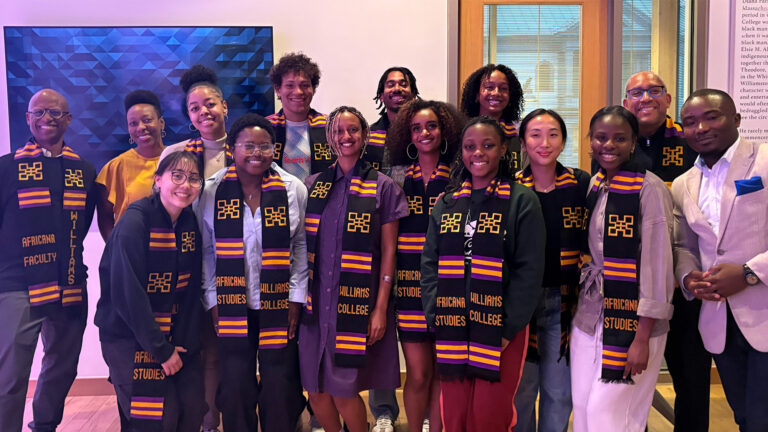
Curriculum & Required Courses
Find the right course for you, whether you’re interested in Black leaders in music and media, the democratic institutions of countries in Africa, or revolution and emancipation in the Caribbean Black Atlantic.