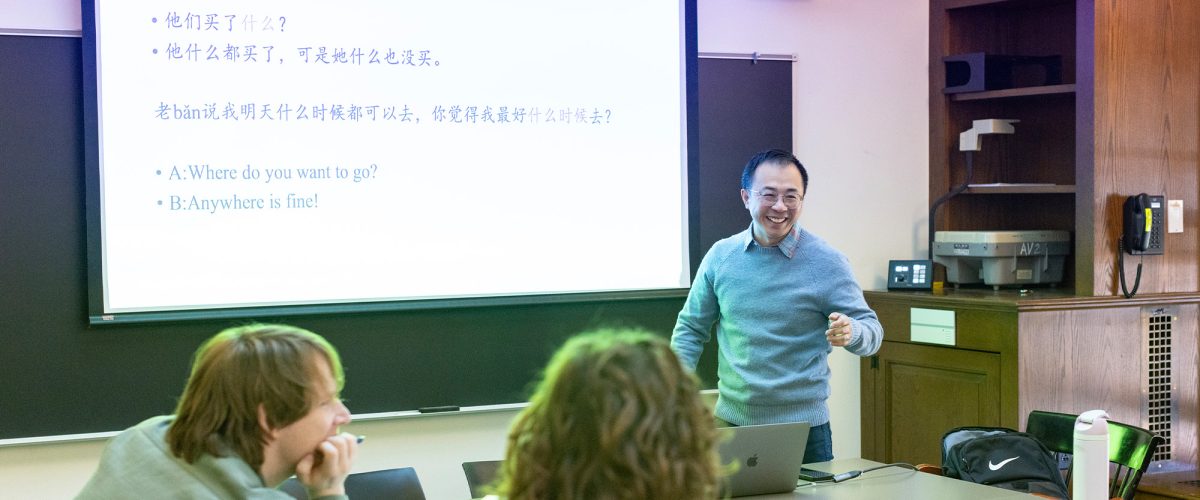
You can take courses that will teach you the Chinese or Japanese language and develop your speaking, listening, reading and writing skills. Courses on Chinese or Japanese literary, linguistic or cultural studies are also taught–either in English or in Chinese/Japanese. And you can enhance your study with a wide range of electives from the Asian Studies program.
East Asian Languages & Cultures Courses
Chinese Courses
CHIN 101 (F) LEC Basic Chinese
An introduction to Mandarin, the language with the largest number of native speakers in the world, which is the national language of China, the de facto official language of Taiwan, and one of the official languages of Singapore. Course objectives are for the student to develop simple, practical conversational skills and acquire basic proficiency in reading and writing at about the 200-character level. The relationship between language and culture and the sociolinguistically appropriate use of language will be stressed throughout. Both audio and video materials will be employed extensively. CHIN 101 and CHIN 102 constitute an integral, indivisible year-long course. Students who register for a year-long course are required to complete both semesters of that course within the same academic year. Students who fail to take and pass the second half of a year-long course will incur a course deficiency.
Taught by: Cornelius Kubler | Catalog details
CHIN 102 (S) LEC Basic Chinese
An introduction to Mandarin, the language with the largest number of native speakers in the world, which is the national language of China, one of the de facto official languages of Taiwan, and one of the official languages of Singapore. Course objectives are for the student to develop simple, practical conversational skills and acquire basic proficiency in reading and writing at about the 500-character level. The relationship between language and culture and the sociolinguistically appropriate use of language will be stressed throughout. Both audio and video materials will be employed extensively. Traditional characters will be introduced. CHIN 101 and CHIN 102 constitute an integral, indivisible year-long course. Students who register for a year-long course are required to complete both semesters of that course within the same academic year. Students who fail to take and pass the second half of a year-long course will incur a course deficiency.
Taught by: Man He | Catalog details
CHIN 121 (F) SEM Songs of love: A bridging course for intermediate speakers of Chinese
Love is a universal human emotion. It is expressed in various ways across different cultures. This emotion can be projected toward one’s nation, family, partner, friends, or political/religious/popular idols. According to the Classic of Poetry (Shi Jing), the earliest collection of classical poems in ancient China, people resort to songs when they find speech to be inadequate of expressing emotions. Songs are therefore an important cultural medium to evoke and express the basic yet complex emotion of love. In this course, we will examine songs and lyrics that reflect changing ideas of love in contemporary China spanning from the 1950s to the present day. Students will be able to 1) analyze how love is expressed in Chinese culture and investigate the historical and social backgrounds of many popular songs; 2) learn to read, interpret, and analyze Chinese lyrics and hand-write basic characters from these lyrics; 3) connect with and build (or strengthen) emotional bonds with the Chinese speaking community on campus and beyond, through a final project about Chinese songs. The course begins with an introduction of the fundamentals of Chinese characters and a discussion about the most effective ways to acquire Chinese literacy skills. Then we will delve into the world of Chinese songs. This course is designed for students who have achieved the intermediate level in spoken Chinese (according to the ACTFL Proficiency Guidelines) but may not have the corresponding Chinese reading and writing skills. The course aims to improve students’ proficiency in written Chinese and provide a bridging experience for them to subsequently take core Chinese language courses at the college level. After successfully completing this course, students will be able to take CHIN 102, 202, or 302 during the spring semester, depending on their spoken proficiency and literacy skills. Recognizing students’ varied prior learning backgrounds in Chinese and their individual linguistic gains, an individualized, formative approach will be adopted to assess each learner’s progress throughout the course. Course conducted in Mandarin. Primary readings (song lyrics) are in Chinese, with background readings in English.
Taught by: Li Yu | Catalog details
CHIN 131 SEM Basic Cantonese
Last offered Spring 2024
An introduction to Standard Cantonese, a major regional language of southern China which is spoken by over 70 million people in Hong Kong, Macao, Guangdong, and Guangxi as well as by many overseas Chinese in Southeast Asia, Hawaii, and North America. Due to the pervasive influence of Hong Kong as well as the economic transformation of Guangdong Province, the prestige of Cantonese within greater China rose steadily in the period 1980-2010 and it continues to be an important language today. Our focus in this course will be on developing basic listening and speaking skills, though some attention will also be paid to written Cantonese, including the special characters which have been used for centuries to write colloquial Cantonese, which have become even more widely used in Hong Kong since 1997. Since students will ordinarily possess prior proficiency in Mandarin, a rather closely related language, they should be able to attain in one semester approximately the same proficiency level that is attained in the first two semesters of Mandarin.
Taught by: Cornelius Kubler | Catalog details
CHIN 134 TUT Leaving the World Behind: The Literature of Reclusion
Last offered Spring 2020
Living in a time of political and social turmoil, Confucius told his followers: “When the realm has the Way, show yourself; when it lacks the way, hide.” Reclusion here is a moral choice, justified by the ethical decline of the state. But it could also be a mortal necessity in a period in which government service was a distinctly hazardous pursuit. In other contexts becoming a hermit could instead be figured as aesthetic stance meant to preserve one’s artistic integrity against the dominant claims of society. This course looks at the literature of reclusion-living a life of seclusion from society-in a range of different cultures and periods, from ancient China to contemporary America. With sources that include poems, essays, novels, and films, we will investigate a set of issues surrounding radical seclusion. What different forms does reclusion take? Can one be a hermit without being completely separated from society? What is the relationship between hermits and the state-to what extent does one depend on the other? What are the philosophical and moral implications of eremitism? Is separating oneself from human society an inherently immoral act? What is the relationship between reclusion and technology in the contemporary world? What is the nature of solitude and can it be experienced in a group (for example, in contemporary “intentional communities”)? While most of our work will focus on textual analysis, there will be an experiential component to the course as well. Each student will design and implement their own experiment in (short-term) eremitism.
Taught by: Christopher M. B. Nugent | Catalog details
CHIN 140 LEC Introduction to Traditional Chinese Literature
Last offered Fall 2017
With a written record stretching over 3000 years, China’s literary cultures are some of the richest and most varied in human history. Their influence continues to be felt not only in modern China, but also throughout much of the world. This course examines the origins and development of the different literatures of China from their earliest stages up until the end of the imperial system in 1911. We will read texts ranging from the Analects of Confucius to the medieval poetry of the Tang dynasty, from Buddhist sutras to plays about prostitutes and singing girls. An invulnerable monkey god may make an appearance to sow chaos as well. He’s difficult to pin down. Some important themes will include: the role of the individual versus that of the community, responses to catastrophe and disorder, the fantastic, the articulation of the self through literature, and ways of dealing with historical and literary legacies. All readings are in English translation.
Taught by: Christopher M. B. Nugent | Catalog details
CHIN 152 (S) SEM Basic Taiwanese/Southern Min
This course constitutes an introduction to Taiwanese, the traditional majority language of Taiwan, which is closely related to the native language of Xiamen, China and environs. Different varieties of this language, which is also known as Southern Min, Southern Fukienese, Amoy, Hokkien, Hoklo, and Holo, are spoken by about 50 million people in Taiwan, southern Fujian, the Philippines, Indonesia, Malaysia, and Singapore. Suppressed in Taiwan by the Japanese from 1895-1945 and by the KMT Chinese government from 1945 through the 1970s, Taiwanese–in both its spoken and written forms–has been experiencing a fascinating revival in recent decades. The most divergent of all the Sinitic languages, this language is of special linguistic interest because it has preserved a number of features of Old Chinese. Our focus will be on developing basic listening and speaking skills, though we will also study some of the special characters used to write Taiwanese. The relationship between language and culture and the sociolinguistically appropriate use of language will be stressed throughout. Since students in the course will ordinarily possess prior proficiency in Mandarin, a related language, we should be able to cover in one semester about as much as is covered in the first two semesters of Mandarin. Classes will include dialog performance, drills, communicative exercises, and oral reading and discussion of written Taiwanese.
Taught by: Cornelius Kubler | Catalog details
CHIN 162 (S) SEM Languages of East Asia
A survey of the Chinese, Japanese, and Korean languages in their linguistic and cultural context. Working with various types of multimedia including audio, video, and texts, we’ll take up the phonetics, phonology, morphology, syntax, and lexicon of these three major East Asian languages, including also their history and writing systems as well as how they function in the societies where they are spoken. Though the emphasis of the course is on linguistic description and analysis, there will also be an applied component, as part of which we’ll learn several dozen common expressions in each language. Some of the questions to be discussed are: What are the similarities and differences among these three languages? How are and how aren’t they related? How did the modern standard form of each develop and what is its relationship to any non-standard languages or dialects? How do these three languages reflect sociolinguistic phenomena such as gender, class, and politeness? How do the writing systems of these languages function and what is the role of Chinese characters in them? What has been the influence of Classical Chinese on Modern Chinese, Japanese, and Korean? How have these languages changed due to influence from English and other languages? How are they used in Asian American speech communities? And what are the prospects for their future development, including the influence of computers and digital communications? While this course is not intended as a comprehensive introduction to linguistics, it does introduce many basic terms and concepts from that discipline.
Taught by: Cornelius Kubler | Catalog details
CHIN 200 LEC Accelerated Chinese on Special Topics for Heritage Speakers
Last offered Fall 2025
This course is tailor designed for students who already possess intermediate-level proficiency in speaking Chinese but lack the basic reading and writing skills, commonly referred to as heritage speakers of Chinese. They will make accelerated progress in their literacy skills through this course and be able to take either CHIN 202 or CHIN 302 in the spring semester. Adopting a semi-tutorial format (a mix of group classes and two/three-people classes) , this course aims to provide differentiated instruction to heritage learners of varying proficiency levels whose Chinese speaking and listening abilities exceed their reading and writing skills. This tailored course will help students effectively expand their literacy skills while helping to solidify the linguistic foundation for continuous proficiency advancement. The main theme of the course is focused on the experiences of Chinese Americans in a global context. Students will gain a deeper understanding of Chinese culture by way of individual projects that are meaningful and relevant to their intellectual interests. Students who are placed into CHIN 102 or 202 at the beginning of the fall semester should consider taking this course in the fall.
Taught by: Xiaoyu Liu | Catalog details
CHIN 201 (F) LEC Intermediate Chinese I
Intermediate Chinese I and II are designed to consolidate the foundations built in Basic Chinese and continue developing students’ skills in aural comprehension, speaking, reading, writing, and intercultural communication. Upon completion of the courses, students should be able to speak Chinese with fluency on everyday topics, reach a literacy level of 1000 characters (approximately 1200 common words written in both traditional and simplified characters), read materials written in simple standard written Chinese, and produce both orally and in writing short compositions on everyday topics. Traditional characters will be introduced. Conducted in Mandarin.
Taught by: Li Yu | Catalog details
CHIN 202 (S) LEC Intermediate Chinese II
Intermediate Chinese I & II are designed to consolidate the foundations built in Basic Chinese and continue developing students’ skills in aural comprehension, speaking, reading, writing, and intercultural communication. Upon completion of the courses, students should be able to speak Chinese with fluency on everyday topics, reach a literacy level of 1000 characters (approximately 1200 common words written in both traditional and simplified characters), read materials written in simple standard written Chinese, and produce both orally and in writing short compositions on everyday topics. Students will continue to improve reading proficiency in both simplified and traditional characters. Conducted in Mandarin.
Taught by: Li Yu | Catalog details
CHIN 214 LEC Foundations of China
Last offered Fall 2021
This course examines the foundational period of Chinese civilization, from the earliest evidence of human activity in the geographical region we now call China, through the end of the Han dynasty in the early third-century CE. This is the period that saw the creation and spread of the Chinese script (a writing system that would be the dominant one in East Asia for thousands of years), the teachings of Confucius (whose ideas continue to play a role in the lives of billions of people today), the construction of the Great Wall (which is not, as it turns out, visible from space), and the creation of the imperial bureaucratic system (that was, in essence, the progenitor of the modern bureaucratic state). We will proceed chronologically but focus on a set of thematic topics, including language and writing, religion and philosophy, art and architecture, politics and economics, and science and technology. While this course is entitled “Foundations of China,” we will take a critical perspective on narratives, both Chinese and Western, that see Chinese history as an unbroken history of a single “civilization.”
Taught by: Christopher M. B. Nugent | Catalog details
CHIN 215 SEM Foundations of Confucian Thought
Last offered Spring 2024
How should people treat each other? What constitutes human nature and does it tend towards good or evil? How should we organize society, by focusing on laws and regulations, or on ritual and moral guidance? What is the nature of moral rulership? What is the proper relationship between the individual and larger units of society, from the family to the state? These are some of the key questions that the school of thought that has come to be known as “Confucianism” addresses. As the dominant moral and political philosophy for thousands of years in much of East Asia, Confucianism has shaped our world, past and present, in innumerable ways. In this class we will focus on the foundational texts of the Confucian tradition: the Analects (purported to record the words of Confucius himself), Mengzi (often romanized as “Mencius”), and Xunzi. Beyond those questions noted above, we will further examine how these texts construct their arguments; how they were first composed, compiled, and circulated; how they employ such key concepts as “humaneness” (ren), “moral power” (de), and “ritual propriety” (li); and how they functioned as part of the larger philosophical, linguistic, political, and historical context that we now think of as “early China.”
Taught by: Christopher M. B. Nugent | Catalog details
CHIN 217 SEM The Literature of Early China
Last offered Spring 2025
From poems on forbidden trysts and tales of bloody battles to aphorisms about filial piety and essays on moral governance, the literature of early China spans a wide range of topics and genres. In this course we will read, discuss, and write about literary works from the period stretching from approximately 600 BCE to the end of the Han empire in the third century CE, including poems, narratives, and philosophical works. All readings will be in English.
Taught by: Christopher M. B. Nugent | Catalog details
CHIN 223 SEM Ethnic Minorities in China: Past and Present
Last offered Spring 2021
According to the most recent census conducted in China in 2010, of the 1.3 billion population of China, more than 110 million (8.49%) were ethnic minorities (shaoshu minzu). Most of the minority groups reside in autonomous regions and districts, which constitute 64% of China’s total acreage. This course introduces students to the multiethnic aspect of China’s past and present. We will ask the central question of “what is minzu” and address various topics such as the minority-group identification project; the definition of minzu (translated as “ethnic group,” “nationality,” or “race” by different scholars); the intersections between language, religion, tourism, diaspora and ethnicity; historical sino-centric views about “foreigners” and “barbarians” as well as the roles that “barbarians” have played in China’s long history. We will examine how social differences and hierarchy are constructed and discuss how power plays in the shaping of “ethnicity.” A multidisciplinary approach will be adopted for the course, taking in sources from anthropology, history, literature, ethnic studies, and cultural studies. Throughout the course, the pedagogical techniques of “intercultural dialogue” will be adopted to encourage students to discuss their own ethnic experiences and compare ethnic minority issues in China with similar issues in the United States. Students are also encouraged to come up with real-world solutions and strategies to deal with issues of racism, bias, and discrimination.
Taught by: Li Yu | Catalog details
CHIN 226 SEM Chinese Film and Its Significant Others
Last offered Spring 2026
From the first “wows” that the short films invoked at a Shanghai teahouse in 1896, Chinese films have made successive wonders that straddle reality and fantasy, technological modernity and shadow-making craft, aesthetic experiments and monetary yearnings, global investments and local interest. This seminar will explore the evolving relationships between Chinese films and five “significant others” that are central to film and film-making. Roughly following a chronological order, this course will examine 1) the effect of new technological developments (such as photography, sound, color, special FX) on film; 2) the tension between film and traditional modes of public entertainment (such as operas and shadow plays); 3) film’s social role to affirm and contest gender, national, and class identities; 4) the need to garner differing sources of financial support (state funding, cultural entrepreneurs, and transnational capital); and 5) the circulation of Chinese films in the global market. Class materials include various genre films (melodrama, horror, martial arts, comedy, etc.), directors’ notes, contemporary reviews, and scholarship in China and media studies. All materials and discussions are in English.
Taught by: Man He | Catalog details
CHIN 229 TUT Together Apart: Chinese Practices of Reclusion in Comparative Perspective
Last offered Spring 2026
“Neighbors will come from time to time / we’ll have spirited talks of days gone by // In rare writings we’ll find a shared delight / between us we’ll work out problems of meaning.” So wrote the poet Tao Yuanming (365-427 CE) of the life he imagined he would live after quitting his job as a low-level functionary in the state bureaucracy. Though he is categorized as a “recluse,” Tao Yuanming’s vision of reclusion was rarely solitary: he longed for a life apart from elite society but together with simple folk. Indeed, the discourse of reclusion in traditional Chinese society was often one of separation from some other people, but not from all other people. It emphasized time spent with like-minded companions, creating a space in which to think deeply about society’s problems, and also to drink lots of ale and write poems. This tutorial takes this mode of reclusion in China as a foundation from which to examine similar practices in other traditions up to the present day. We will read carefully and take notes with pen and paper. We will focus on conversation and on, together, building arguments and understanding.
Taught by: Christopher M. B. Nugent | Catalog details
CHIN 230 (S) SEM This is the Way: Early Daoist Texts
“Zhuang Zhou once dreamt he was a butterfly, a butterfly full of delight and sure that this suited him. He had no sense that he was Zhou. After a moment he awoke and suddenly was Zhou again. But he didn’t know if he was really Zhou who had just dreamt he was a butterfly, or was a butterfly now dreaming he was Zhou.” In this class we will read, ponder, discuss, and write about some of the most important early Daoist texts, including Zhuangzi, Daode jing, and Liezi. We will consider the nature of the Dao, the transformations of things, the limits of language and knowledge, the use of uselessness, and how ruling the empire is like roasting a small fish. All readings will be in English translation.
Taught by: Christopher M. B. Nugent | Catalog details
CHIN 253 SEM “Illness” in Modern and Contemporary Chinese Literature and Culture
Last offered Spring 2022
From early modern anxieties about China’s status as the “sick man of Asia” to contemporary concerns regarding the prospect of transnational pandemics, “illnesses” and their related stories have played a critical role in making and contesting individual psychologies and Chinese modernity in the 20th and 21st centuries. Actual illnesses, from tuberculosis to AIDS to the Novel Coronavirus, constitute not only social realities that trouble political and popular minds in their own right; but further provide powerful metaphors for exploring issues of human rights, national identity, and transnational circulation. This course examines how Chinese literature in the 20th and 21st centuries writes and visualizes “illness”–a universal human experience that is nevertheless heavily bounded by culture and history. Specifically, we examine the cultural and social meaning of “illness”; the relationship between illness on the one hand, and the politics of body, gender, and class on the other; we ask how infectious disease, and mental illness are defined, represented, and understood in both male and female writers’ analytical essays and fictional writings in the 20th century; we examine how metaphorical “illness” such as infectious cannibalism and fin-de-siècle “viruses,” are imagined and interpreted by key culture figures ranging from the founding father of modern literature (Lu Xun), to the winner of the 2012 Nobel Prize in Literature (Mo Yan). Throughout the course, we will focus on the interplay between literature canons (fictions, essays, and dramas) and popular media and genres: blockbuster cinemas and art house films, popular novels, photographs and posters, etc.
Taught by: Man He | Catalog details
CHIN 267 (F) SEM Universal Themes, Local Worlds: Identity, Aesthetics, and Transnational Form in Global Chinese Lit.
Unlike many traditions of English-language literature, the emergence of global Chinese literatures may be less a product of direct colonialism–though not disconnected from it–than of migration, war, exile, transcultural inheritance, and shifting geopolitical landscapes. This course explores global Chinese-language literatures through a two-fold approach. First, it focuses on a critical question in the study of Chinese-language literatures worldwide: how to identify and theorize literary and cultural productions outside the geopolitical boundary of China. Some of the questions with which this course engages include: “What is Chinese identity?” “How is China/Chinese perceived in different Chinese-speaking communities?” and “How do we identify Chineseness in varying contexts?” Second, the course examines how universal human themes–such as love, friendship, coming-of-age, faith, justice, power, pain and death–are represented across these literatures and localized or “glocalized” in their distinctive historical and political contexts. Taking a comparative approach, we will read Chinese-language literary works created in mainland China, Taiwan, Hong Kong, Singapore, Malaysia, and the United States, among other places, focusing on key historical moments in the last few decades. The readings will be paired with critical essays to help us gain a theoretical understanding of the scholarship. Throughout the semester, students should aim to 1) expand perspectives on the study of Chinese-language literatures and cultures; 2) develop critical thinking skills to understand how Chinese and Chineseness travel and translate among peoples, regions, nations, and cultures. All readings and discussion will be in English; no prior knowledge of Chinese being required. The readings are available in their original Chinese for those who are interested.
Taught by: Chen Wang | Catalog details
CHIN 272 LEC The History and Mythology of Chinese Scripts
Last offered Spring 2020
Written scripts using what are most often called “Chinese characters” have an attested history of over 3000 years and have been used all over the world to represent a range of different languages. In this course we will examine the history and development of Chinese characters from their earliest extant examples on sacrificial animal bones to their often amusingly misguided use for contemporary tattoos. We will look at historical evidence and mythology, carefully constructed grammatological studies and wild orientalist imaginings. Some topics will include: comparisons between the development of Chinese characters and other written scripts, the relationship between Chinese characters and the languages of China, the use of Chinese characters to write non-Chinese languages, Chinese characters in art and calligraphy, theories of connections between Chinese characters and Chinese philosophy and literature, issues of education and literacy, and the future of Chinese characters in the digital age.
Taught by: Christopher M. B. Nugent | Catalog details
CHIN 275 SEM Acting Out: Performativity, Production, and Politics in East Asian Theatres
Last offered Spring 2025
“Asian Theaters,” for those in the West, can conjure up a variety of exotic impressions: spectacle and cacophony, mysterious masks and acrobatic bodies, exquisite styles and strangely confusing conventions. Although Asian theaters have been studied systematically in the West for at least a century, the West has never truly left its “othering” look at them. Yet, what is “different” for the West is bedrock for Asian cultures. Theatre, one of the most important and dynamic forms of cultural production and communication, has actively involved all strata of Asian societies for a millennium. How to explain theatre’s continued presence and relevance for Asian nations? What do the traditions of Kun, Kabuki, and P’ansori reveal about the cultures and communities in which they were created? This course seeks to understand from the Asian perspective, rather than “exoticize” and “other,” musical and dance theatres from China, Japan, and Korea. Examining the evolving presentations of signature dramas dating from the sixteenth to the eighteenth centuries, we will act out Asian theatres in the following ways: (1) by reading the original plays in translation in tandem with their contemporary and intercultural reproductions, we will explore how Asian theatres fare in the era of globalization within and beyond national borders; (2) by revealing the “technologies” of writing, reading, acting, and staging these plays in different cultural milieus, we will consider what kinds of language and rhetoric, forms of music and movement, as well as visual components are deployed to convey evolving messages; (3) by considering key performances held outside of the proscenium stage, we will gain exposure to alternative theatrical spaces in Asian and diasporic communities that reform performing conventions, reconfigure staging environments, and renegotiate cultural values. In this manner, we will together gain an appreciation for the aesthetic devices, thematic concerns, and production politics of East Asian theatres and their global reproductions. Class materials include drama, production videos, and invited zoom sessions with Asian theatre practitioners and directors who live in the U.S. and other diasporic communities. All materials are in English. No language prerequisite. Funded by the Global Initiatives Venture Fund, this course includes an all-expense-paid travel component, a cultural and academic exchange project titled “Redefining Amateurism: Experientail Learning with Student Theatre in Contemporary China,” which will bring up to eight Williams students to Nanjing, China during the Spring Break (3/23-4/3/2025). Students will participate in workshops with playwrights and theater-makers in contemporary China and engage in black-box theater productions with students from Nanjing University and Shanghai Theatre Academy. This travel component is OPTIONAL for students taking this course. However, students enrolled in this class will receive priority consideration to be included in the free travel project. Selection criteria include active participation, excellent performance in the course, etc.
Taught by: Man He | Catalog details
CHIN 301 (F) CON Upper-Intermediate Chinese I
The goal of this course is to continue developing students’ overall language proficiency. However, special emphasis will be on strengthening students’ reading and writing proficiency in standard written Chinese, the grammar and vocabulary of which differ considerably from colloquial Chinese introduced during the first two years of instruction. Students will continue to improve reading proficiency in both simplified and traditional characters. Conducted in Mandarin.
Taught by: Man He | Catalog details
CHIN 302 (S) CON Upper-Intermediate Chinese
The goal of this course is to continue developing students’ overall language proficiency. However, special emphasis will be placed on strengthening students’ reading and writing proficiency in standard written Chinese, the grammar and vocabulary of which differ considerably from colloquial Chinese introduced during the first two years of instruction. Students will continue to improve their reading proficiency in both simplified and traditional characters. Conducted in Mandarin.
Taught by: Chen Wang | Catalog details
CHIN 312 (F) SEM Introduction to Classical Chinese
This course is an introduction to the grammar and basic vocabulary of Classical Chinese, the standard written language of China from around the seventh century BCE through the 1920s (and for many centuries an important written language in Japan, Korea, and Vietnam as well). Aspects of Classical Chinese continue to play a role in both written (e.g., in newspaper, academic, and legal writing) and in spoken (e.g., proverbs and aphorisms) modern Chinese. Our work in this course will be based on reading, translating, and discussing philosophical, political, literary, and historical anecdotes from the Spring and Autumn (770-481 BCE) through the Han (206 BCE-220 CE) periods, as they served as the foundation for the language. We will conduct discussions of grammatical and philological issues primarily in English and most of our translation work will be from Classical Chinese into English. We will, however, frequently discuss the points of intersection between Classical and Modern Chinese. Students are required to have completed CHIN 202 or the equivalent. Students who have extensive reading knowledge of Chinese characters through other languages (such as Japanese) may also take this course with the instructor’s permission.
Taught by: Christopher M. B. Nugent | Catalog details
CHIN 401 (F) CON Advanced Chinese I
This course is designed to enhance the Chinese language proficiency of students at the advanced level. A wide assortment of materials about Chinese culture and society is used to help learners develop advanced skills to use formal written Chinese (shumianyu) in spoken and written registers. Students will continue to improve reading proficiency in both simplified and traditional characters. Conducted in Mandarin.
Taught by: Chen Wang | Catalog details
CHIN 402 (S) CON Advanced Chinese II
This course is designed to enhance the Chinese language proficiency of students at the advanced level. A wide assortment of materials about Chinese culture and society is used to help learners develop advanced skills to use formal written Chinese (shumianyu) in spoken and written registers. Students will continue to improve reading proficiency in both simplified and traditional characters. Conducted in Mandarin.
Taught by: Chen Wang | Catalog details
CHIN 413 SEM Intermediate Classical Chinese: Ideas of Authority in Classical Chinese Literature
Last offered Spring 2026
This course builds on the foundation established in Introduction to Classical Chinese (CHIN 312) to introduce students to a much broader range of Classical Chinese texts and genres. The works we will read include philosophical, political, and historical texts that express evolving ideas of authority in the Chinese tradition. While our focus will be on careful linguistic analysis and translation, we will also discuss these texts in terms of their philosophical ideas, rhetorical methods, and cultural and historical contexts. The works we will read include the Confucian Analects, Mencius, Zhuangzi, and Shiji. All primary readings will be in Classical Chinese. Translation will be primarily into English and classroom discussion will be in English. While this course is a continuation of Chinese 312, students with prior work in Classical Chinese (through study abroad, attending high school in a Chinese-speaking region, etc.) are welcome as well.
Taught by: Christopher M. B. Nugent | Catalog details
CHIN 421 SEM Chinese Societies through the lens of COVID-19
Last offered Fall 2024
The COVID-19 pandemic has profoundly changed the world. How did the Chinese-speaking regions in Asia, including Mainland China, Taiwan, and Singapore, respond to the pandemic during its earlier years? How did their responses reflect the political and economic systems as well as the cultural values of Asian societies? What were the effects of these responses on the regions and people’s daily lives? In this course, students will gain a deeper understanding of Chinese-speaking societies through an analysis of the “public” and “private” literature pertaining to the lived experiences of the COVID-19 pandemic. Through readings and discussions of various materials such as government records, scientific publications, journalistic writings, personal diaries, and online narratives, students will explore a wide range of issues related to the politics, economy, public health, and sociocultural issues of Asian societies. Simultaneously, Chinese language learners will further enhance their language proficiency and intercultural competency by engaging in complex discourse in the target language. All readings and discussions are in Chinese.
Taught by: Xiaoming Hou | Catalog details
CHIN 422 (S) TUT Old Shanghai, New Shanghai
Once nicknamed as “Paris of the East,” Shanghai, now a megacity with a population of 25 million, is the industrial, commercial and financial center of contemporary China. Shanghai is often depicted as a metropolis that marked the beginning of China’s modernity and urban culture. People from other regions in China see Shanghai as a city full of opportunities, but characterize its people as astute and shrewd, cocky and unwelcoming. Foreigners, however, find the city appealing and its people open-minded. Jews fleeing Nazi persecutions during WWII, found Shanghai to be a “paradise of ghetto” that provided the only haven of survival. For local people, there have always been two Shanghai: an old one and a new one. They are proud of the new Shanghai but constantly nostalgic about the old one. This tutorial examines the multifaceted city of Shanghai and its people from historical and cultural perspectives. We will look at the city’s history (from the late nineteenth century to present day), its local language and culture, and everyday life of the people (including migrants and foreigners) living in it. The central ideas we will explore are “modernity” and “regional identity.” We will investigate how these theoretical constructs play out in the making of the city of Shanghai and the formation of its unique local identity. Course readings include historical and cultural studies as well as documentaries in English about Shanghai, and primary sources in Chinese in a wide range of genres including fiction, essays, and films (English translation of the primary sources are available for students taking the course in English). The course is conducted in either Chinese or English. Students wishing to take the course in English should register under ASST 122T or GBST 122T and students wishing to take the course in Chinese should register under CHIN 422T. Students will come away with a critical understanding about China’s regional cultures and one of its most important metropolitan cities. Chinese language learners will be able to improve their reading and writing skills in Chinese through this course. The course has a required field trip to a Chinese restaurant on a Saturday or Sunday, depending on all students’ schedules.
Taught by: Li Yu | Catalog details
CHIN 426 SEM Home: Leave & Return in Chinese-Speaking Societies
Last offered Fall 2025
What does “home” mean for those who have never left and for others who have never returned? How is “home” remembered and dismembered by sounds and sights? How is “home” built and rebuilt by roots and words? Ultimately, how do people leave and return “home” while searching for genuine human connections? In this course, we will delve into “home” as both a literary motif and a social infrastructure, drawing insights from a corpus of works produced in various Chinese-speaking societies and Chinese diasporic communities in the twenty-first century. Course materials include autobiographies and memoirs, travelogs and literary reportage, short stories and one-act plays, as well as academic discourse. Through group discussions and individual projects, students will develop specialized vocabulary, enhance their narrative capacities, and engage in intellectual conversations in Mandarin related to these themes. Conducted in a semi-tutorial format, this course aims to cultivate linguistic proficiency ranging from Advanced Low to Advanced Mid as outlined by the ACTFL proficiency guidelines. To enrich the learning experience, language partnerships will be forged in collaboration with graduate programs in Chinese pedagogy based in different Chinese-speaking societies, offering deeper engagement with course materials.
Taught by: Man He | Catalog details
CHIN 427 TUT Spring Grass: A Peek into Inequality in China
Last offered Fall 2023
Spring Grass (Chuncao) is a Chinese novel written by award-winning author Qiu Shanshan (1958-). Using the literary techniques of social realism, the novel chronicles the life of a young rural woman from 1961 to 2001. Spring Grass, the protagonist of the novel, was born in a rural village to a mother who preferred sons over daughters. At a young age, Spring Grass was deprived of the opportunity to attend school. Against all odds, she managed to marry for love, venture into the city, and become an enterprising migrant worker. This novel not only reflects the struggles of women in contemporary China but also captures the economic transformation of modern China since 1978 when the Reform and Open-Door Policy (gaige kaifang) was initiated. The novel was adapted into a television drama series and became an instant hit in 2008. This course takes an interdisciplinary, cultural studies and humanistic approach to studying a literary text, using literature as a means to help students better understand social and cultural issues. Through close readings of the novel, the eponymous TV drama series, documentaries, and films depicting rural life and women’s roles in China, as well as in-depth discussions of both primary and secondary sources that deal with the cultural, historical, and socioeconomic background of the unfolding story of Spring Grass, this course aims to provide a window for students to examine the issues of inequality in the Chinese village and society at large. Why would mothers be harsh to their own daughters and bar girls’ right to education? Why would young people leave their village and migrate to the city? Why would migrant workers leave their children behind in the village? Why would economic developments in China exacerbate the problem of gender inequality in society? Why would the ideology and cultural logic behind Mao Zedong’s proclamation “women can hold up half of the sky” add more burden to women rather than truly liberate them? Why would city people discriminate against country folks? After taking this course, students will gain a deeper understanding of the issues related to gender inequality (nannü bu pingdeng) and the urban/rural-gap (chengxiang chabie) in China. Throughout the course, they are also encouraged to critically think about how to achieve equity in different societies. This tutorial is conducted in either Chinese or English. Students wishing to take the course in English should register under ASST or WGSS and language learners wishing to take the course in Chinese should register under CHIN.
Taught by: Li Yu | Catalog details
CHIN 428 TUT Present Pasts: The Politics of Memory in Contemporary Chinese Literatures and Films
Last offered Spring 2023
What happens when memories, already slippery, are further massaged by literary and cinematic narrative strategies? How is the historical “pasts” remembered, forgotten, and subverted in a literary “presence”? This tutorial explores the politics of memory in contemporary literatures and films from the People’s Republic of China (post-socialist era, 1978), Taiwan (post-martial law, 1987), and Hong Kong (postcolonial era, 1997). We will look at how literary and cinematic works in each of these “post” societies represent state-sponsored narratives of remembrance, dissidents’ collective amnesia, and at the popular level, a playful yet cynical flirtation with politics. With close- and distant- readings of textualized and visualized memories, we will examine themes of nation and locality, public and private, mesology and mythology, amnesia and nostalgia, and diaspora and settlement in the PRC, Taiwan, and Hong Kong from the late 1980s until to today. Course readings include “root-seeking”, “new realist”, “avant-garde” and “hooligan” novels, examples from the Taiwanese small theater movement, and the transnational cinemas made by the fifth, sixth, and second new wave filmmakers from these three “post” societies. This tutorial is conducted in either Chinese or English. Students wishing to take the course in English should register under ASST or COMP and language learners wishing to take the course in Chinese should register under CHIN.
Taught by: Man He | Catalog details
CHIN 431 LEC Introduction to Chinese Linguistics
Last offered Spring 2017
Is Chinese–whose nouns “lack” number and whose verbs have no tense–a monosyllabic, “primitive” language? Are the Chinese characters a system of logical symbols or “ideographs,” which indicate meaning directly without regard to sound? Could (and should) the characters be done away with and alphabetized? Are Cantonese, Hakka, and Taiwanese dialects or languages? And what is the relationship between Chinese, Japanese, Korean, and Vietnamese? These are some of the questions we will be taking up in this one-semester introduction to the scientific study of the Chinese language. Topics to be covered include: the phonological, syntactical, and lexical structure of Modern Standard Chinese; the Chinese writing system; the modern Chinese dialects; the history of the Chinese language; sociolinguistic aspects of Chinese; and language and politics in various Chinese-speaking societies. Readings in English and Chinese, with class discussion in Mandarin
Taught by: Cornelius Kubler | Catalog details
CHIN 493 (F) HON Senior Thesis: Chinese
Chinese senior thesis; this is part of a full-year thesis (493-494).
Taught by: Man He | Catalog details
CHIN 494 (S) HON Senior Thesis: Chinese
Chinese senior thesis; this is part of a full-year thesis (493-494).
Taught by: Man He | Catalog details
CHIN 497 (F) IND Independent Study: Chinese
For students who have completed Chinese 402 and Chinese 412 or equivalent. Interested students must contact the Coordinator of the Chinese Program one semester in advance and present a proposal to the Coordinator or the professor with whom they wish to study during pre-registration week.
Taught by: Man He | Catalog details
CHIN 498 (S) IND Independent Study: Chinese
For students who have completed Chinese 402 and Chinese 412 or equivalent. Interested students must contact the Coordinator of the Chinese Program one semester in advance and present a proposal to the Coordinator or the professor with whom they wish to study during pre-registration week.
Taught by: Man He | Catalog details
Japanese Courses
JAPN 101 (F) CON Elementary Japanese
An introduction to modern spoken and written Japanese, the course aims to instill proficiency in Japanese by developing four necessary skills of speaking, listening, reading, and writing to successfully interact with native speakers. The relationship between language and culture and the sociolinguistically appropriate use of language will be stressed throughout. Audio, video and computer–assisted learning materials will be used extensively. Classes consist of a combination of “act” classes, conducted exclusively in Japanese, where students use the language in various types of drills and communicative activities, and “fact” classes, conducted in Japanese and English, where students learn about the language and culture. JAPN 101 and 102 constitute an integral, indivisible year-long course. Students who register for a year-long course are required to complete both semesters of that course within the same academic year. Students who fail to take and pass the second half of a year-long course will incur a course deficiency.
Taught by: Shinko Kagaya | Catalog details
JAPN 102 (S) CON Elementary Japanese
An introduction to modern spoken and written Japanese, the course aims to instill proficiency in Japanese by developing four necessary skills of speaking, listening, reading, and writing to successfully interact with native speakers. The relationship between language and culture and the sociolinguistically appropriate use of language will be stressed throughout. Audio, video and computer–assisted learning materials will be used to facilitate learning. Classes consist of a combination of “act” classes, conducted exclusively in Japanese, where students use the language in various types of drills and communicative activities, and “fact” classes, conducted in Japanese and English, where students learn about the language and culture. JAPN 101 and 102 constitute an integral, indivisible year-long course. Students who register for a year-long course are required to complete both semesters of that course within the same academic year. Students who fail to take and pass the second half of a year-long course will incur a course deficiency.
Taught by: Shinko Kagaya | Catalog details
JAPN 131 SEM Introduction to Japanese Formal Linguistics
Last offered Fall 2024
This course provides a comprehensive introduction to the theoretical study of the Japanese language. We will delve into various aspects of linguistic theory, exploring speech sounds (phonetics and phonology), word formation (morphology), sentence structures (syntax), and meaning (semantics). Throughout, we will primarily juxtapose Japanese with English to deepen our understanding. By the end, we will not only grasp the fundamentals but also gain practical skills to delve into applied linguistics with confidence. This includes areas such as language acquisition, pragmatics, psycholinguistics, neurolinguistics, sociolinguistics, historical linguistics, language change, and cross-linguistic variation. While there is no prerequisite, having some proficiency in Japanese would enhance your experience.
Taught by: Masashi Harada | Catalog details
JAPN 201 (F) CON Intermediate Japanese
This course is a continuation of First-Year Japanese 101-102, further developing the four skills of speaking, listening, reading, and writing. The same general methodology will be used. Upon completing the course, students will have been introduced to most of the major structural patterns of contemporary Japanese and will be able to read simple expository prose.
Taught by: TBA | Catalog details
JAPN 202 (S) CON Intermediate Japanese
This course is a continuation of Japanese 201, further developing the four skills of speaking, listening, reading, and writing. The same general methodology will be used. Upon completing the course, students will have been introduced to most of the major structural patterns of contemporary Japanese and will be able to read simple expository prose.
Taught by: TBA | Catalog details
JAPN 223 SEM Japanese Food Culture in a Global Context
Last offered Spring 2026
The bourgeoning popularity of Japanese food on a global scale has resulted in a surge of new research, literature, and films. Conversely, the effects of globalization have transformed the dining experience within Japan to be ever more multiethnic. This interdisciplinary course explores the complex relationship between food and culture in Japan, and the emergence of Japanese cuisine as a global phenomenon, referring to a variety of materials and practices. Topics to be addressed include modernization, nation-building, militarization, globalization, the environment, and popular culture.
Taught by: Shinko Kagaya | Catalog details
JAPN 231 LEC The Sounds of Language: An Introduction to Phonetics and Phonology
Last offered Fall 2025
This course offers an in-depth exploration of the sound systems of human languages. Topics include the mechanics of sound transcription, production, and perception; sound symbolism–how and why different sounds evoke concepts such as strength and size; sound change rules (e.g., the “t” can sometimes sound like “l” as in “latter” but not always as in “attend”); and sound markedness–what types of sounds are common in human languages, acquired by children earlier, and lost earlier by people with language disorders. Throughout these topics, we will quantitatively measure sound features like frequency and duration, analyze sound data, and/or create formal rules based on data. We will use English and Japanese–two very distinct languages–as primary examples, exploring how languages with vastly different structures nonetheless conform to universal linguistic principles. No prior knowledge of Japanese is required, and JAPN/ASIA 131 is not a prerequisite. However, students who have taken JAPN/ASIA 131 are welcome and will find this course an excellent continuation of their linguistic studies.
Taught by: Masashi Harada | Catalog details
JAPN 274 TUT Confronting Japan
Last offered Fall 2017
This tutorial looks into confrontations, within Japan and across its borders, how such confrontations are perceived, handled and narrated, and what they tell us about Japanese society. Through literature and other media, we will probe domestic issues, such as gender/economic disparities, aging, minorities, suicide, reclusion and post 3-11 recovery, and international issues, related to Japan’s shifting roles within East Asia and beyond. Discussions will untangle the conflicting perspectives, and elaborate the thoughts and feelings of the various contestants. All readings and discussions will be in English. Some course materials will also be available in Japanese, for those interested.
Taught by: Shinko Kagaya | Catalog details
JAPN 276 LEC Premodern Japanese Literature and Performance
Last offered Spring 2017
Some of Japan’s performance traditions, which developed in different historical settings, have survived to this day and continue to coexist and compete for the attention of audiences both domestically and abroad. This course examines the Japanese literature of three major periods in Japan’s history, focusing on how literary and performance traditions have been interrelated in the unfolding of Japanese literary history. We will begin by looking into the Heian period (794-1185), when the work of female authors occupied center stage and some of the canonical texts of the Japanese literary and cultural tradition were born. Next we will consider the medieval period (1185-1600), which saw the rise of the samurai class and the consequent shift in the domain of artistic creation. Then we will look at the Edo period (1600-1867), when a new bourgeois culture flourished and audiences were greatly transformed. We will also explore the continuing force of premodern literary traditions in contemporary performing arts. All readings and discussions will be in English.
Taught by: TBA | Catalog details
JAPN 285 (F) SEM Boys’ Love and Pop Idols: Women, Gender, and Sexuality in Modern Japan, Korea, and Their Neighbors
How do Yuri!!! on Ice and BTS inform our understanding of women, gender, and sexuality in East Asia? For many viewers, these images participate in a familiar story in which East Asian gender and sexual norms appear hyper-modern and uniquely local. Yet what looks distinctive or exotic from afar is part of a long history of how women, gender, and sexuality have been produced, regulated, and imagined in these regions. This course examines these histories–focusing on Japan and Korea, and on neighboring regions including Okinawa and Taiwan–from the nineteenth century through the present, tracing major forces that have shaped contemporary gender and sexual formations in the region. Exploring how women, gender, and sexuality have evolved alongside transnational encounters over the past two hundred years, the course aims both to challenge the notion that East Asian gender and sexual formations are simply unique and indigenous and to rethink concepts that are often assumed to be grounded primarily in Western contexts. We will approach these questions by (1) reading academic and public articles to see how scholars and journalists study women, gender, and sexuality in the region and situate these topics within broader theoretical and public debates; (2) examining the sources they use in order to see how contemporary understandings are rooted in specific historical moments; and (3) analyzing contemporary sources ourselves to develop our own interpretations and reflect on how our perspectives are shaped by transnational flows of culture and knowledge. Class materials also include songs, images, and videos. All materials are in English. No language prerequisite.
Taught by: Aoi Saito | Catalog details
JAPN 301 (F) SEM Upper-Intermediate Japanese
This course is a continuation of Japanese 201 and 202. Students will further develop the four skills of speaking, listening, reading, and writing, while consolidating the foundations built in Elementary and Intermediate Japanese. The same general methodology will be used. In this course, students begin to emphasize vocabulary building through the study of situationally oriented materials stressing communicative competence. The reading of expository prose in both semi-authentic and authentic materials of intermediate difficulty will also receive some extensive attention.
Taught by: TBA | Catalog details
JAPN 302 (S) SEM Upper-Intermediate Japanese
This course is a continuation of Japanese 301. Students will further develop the four skills of speaking, listening, reading, and writing, while consolidating the foundations built in Elementary and Intermediate Japanese. In this course, students work on the reading skills for comprehending primary source materials and expository prose of intermediate difficulty; the communication skills for conducting practical conversations and presentations; and the listening skills for interpreting various types of information.
Taught by: TBA | Catalog details
JAPN 401 (F) SEM Advanced Japanese
This course is a continuation of Japanese 301 and 302. Students will develop the four skills of speaking, listening, reading, and writing in the discussion of social issues in contemporary Japan. Topics may vary according to the level of the students.
Taught by: Shinko Kagaya | Catalog details
JAPN 402 (S) SEM Advanced Japanese
A continuation of Japanese 401, developing speaking, listening, reading, and writing skills in the discussion of social issues in contemporary Japan. Topics may vary according to the level of the students.
Taught by: Shinko Kagaya | Catalog details
JAPN 493 (F) HON Senior Thesis: Japanese
Japanese senior thesis; this is part of a full-year thesis (493-494).
Taught by: Shinko Kagaya | Catalog details
JAPN 494 (S) HON Senior Thesis: Japanese
Japanese senior thesis; this is part of a full-year thesis (493-494).
Taught by: Shinko Kagaya | Catalog details
JAPN 497 (F) IND Independent Study: Japanese
Japanese independent study. For students who have completed Japanese 402 or the equivalent.
Taught by: Shinko Kagaya | Catalog details
JAPN 498 (S) IND Independent Study: Japanese
Japanese independent study. For students who have completed Japanese 402 or the equivalent.
Taught by: Shinko Kagaya | Catalog details
Curriculum & Required Courses
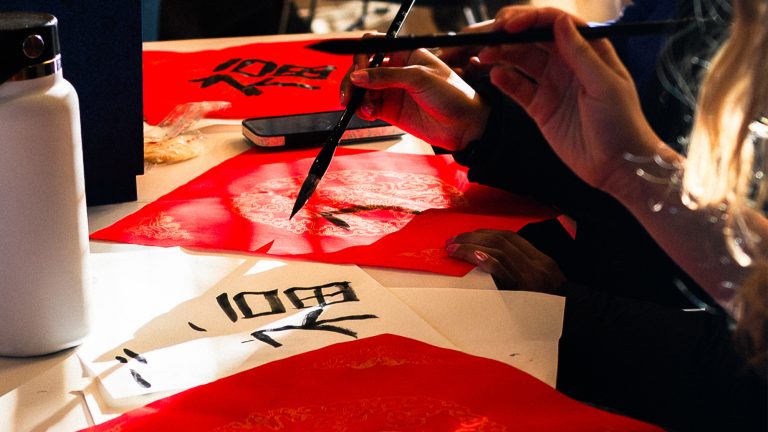
Find the right course for you, whether it’s an introductory level language course or one about art and culture.