<?xml version="1.0" encoding="ISO-8859-1"?>
<!-- generator="FeedCreator 1.7.2-ppt (info@mypapit.net)" -->
<rss version="0.91">
    <channel>
        <title>Williams College Press Releases</title>
        <description>Williams College Press Releases</description>
        <link>http://www.williams.edu/admin/news/releases/</link>
        <lastBuildDate>Sat, 21 Nov 2009 17:42:39 -0500</lastBuildDate>
        <generator>FeedCreator 1.7.2-ppt (info@mypapit.net)</generator>
        <item>
            <title>Nov. 20: Latin American Singer to Pay Tribute to Latino Heritage Month at Williams</title>
            <link>http://www.williams.edu/admin/news/releases/1886/</link>
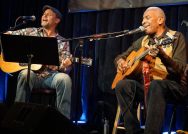
            <description><![CDATA[<p>WILLIAMSTOWN, Mass., November 17, 2009 -- Rebecca Salazar, <a href="/">Williams College</a> Class of 1989, will return to campus with guitarist Barry Kornhauser and Professor Freddie Bryant to perform a Mercedes Sosa Tribute Concert on Friday, Nov. 20, at 5:30 p.m. at the Williams College Museum of Art. It is free and open to the public.&nbsp; There will be a reception before the concert at 4:30 p.m.</p>
<p>This event is part of the Latin Heritage Month Celebration, and is sponsored by Vista, alumni relations, WCMA and the Multicultural Center. Salazar was co-founder of Vista at Williams.</p>
<p>Salazar graduated from Williams with a B.A. in political science, and received her master's degree in vocal performance from the Manhattan School of Music. At the Manhattan School of Music, Salazar studied European opera and classical music, but discovered her passion was for the folk and popular music traditions of Latin America.</p>
<p>She returns to Williams to pay tribute to the great Argentinean <em>cantante</em>, Mercedes Sosa, who died on October 4.</p>
<p>Bryant is the visiting lecturer in Africana Studies and music and studio instructor of intermediate and advanced jazz guitar at Williams. He received his M.A. in classical guitar at the Yale School of Music. He has toured as a cultural ambassador for the U.S. Department of State four times and recently performed at the Kennedy Center with the Billy Taylor Trio, as has performed with numerous well known national and international artists.</p>
<p>Kornhauser is a composer, arranger, teacher, and multi-instrumentalist (guitar, bass guitar and cello) in a wide variety of musical environments.</p>
<p>END</p>
<p>For building locations on the Williams campus, please consult the map outside the driveway entrance to the Security Office located in Hopkins Hall on Main Street (Rte. 2), next to the Thompson Memorial Chapel, or call the Office of Public Affairs (413) 597-4277. The map can also be found on the web at www.williams.edu/home/campusmap/</p>
<p>To visit the college on the Internet: http://www.williams.edu/ Williams College can also be found on Facebook: http://www.facebook.com/williamscollege and Twitter: <a href="http://twitter.com/williamscollege">http://twitter.com/williamscollege</a></p>
<p>Event: Meira Bernstein</p>]]></description>
            <pubDate>Tue, 17 Nov 2009 05:00:00 -0500</pubDate>
        </item>
        <item>
            <title>Sustainability is a Strategic Imperative for Williams College Dining Services</title>
            <link>http://www.williams.edu/admin/news/releases/1881/</link>
            <description><![CDATA[<p>WILLIAMSTOWN, Mass., Nov. 10, 2009 -- Sustainability is more than a buzzword within <a href="/">Williams College</a> <a href="/admin/dining/">dining services</a>; it's an imperative. One of the most important ways the college achieves sustainability is by reducing food waste and minimizing resource consumption -- a goal that is written into the department's systems, policies, infrastructure, and building design.</p>
<p>"We have made tremendous strides," says Chris Abayasinghe, assistant director of dining services.</p>
<p>All campus food waste -- 20 tons annually -- is salvaged, then hauled off campus to be used as compost on local farms.</p>
<p>New garbage disposals in two of the four dining halls have reduced water consumption from 1,200 gallons of water per meal to 3 gallons per meal, each. Replacing the dish machine in another dining hall resulted in an annual water savings of 780,000 gallons of water, while reducing energy costs of the water needed to be heated. Replacing all rinse jet sprayers on campus with low distribution spray heads saved two gallons of water every minute -- an accumulated water savings of over one million gallons annually.</p>
<p>At the Paresky Center, the major hub for the college's food preparation, an on-site bakery uses a rotary oven to bake up to 90 two-pound bread loaves at once, significantly reducing energy consumption. Another oven bakes 380 cookies every 10 minutes in a minimal space. On-demand induction stovetops heat up instantly as needed, using minimal energy. Meanwhile, occupancy sensors automatically adjust the heating, cooling, and lighting to the minimum necessary.</p>
<p>Sustainability is addressed in the smallest details, as well -- from napkin dispensers that dispense only a single napkin at a time, to biodegradable soaps that are dispensed in specific amounts to reduce waste. Dining services uses minimal disposables, and those that are used are fully compostable.</p>
<p>In addition, Williams goes through 120 gallons of vegetable oil every week. Rather than discarding it, the college saves it for a local pork farm, Flying Pigs Farm, which converts it to biodiesel fuel. Flying Pigs then uses this biodiesel to deliver its products to restaurants in the New York City area -- in this way, the college helps small farms lessen their own carbon footprint.&nbsp;</p>
<p>"We're shooting for sustainability from every angle," says Abayasinghe. "This includes purchasing, catering events, the equipment we use, the design of our buildings, how we serve our food, and what we do with the leftovers. Sustainability has become our standard operating procedure."</p>
<p>The results are impressive; when the college decided to eliminate its use of bottled water -- both through the strategic placement of water stations and by delivering glasses and drink machines to campus events -- waste was eliminated drastically.&nbsp; Measured over the course of two weekends -- commencement and alumni reunion weekends -- the college eliminated 10,000 bottles worth of waste.</p>
<p>At another annual event, the all-campus barbecue, the decision to eliminate disposables and bottles/cans allowed the college to reduce its waste from 10-yard dumpster's worth, to a mere 22 garbage bags -- 11 of which were compost, and another five of which were filled with recyclables.</p>
<p>"It took some real thought," said Abayasinghe. "But it was incredible how much waste we eliminated."</p>
<p>This approach to events is now standard operating procedure.&nbsp; The catering department has developed a 20-point sustainability guideline for all events. Among these are to use local foods and to "use reusable dishes, flatware and glassware or biodegradable disposables." &nbsp;Williams traditional rivalry, the Williams/Amherst football game and tailgating, will "Go Green" this year.</p>
<p>Such changes require commitment. Bob Volpi, director of dining services, notes that this commitment comes both from the students, most of whom are passionate about the environment, as well as from the highest levels of the administration. Indeed, sustainability is one of the college's four strategic imperatives; the others, which dining services also integrates into all working areas, include diversity, relationships, and stewardship.</p>
<p>"It's a college initiative," said Jeanette Kopczynski, assistant director, catering and faculty house. "And it's our goal to do the best we can as a department."</p>
<p>"Sustainability is simply how we do business," agrees Volpi. "It's here to stay."</p>
<p>END</p>
<p>Founded in 1793, <strong>Williams College</strong> is the second oldest institution of higher learning in Massachusetts. The college's 2,000 students are taught by a faculty noted for the quality of their teaching and research, and the achievement of academic goals includes active participation of students with faculty in their research. Students' educational experience is enriched by the residential campus environment in Williamstown, Mass., which provides a host of opportunities for interaction with one another and with faculty beyond the classroom. Admission decisions are made regardless of a student's financial ability, and the college provides grants and other assistance to meet the demonstrated needs of all who are admitted.</p>
<p>To visit the college on the Internet: http://www.williams.edu/ Williams College can also be found on Facebook: http://www.facebook.com/williamscollege and Twitter: http://twitter.com/williamscollege</p>
<p>News: ABenjamin</p>]]></description>
            <pubDate>Tue, 10 Nov 2009 05:00:00 -0500</pubDate>
        </item>
        <item>
            <title>Williams College Students Help Boost Charter School's Academic Progress</title>
            <link>http://www.williams.edu/admin/news/releases/1875/</link>
            <description><![CDATA[<p>WILLIAMSTOWN, Mass., Nov. 2, 2009 -- Abi Ury was struggling academically when she met Gershwin Penn '11.</p>
<p>"I was having a lot of difficulties with math," said Ury, now an 8<sup>th</sup> grade student at the Berkshire Arts and Technology Charter Public School (BArT) in Adams. "I really needed extra help."</p>
<p>For that extra help, she began attending an intensive after-school academic tutoring program where Penn and other <a href="/">Williams</a> students volunteer regularly, as part of a "Williams/BArT tutoring corps." The tutoring corps, which involves roughly 25 Williams students, provides BArT students with five hours each week of extra instruction in targeted subjects. The program has been cited by the school as a critical part of BArT's impressive academic gains as measured by the MCAS and Stanford achievement tests, and has continued in this academic year.</p>
<p>"I found the tutoring really helpful," said Ury. "Gershwin showed me different ways of looking at problems. I started getting the answers right in science and math. I'm just really proud about that."</p>
<p>Ury isn't alone. Thanks to programs like the tutoring corps, BArT demonstrated dramatic growth in their 2009 MCAS results and other standardized test results. As a school, BArT met annual yearly progress (AYP) in both mathematics and English Language Arts and demonstrated significant achievement in all sub-categories. In English Language Arts 96% of all students at BArT earned a passing grade, and the percentage of students who scored in the proficient/advanced category improved 65% over the previous year. For mathematics, 70% earned a passing grade in mathematics, with a 90% increase in the percent of students scoring proficient/advanced.&nbsp;&nbsp; Using the Stanford Achievement Test (SAT 10) as a standard of measurement, the majority of BArT students at every grade level exceeded the national average of other students who also took this exam in both reading and mathematics.</p>
<p>"The Williams tutors have been extremely helpful," said BArT principal Ben Klompus. "From the start, BArT has worked to meet students' individual learning needs, and to growing a program where every student is able to excel. The Williams/BArT tutoring corps is an extremely important way for us to do that."</p>
<p>Many Williams students worked one-on-one with BArT counterparts. Penn, however, quickly moved from one-on-one tutoring to a larger group setting.</p>
<p>"It was definitely intimidating at the beginning," said Penn.&nbsp; "It was hard to figure out where each needed help and where they didn't. Sometimes it was hard powering through an hour and a half when they were tired after a long day at school. But it was also really fun."</p>
<p>Penn worked with students on specific math problems, breaking them down into parts. "Breaking it down allowed them to understand each step, which allowed them to then rely on themselves," he said. "Many of them seemed to need an extra push of confidence, so that they could confront a problem on their own."</p>
<p>Klompus says the Williams/BArT tutoring corps was modeled on a similar program in Boston.</p>
<p>"We had been searching for a tutoring model that provides students who need extra help in math classes with additional targeted instruction," said Klompus. "We saw a great model at the MATCH Charter School, which helped us to envision a similar program here. It's worked out terrific."</p>
<p>After seeing the MATCH program, BArT enlisted the help of Kaatje White, Director of the Williams Center at Mount Greylock, to present the idea to potential Williams volunteers. At first, ten students signed up for the program. Over the course of the year, the program grew to 25 students, who collectively came three days a week.</p>
<p>While the tutoring was in math, Williams students came from all backgrounds.</p>
<p>"I'm a sociology major," Penn laughed. "I've taken one math class on campus. But all of the math skills came back as I worked."</p>
<p>At the end of each tutoring session, BArT asked both students and tutors to evaluate the program and each other in a 360-degree evaluation.</p>
<p>"Our students are exceptionally enthusiastic about the program," said Klompus.&nbsp; "They appreciate the opportunity to work with college students. Sometimes, this is our students' first exposure to a college student. I think that they are amazed that these students travel from Williamstown just to help them learn math."</p>
<p>Williams students volunteer in many of the area schools.&nbsp; They can be found supporting students and teachers at Mt. Greylock Middle and High Schools, Williamstown Elementary School, Pine Cobble School, Hancock School, as well as assisting programs like the Williamstown Youth Center and A Better Chance. (And, Williams associate dean and registrar Charles Toomajian is a founding trustee and first chair of BArT.)</p>
<p>Penn says that he gets as much out of the program as he gives.&nbsp; "I'm a big fan of getting off campus, of leaving the purple bubble," said Penn. "We can build these walls around us, and never see what's here. But there are people here, kids, and we can learn things from getting to know them."</p>
<p>A native of Houston, Texas, Penn said, "it would be kind of sad if I traveled all this way and then never explored rural New England. Doing this is absolutely worth it."</p>
<p>END</p>
<p>Founded in 1793, <strong>Williams College</strong> is the second oldest institution of higher learning in Massachusetts. The college's 2,000 students are taught by a faculty noted for the quality of their teaching and research, and the achievement of academic goals includes active participation of students with faculty in their research. Students' educational experience is enriched by the residential campus environment in Williamstown, Mass., which provides a host of opportunities for interaction with one another and with faculty beyond the classroom. Admission decisions are made regardless of a student's financial ability, and the college provides grants and other assistance to meet the demonstrated needs of all who are admitted.</p>
<p>To visit the college on the Internet: http://www.williams.edu/ Williams College can also be found on Facebook: http://www.facebook.com/williamscollege and Twitter: http://twitter.com/williamscollege</p>]]></description>
            <pubDate>Mon, 02 Nov 2009 05:00:00 -0500</pubDate>
        </item>
        <item>
            <title>Williams College Dining Services Takes Local Farms to Heart and to the Table</title>
            <link>http://www.williams.edu/admin/news/releases/1873/</link>
            <description><![CDATA[<p>WILLIAMSTOWN, Mass., Oct. 29, 2009 --<strong> </strong>On the front door of the <a href="/">Williams College</a> <a href="/admin/dining/">dining services</a> office -- a small grey clapboard house tucked in the middle of the school's campus in bucolic western Massachusetts -- staffers have placed a bumper sticker that reads "No Farms, No Food." It's a message the college takes to heart.&nbsp;</p>
<p>Williams dining services prepares 885,690 meals annually, for its approximately 2,000 students, in four dining halls, a faculty house, and a number of snack bars. The college also runs over 425 catered events each academic year. In each of these settings, the college maintains a deep and long-term commitment to local food.</p>
<p>A few years ago, the college purchased only a handful of foods from local producers. Today Williams spends up to 20 cents of every food dollar on local foods -- a $400,000 boost to the local economy. One hundred percent of their milk is now supplied by High Lawn Farm, a small dairy in nearby Lee, Massachusetts that raises grass-fed, hormone-free Jersey cows. Dining services employees use this milk to make gourmet-quality gelato and ice cream.</p>
<p>In addition, virtually all of the college's summer vegetables, and many of its winter storage vegetables come from Peace Valley Farm, a 60-acre family farm located ten minutes from campus. Other local producers supply pastured meats, a limited supply of organic shiitake mushrooms, organic honey, low-spray apples, melons, blueberries, organic granola, free-range eggs, and several varieties of artisanal cheeses. Across campus, 100% of coffee is fair-trade, brewed by Dean's Beans in nearby Orange, Massachusetts, and local, grass-fed beef hamburgers are served nightly in two of the campus dining halls.</p>
<p>Executive chef Mark Thompson notes that Williams Unit Chefs plan menus around the harvest timeline to incorporate fresh products that can be blast frozen for use in the colder months. Onsite vacuum sealers and flash freezers make processing local foods simple, and loading docks are specifically designed to accommodate small growers.</p>
<p>"It's become like clockwork," said Thompson. "Each July, Bill Stinson from Peace Valley Farm calls me to say that he's got 400 pounds of ripe tomatoes ready, along with onion and basil." In a matter of days, Thompson and his staff have processed these ingredients into 50 gallons of tomato sauce, which are blast-chilled, then frozen for use during the school year.</p>
<p>"I also know he'll call me in mid-July with pickling onions and cauliflower, which we'll turn into marinated vegetables for our Harvest Dinner, and that in the fall, we'll be making pesto from his fresh basil. It's just part of the cycle."</p>
<p>Thompson even finds uses for unusual local ingredients. Last year, Stinson offered the college 200 pounds of chive blossoms. Dining services purchased these and used them in a homemade chive-infused vinegar, which were offered at the campus salad bars.&nbsp;</p>
<p>"It takes a little planning to work this way," says Thompson. "But this approach allows us to serve the very best food."</p>
<p>Bob Volpi, director of dining services, agrees. "It starts with deciding what's important. We want to make sure the food we serve is healthful, fresh, and good. We buy local produce, because that is what's best. We buy High Lawn Farm's milk, because it's the healthiest, best-tasting milk we can get."</p>
<p>Jeanette Kopczynski, assistant director of catering and the faculty house, created a 20-point list of guidelines for catered events; among these guidelines are "use organic, locally grown and produced foods whenever possible."</p>
<p>While critics dismiss sustainable food practices as too expensive, the college is tangible proof that an institution can prioritize sustainability without increasing costs. Last year, when the college purchased the highest volume of local foods than ever before, Williams enjoyed its lowest food cost ever -- less than 15% below what it was a few years prior.</p>
<p>"It simply does not cost more to do it this way," said Volpi.</p>
<p>For example, prior to making the transition to High Lawn Farm dairy products, dining services staff analyzed the quantity and types of milk consumed at the college. They found that the majority of the milk consumed on campus was fat-free, while whole milk was least-consumed. Meanwhile, High Lawn Farm's other clients preferred the higher-fat products. The college purchased High Lawn Farm's excess skim milk for a lower price; the deal saved the college $10,000 annually on dairy costs.</p>
<p>"It was a perfect match," said Roberto Laurens, farm manager at High Lawn Farm. "They needed the very product that we most needed to sell."</p>
<p>Volpi came to Williams from Bates College, where he greatly improved the sustainability of the college's dining services. Under Volpi's direction, Bates College won the coveted National Award for Environmental Sustainability from Renew America.</p>
<p>"The benefits of local food are compelling -- a healthier local economy, better relationships with the town, and the best, freshest foods available. Plus," says Volpi, "there is another reason to buy locally. It's just the right thing to do."</p>
<p>END</p>
<p>Founded in 1793, <strong>Williams College</strong> is the second oldest institution of higher learning in Massachusetts. The college's 2,000 students are taught by a faculty noted for the quality of their teaching and research, and the achievement of academic goals includes active participation of students with faculty in their research. Students' educational experience is enriched by the residential campus environment in Williamstown, Mass., which provides a host of opportunities for interaction with one another and with faculty beyond the classroom. Admission decisions are made regardless of a student's financial ability, and the college provides grants and other assistance to meet the demonstrated needs of all who are admitted.</p>
<p>To visit the college on the Internet: http://www.williams.edu/ Williams College can also be found on Facebook: http://www.facebook.com/williamscollege and Twitter: http://twitter.com/williamscollege</p>
<p>news: abenjamin</p>]]></description>
            <pubDate>Thu, 29 Oct 2009 04:00:00 -0500</pubDate>
        </item>
        <item>
            <title>Williams College Welcomes Nine New Assistant Professors</title>
            <link>http://www.williams.edu/admin/news/releases/1872/</link>
            <description><![CDATA[<p>WILLIAMSTOWN, Mass., Oct. 28, 2009 -- <a href="/">Williams College</a> welcomed the following assistant professors, tenure track, beginning this fall:</p>
<p><strong>Quamrul Ashraf</strong>, assistant professor of economics. Ashraf received his B.A. from Trinity College in 1999 and his Ph.D. in economics from Brown University in 2009. He wrote his dissertation on Cultural, Biological, and Geographical Determinants of Comparative Development. His teaching and research focus include economic growth, macroeconomics, population economics, and computational economics.</p>
<p><strong>Devyn Spence Benson</strong>, assistant professor of Africana studies and history. Benson received her B.A. in 2001 and her Ph.D. in history from the University of North Carolina-Chapel Hill in 2009. Her dissertation was titled Not Blacks, But Citizens! Racial Politics in Revolutionary Cuba, 1959-1961. Benson specializes in Latin American history, the Caribbean, Cuba, African Diaspora studies, and global history.</p>
<p><strong>Mea Cook</strong>, assistant professor of geosciences. Cook completed her A.B. from Princeton University in 1999 and her Ph.D. in marine geology and geophysics from the Massachusetts Institute of Technology/Woods Hole Oceanographic Institution in 2006. Her dissertation was titled The Paleoceanography of the Bering Sea during the Last Glacial Period. She is teaching global warming, carbon cycle, climate changes, and environmental science.</p>
<p><strong>Justin Crowe</strong>, assistant professor of political science. He received his B.A. from Williams College in 2003 and his Ph.D. in politics from Princeton University in 2007. His dissertation is titled Building the Judiciary: Law, Courts, and the Politics of International Development. Crowe has taught at Pomona College. His interests include American Constitutionalism, political development and politics and history.</p>
<p><strong>Sara Dubow</strong>, assistant professor of history. Dubow graduated from Williams College in 1991. She completed her M.A. in history at Amherst College in 1996 and her Ph.D. in U.S. history at Rutgers, The State University of New Jersey in 2003. Her dissertation is titled Ourselves Unborn: Fetal Meanings in Modern America. Dubow has taught at Hunter College of the City University of New York. Her areas of expertise include women's and gender history, early American history, and 19<sup>th </sup>and 20<sup>th</sup> century American history.</p>
<p><strong>Nate Kornell</strong>, assistant professor of psychology. Kornell received his B.A. in psychology from Reed College in 1996 and his Ph.D. in psychology from Columbia University in 2005. His research interests include human learning and memory, memory monitoring and self-regulated study, optimizing learning, applying principles of learning and memory to educational settings, and memory and memory monitoring in animals. His work has been published in more than 20 scientific journal articles.</p>
<p><strong>David Morris</strong>, assistant professor of theatre. Morris graduated from Williams College in 1996 and completed his M.F.A. in scenic design at the University of Washington, Seattle in 2001. He has done scenic design in New York City and in regional opera, on tour, industrial, at Bard College and The New School, and at may other venues.&nbsp; He previously taught at Bard and Williams.&nbsp;</p>
<p><strong>Oyindasola Oyelaran</strong>, assistant professor of chemistry. Oyelaran received her B.S. from Salem College and her Ph.D. in chemistry from Harvard University in 2005. She did her postdoctoral work at the National Institutes of Health, National Cancer Institute, and Laboratory of Medicinal Chemistry.&nbsp; She has conducted research in pharmacology at the Wake Forest University Medical School.&nbsp; She was co-founder of the Harvard Women in Chemistry and was on the Women in Science and Engineering Task Force at Harvard.</p>
<p><strong>Benjamin Rubin</strong>, assistant professor of classics. Rubin graduated from Macalester College in 2001 and, in 2008, received his Ph.D. in classical art and archaeology from the University of Michigan, Ann Arbor. His dissertation is titled (Re)presenting Empire: The Roman Imperial Cult in Asia Minor, 31 BC-AD 68. Rubin's teaching and research interests include: Roman urbanism and social history, Greek and Roman art and archaeology, divine kingship in the ancient Mediterranean world, the art and ideology of the Achaemenid Empire, and postcolonial theory and gender studies.</p>
<p align="center">END</p>
<p>Founded in 1793, <strong>Williams College</strong> is the second oldest institution of higher learning in Massachusetts. The college's 2,000 students are taught by a faculty noted for the quality of their teaching and research, and the achievement of academic goals includes active participation of students with faculty in their research. Students' educational experience is enriched by the residential campus environment in Williamstown, Mass., which provides a host of opportunities for interaction with one another and with faculty beyond the classroom. Admission decisions are made regardless of a student's financial ability, and the college provides grants and other assistance to meet the demonstrated needs of all who are admitted.</p>
<p>To visit the college on the Internet: http://www.williams.edu/ Williams College can also be found on Facebook: http://www.facebook.com/williamscollege and Twitter: http://twitter.com/williamscollege</p>]]></description>
            <pubDate>Thu, 29 Oct 2009 04:00:00 -0500</pubDate>
        </item>
        <item>
            <title>Sustainability and Green Initiatives: Zilkha Center Aims to Change the Culture</title>
            <link>http://www.williams.edu/admin/news/releases/1866/</link>
            <description><![CDATA[<p>WILLIAMSTOWN, Mass. Oct. 21, 2009 -- Keeping <a href="/">Williams College</a> on course to meet its sustainability goals is central to the work of the college's year-old <a href="/resources/sustainability/zilkha.php">Zilkha Center for Environmental Initiatives</a>. It takes not only thinking<em> big</em>, but also thinking<em> small</em>.</p>
<p>The center is charged with finding ways to incorporate principles of sustainability into campus life and to help the college in reducing its greenhouse gas emissions to 10 percent below 1990-91 levels by 2020.</p>
<p>It is a difficult task.&nbsp; Since the 1990-91 academic year, the amount of building space on campus has increased.</p>
<p>Testament to the progress already being made, Williams College received an A-minus on the College Sustainability Report Card 2010 of the Sustainable Endowments Institute -- the highest score an institution can achieve. The complete College Sustainability Report Card is available at <a href="http://www.greenreportcard.org/">http://www.greenreportcard.org/</a></p>
<p>"Greenhouse gas emissions were down 28 percent last year from the peak in 2005," said Stephanie Boyd, director of the Zilkha Center. "In the last year, many energy conservation projects have been implemented across campus and we have added renewable sources of energy to our portfolio."</p>
<p>Older lighting fixtures, motors, and fans have been replaced with new energy efficient ones; occupancy sensors have been installed turning lights off when nobody is in a space; and building systems have been set to turn down or off at night and during the weekends. The campus was closed during the Winter Break in early 2009 and the college will extend that experiment to a second year this winter.</p>
<p>"Renewable energy has to play a large role in reaching our 2020 emissions goals," said Boyd. "We're working on a renewable energy plan -- looking at a lot of different options, including the possibility of working with others. The best solution might not be one that involves Williams alone."</p>
<p>In an attempt to reduce paper waste, this year's new "Paper Cut" program cuts back students' previously unlimited free printing options.&nbsp; Students must pay if they exceed their free allotments. One month into the semester, paper use was down 25 percent compared to the previous year.</p>
<p>Another effort new this year is that all the college's dining halls have become tray-free. Early numbers show there has been about 20 percent less food waste, perhaps because diners are more conservative, taking only food they plan to eat.</p>
<p>Heating efficiency in dorms, Boyd said, remains to be solved and is complicated by the diversity of buildings, but new steam meters are being installed around the campus to allow evaluation of heating inefficiencies.</p>
<p>An important mission of the Zilkha Center is to find meaningful ways to engage students, faculty, and staff. "We are asking a lot of questions about why we do things the way we do," said Boyd. "How can we develop sustainable approaches to our lives? While it is important to reduce our emissions, it is equally important to adopt more sustainable practices in all our lives."</p>
<p>In accomplishing its mission, the Zilkha Center is encouraging students to come up with ideas and to be responsible for the implementation of those ideas. During the summer of 2009, six student interns worked in the Zilkha Center on projects ranging from green grounds maintenance, to greater energy efficiency in the college's hockey rink, to local food, to renewable energy possibilities.</p>
<p>"When students get a chance to design and develop projects, they learn a lot about the realities of making a campus more sustainable," Boyd said. "Our goal is for them to take what they've learned out into the world and to be leaders on these issues.&nbsp;</p>
<p>"While we want Williams to meet its own emissions goals, what's really important is the global situation.&nbsp; We hope that by educating our students and showing leadership on campus, we can contribute to the global move towards sustainability."&nbsp;</p>
<p>END</p>
<p>Founded in 1793, <strong>Williams College</strong> is the second oldest institution of higher learning in Massachusetts. The college's 2,000 students are taught by a faculty noted for the quality of their teaching and research, and the achievement of academic goals includes active participation of students with faculty in their research. Students' educational experience is enriched by the residential campus environment in Williamstown, Mass., which provides a host of opportunities for interaction with one another and with faculty beyond the classroom. Admission decisions are made regardless of a student's financial ability, and the college provides grants and other assistance to meet the demonstrated needs of all who are admitted.</p>
<p>To visit the college on the Internet: http://www.williams.edu/ Williams College can also be found on Facebook: http://www.facebook.com/williamscollege and Twitter: http://twitter.com/williamscollege</p>
<p>News: Chris Marcisz and Amy Johns</p>]]></description>
            <pubDate>Wed, 21 Oct 2009 04:00:00 -0500</pubDate>
        </item>
        <item>
            <title>25 Williams Seniors Elected to Phi Beta Kappa</title>
            <link>http://www.williams.edu/admin/news/releases/1865/</link>
            <description><![CDATA[<p>WILLIAMSTOWN, Mass., Oct. 19, 2009 -- <a href="/">Williams College</a> has announced the 25 members of the class of 2010 elected into the national honor society, Phi Beta Kappa. Membership in Phi Beta Kappa signifies top academic success and achievement at colleges and universities across the countries.</p>
<p>Students are selected for Phi Beta Kappa at the end of their junior years, based on their cumulative grade point averages. The top five percent of the class is granted election. The following students, (listed in name, major(s), hometown format) make up the elected seniors:</p>
<p>Chloe Blackshear, comparative literature, Chapel Hill, N.C.</p>
<p>Ireane Cao, art, Springfield, Va.</p>
<p>Christopher Chudzicki, physics and math, Saratoga Springs, N.Y.</p>
<p>Carolyn Clark, English, St. Louis. Mo.</p>
<p>Yang Du, economics and physics, Hubei Province, China</p>
<p>Kristine Ericson, history and art, Hanover, N.H.</p>
<p>Ruth Ezra, art, Ithaca, N.Y.</p>
<p>Julianne Feder, religion, New York, N.Y.</p>
<p>Cristina Florea, anthropology and history, Bucharest, Romania</p>
<p>Andrew Forrest, political economy, Roslyn Heights, N.Y.</p>
<p>Matthew Furlong, philosophy and sociology, Amesbury, Mass.</p>
<p>Sophie Glickstein, history, Edina, Minn.</p>
<p>Benjamin Iliff,&nbsp; biology and psychology, Arnold, Md.</p>
<p>Steven Jackson, physics and math, Victor, N.Y.</p>
<p>Jamie Lahvic, biology, Richmond, Va.</p>
<p>Kefei Lei, computer science, Shenyang, China</p>
<p>Yibai Li, economics and Asian studies, Brooklyn Park, Minn.</p>
<p>Joseph Lorenz, religion, Takoma Park, Md.</p>
<p>Zachary Miller,&nbsp; economics and history, Bridgeton, N.J.</p>
<p>David Moore,&nbsp; computer science and math, Knoxville, Tenn.</p>
<p>Ralph Morrison, math, Danville, Ky.</p>
<p>Kathleen Palmer,&nbsp; chemistry, Westport, Conn.</p>
<p>Lauren Sinnenberg, biology, Westfield, N.J.</p>
<p>Stephen Vrla, history, Paradise Valley, Ariz.</p>
<p>Leiyu Xie, math and economics, Shijiazhuang, Hebei, China</p>
<p>At the end of the academic year, the seniors in the top 12.5 percent of the class, excluding those already members of Phi Beta Kappa, are eligible for election as well.</p>
<p>END</p>
<p>Founded in 1793, <strong>Williams College</strong> is the second oldest institution of higher learning in Massachusetts. The college&rsquo;s 2,000 students are taught by a faculty noted for the quality of their teaching and research, and the achievement of academic goals includes active participation of students with faculty in their research. Students' educational experience is enriched by the residential campus environment in Williamstown, Mass., which provides a host of opportunities for interaction with one another and with faculty beyond the classroom. Admission decisions are made regardless of a student&rsquo;s financial ability, and the college provides grants and other assistance to meet the demonstrated needs of all who are admitted.</p>
<p>To visit the college on the Internet: http://www.williams.edu/ Williams College can also be found on Facebook: http://www.facebook.com/williamscollege and Twitter: <a href="http://twitter.com/williamscollege">http://twitter.com/williamscollege</a></p>
<p>News: Laura Corona</p>]]></description>
            <pubDate>Mon, 19 Oct 2009 04:00:00 -0500</pubDate>
        </item>
        <item>
            <title>Health Economist Examines Impact of Public Health Coverage - Lara Shore-Sheppard Studies ...</title>
            <link>http://www.williams.edu/admin/news/releases/1863/</link>
            <description><![CDATA[<p>WILLIAMSTOWN, Mass., Oct. 19, 2009 -- As the national debate rages over health care reform, <a href="http://econ.williams.edu/people/lshore">Lara Shore-Sheppard</a>, associate professor of economics at <a href="/">Williams College</a>, says one thing is clear: "doing nothing is definitely worse than doing something."</p>
<p>Shore-Sheppard notes that while the debate can seem complex, the need for reform comes down to two big issues. "First, a large chunk of the American population has unstable health coverage, or no coverage whatsoever. Second, health care costs are high and rising."</p>
<p>President Obama, she says, is tackling coverage first. Shore-Sheppard knows a little something about health coverage; she has spent much of her career studying the effect of expanding children's access to Medicaid.</p>
<p>"Originally, Medicaid was offered to only the very poorest children," she said. "It has since been expanded, along with the newer State Children's Health Insurance Program, CHIP, to cover children with family incomes below 300 percent of poverty" -- three times the federal poverty level. "My research has studied the effects of this expansion on private health insurance coverage, on children's physician visits, and on other factors."</p>
<p>Most recently, Shore-Sheppard and a collaborator were awarded a two-year grant from the Robert Wood Johnson Foundation to study the impact of public dental coverage on access to care for low-income children. While Medicaid covers dental services for children, reimbursement is low, and many dental providers don't accept Medicaid. Consequently many low-income children go without dental care. &nbsp;Her study will be the first to examine how states responded to the increased flexibility and greater federal funding offered by CHIP and whether the changes states made resulted in improved access to dental care for children.</p>
<p>One of her research papers, Stemming the Tide? The Effect of Expanding Medicaid Eligibility On Health Insurance Coverage, published last year in the BE Journal of Economic Analysis and Policy, examined whether public health insurance "crowds out" private insurance -- a claim often made by insurance companies. In other words, do people drop private coverage when public coverage is expanded?</p>
<p>"Based on the evidence, it seems that the number of people who drop private insurance for government-funded insurance is quite small. We can't rule out that there is a small crowd-out effect, but we can rule out a large one."</p>
<p>The larger problem, Shore-Sheppard found, is that as public coverage expands beyond the poorest children, eligible children are not being enrolled in the program; they simply remain uninsured.&nbsp; Shore-Sheppard notes that this might be because as one moves up the income scale, parents don't know that their children are eligible for public coverage. Another possibility is that while they know their children are eligible, they do not enroll until they really need it.</p>
<p>Either way, Shore-Sheppard feels that the low enrollment speaks to the need for a government mandate, like the one that exists in Massachusetts. "To truly expand coverage, a mandate is very effective. However, for a mandate to work, both logistically and ethically, coverage must be made affordable."</p>
<p>Shore-Sheppard notes that while there's evidence that children who have more stable coverage are more likely to see the physician, expanding coverage won't solve all the problems.</p>
<p>"It's also essential to tackle health costs," she says.</p>
<p>Health costs, she says, have been rising for many reasons. First, there have been vast technological improvements in health care. While these improvements may enhance diagnostic care or treatment, they are extremely expensive. Other factors include "defensive medicine" -- the tendency to order a battery of tests for a patient to rule out any potential problems -- as well as the practice of paying providers by the procedure, a highly inefficient provider payment system, a rise in many chronic diseases, an aging population, a lack of cost-awareness by patients of the costs involved, and the cost of pharmaceutical research and development.&nbsp;</p>
<p>"It's like somebody opening a credit card bill at the end of the month. They may not have spent large sums on any one item," she says, "but the combined total can be many thousands of dollars."&nbsp;</p>
<p>"People want a magic bullet," she adds. "But there's no one magic bullet that will solve the cost problem."&nbsp;</p>
<p>Shore-Sheppard notes that she is frustrated by the presence of "red herrings" in the health care debate, like the often-discussed "death panels."</p>
<p>"I respect differences of opinions," she says. "But to simply disrupt the process is irresponsible, and it's bad for constituents. If we fail, health care costs will continue to rise. The uninsured will still be there. We have two very big problems, and they're not going away."</p>
<p>While much attention has been focused on the "public option," or government-provided health care, Shore-Sheppard notes that a public option might not be necessary if we could create incentives for insurance companies to do the right thing.</p>
<p>"We can set up regulations that make it clear to insurers that claims must be honored, so there's no ambiguity. Also, if everyone had coverage, the whole notion of pre-existing coverage would be moot. There's an opportunity to create incentives that aligns insurance companies' interests with what we think is right socially."&nbsp;</p>
<p>However we move forward, Shore-Sheppard says she hopes that her work, and that of other researchers, continues to have a place in the debate.</p>
<p>"Sound health policy must be informed by data," Shore-Sheppard says. "It's not always a seamless transition from research to policy, but good policy will be based on the evidence that exists."</p>
<p>END</p>
<p>Founded in 1793, <strong>Williams College</strong> is the second oldest institution of higher learning in Massachusetts. The college's 2,000 students are taught by a faculty noted for the quality of their teaching and research, and the achievement of academic goals includes active participation of students with faculty in their research. Students' educational experience is enriched by the residential campus environment in Williamstown, Mass., which provides a host of opportunities for interaction with one another and with faculty beyond the classroom. Admission decisions are made regardless of a student's financial ability, and the college provides grants and other assistance to meet the demonstrated needs of all who are admitted.</p>
<p>To visit the college on the Internet: http://www.williams.edu/ Williams College can also be found on Facebook: http://www.facebook.com/williamscollege and Twitter: <a href="http://twitter.com/williamscollege">http://twitter.com/williamscollege</a></p>
<p>News: A. Benjamin</p>]]></description>
            <pubDate>Mon, 19 Oct 2009 04:00:00 -0500</pubDate>
        </item>
        <item>
            <title>Blue Highways: Anne Skinner Leading Williams College Winter Study to Ethiopia</title>
            <link>http://www.williams.edu/admin/news/releases/1860/</link>
            <description><![CDATA[<p>WILLIAMSTOWN, Mass., Oct. 14, 2009 -- In January, <a href="/Chemistry/askinner/index.www.html">Anne Skinner</a>, senior lecturer in Chemistry at <a href="/">Williams College</a>, along with six Williams students, will visit the headwaters of the Blue Nile to conduct archeological research. The project is part of a National Science Foundation (NSF) grant.</p>
<p>The three-year $330,000 NSF grant, under the direction of Professor John Kappelman of the University of Texas-Austin, is supporting research on "Blue Highways: Evaluating Middle Stone Age Riverine-Based Foraging, Mobility, and Technology Along the Trunk Tributaries of the Blue Nile."</p>
<p>As part of this research, Skinner and her students will test the idea that the lifestyle of humans living near the Nile tributaries during the Middle Stone Age was centered on food and water resources concentrated near the riverbanks during the seasonal dry period.</p>
<p>Water holes holding fresh water would have attracted mammals and contained other food sources in one place. Previous research in the area has revealed the presence of human occupation in the form of tools.</p>
<p>Williams College students participating in the <a href="/resources/committees/winterstudy/">Winter Study</a> course Archaeology in Ethiopia will spend two weeks at John Kappelman's excavation site in northwest Ethiopia, which evidence has suggested may have been a refuge during times of climate stress.</p>
<p>Kappelman, a paleontologist, recently completed the first high-resolution CT scan of "Lucy," the 3.2 MYR-old and best preserved Australopithecine.</p>
<p>"Dating the occupation would indicate whether the site might have been one of the essential ones in human development," said Skinner. The oldest hominid, Ardipithecus, recently reconstructed, was found in Ethiopia and the&nbsp;oldest fossils of modern human aspect have all come from there as well.</p>
<p>Skinner's interdisciplinary research focuses on overlaps between chemistry, geology, and archaeology. She has conducted work on electron spin resonance, a technique that dates materials by looking at damage to fossils from environmental radiation.</p>
<p>Her research has been conducted at sites across the globe, including Olduvai Gorge in Tanzania, Mesmaiskaya Cave in Russia, the Narmada River in India, and Sao Raimundo in Brazil.</p>
<p>Her work has appeared in numerous scientific journals, including Nature, The Journal of Human Evolution, The Journal of Coastal Research, and Applied Radiation and Isotopes. In 2005, her work on burnt bones from South Africa was featured in Discover Magazine as one of the top 100 scientific stories.</p>
<p>Skinner received her bachelor's degree from Radcliffe College, and her doctorate from Yale University. She joined the Williams faculty in 1967.</p>
<p>END</p>
<p>Founded in 1793,<strong> Williams College</strong> is the second oldest institution of higher learning in Massachusetts. The college's 2,000 students are taught by a faculty noted for the quality of their teaching and research, and the achievement of academic goals includes active participation of students with faculty in their research. Students' educational experience is enriched by the residential campus environment in Williamstown, Mass., which provides a host of opportunities for interaction with one another and with faculty beyond the classroom. Admission decisions are made regardless of a student's financial ability, and the college provides grants and other assistance to meet the demonstrated needs of all who are admitted.</p>
<p>To visit the college on the Internet: http://www.williams.edu/ Williams College can also be found on Facebook: http://www.facebook.com/williamscollege and Twitter:<span style="text-decoration: underline;"> http://twitter.com/williamscollege</span></p>
<p>News: Laura Corona</p>]]></description>
            <pubDate>Wed, 14 Oct 2009 04:00:00 -0500</pubDate>
        </item>
        <item>
            <title>Summer Internships: Emma Steinkraus '10 Interned at Gardner Museum</title>
            <link>http://www.williams.edu/admin/news/releases/1859/</link>
            <description><![CDATA[<p>WILLIAMSTOWN, Mass., Oct. 13, 2009 -- Late this summer the <a href="http://www.steamboatfoundation.org/">Steamboat Foundation</a> celebrated its Sixth Annual Final Dinner at New York City's Harvard Club, where Emma Steinkraus '10, a rising senior at <a href="/">Williams College</a> from Fayetteville, Ark., and 12 other Steamboat Scholars officially commemorated the end of the 10-week internship and leadership development fellowship.&nbsp;</p>
<p>This past summer the Steamboat Foundation provided 13 Steamboat Scholars from different universities with internships in a variety of fields, such as journalism, medicine, and art history.&nbsp; Each scholar is given $12,000 and the opportunity to live and participate in leadership-building initiatives with the other scholars.</p>
<p>An art major, Steinkraus worked in the contemporary program at the <a href="http://www.gardnermuseum.org/">Isabella Stewart Gardner Museum</a> in Boston with artists-in-residence, including David Wilson, a MacArthur "Genius " grant recipient who is director of The Museum of Jurassic Technology in Los Angeles; Taro Shinoda, a Japanese installation artist; and Luisa Lambri, an Italian photographer.&nbsp;</p>
<p>Steinkraus is one of four students from Williams College who have been chosen for the honor.&nbsp; The others were Adam Weber '07, Kim Dacres '08, and Matthew Lincoln '09, who were selected for the fellowship and worked at the Gardner Museum.</p>
<p>Williams students wanting more information about the Steamboat Foundation internship should contact Ron Gallagher in the Office of Career Counseling. The application deadline is Jan. 8, 2010.</p>
<p>Selection for the fellowship is based on students' academic and extra-curricular achievement, potential for leadership, and financial need.</p>
<p>END</p>
<p>Founded in 1793, <strong>Williams College</strong> is the second oldest institution of higher learning in Massachusetts. The college's 2,000 students are taught by a faculty noted for the quality of their teaching and research, and the achievement of academic goals includes active participation of students with faculty in their research. Students' educational experience is enriched by the residential campus environment in Williamstown, Mass., which provides a host of opportunities for interaction with one another and with faculty beyond the classroom. Admission decisions are made regardless of a student's financial ability, and the college provides grants and other assistance to meet the demonstrated needs of all who are admitted.</p>
<p>To visit the college on the Internet: http://www.williams.edu/ Williams College can also be found on Facebook: http://www.facebook.com/williamscollege and Twitter: <a href="http://twitter.com/williamscollege">http://twitter.com/williamscollege</a></p>
<p>News: Leah Eryenyu</p>]]></description>
            <pubDate>Tue, 13 Oct 2009 04:00:00 -0500</pubDate>
        </item>
        <item>
            <title>Summer Fellowship: Catalina Vielma '10 Studies at Public Policy Institute on PPIA Fellowship</title>
            <link>http://www.williams.edu/admin/news/releases/1858/</link>
            <description><![CDATA[<p>WILLIAMSTOWN, Mass., Oct. 13, 2009 --<a href="/">Williams College</a> senior Catalina Vielma '10 was awarded a <a href="http://www.ppiaprogram.org/">Public Policy and International Affairs (PPIA)</a> Fellowship and spent eight weeks last summer in intensive study of public policy.</p>
<p>Students awarded PPIA fellowships spend their summers at one of the Junior Summer Institutes at UC Berkeley, Michigan, Carnegie Mellon, Maryland, or Princeton. Students take classes in economics, statistics, and public policy and analysis.</p>
<p>A political science major from Chicago, Ill., Vielma's interests lie in U.S. economics and politics, housing policy, and income equality. She completed her program with 16 other students at the Heinz College at Carnegie Mellon University in Pittsburgh, which specializes in public policy. She studied economics and statistics with Professor Marc Wessel, cross-cultural communication with Professor Amir Anwar, and policy analysis with Professor Sylvia Brozutzky.</p>
<p>"I really enjoyed the PPIA fellowship," Vielma said.&nbsp; "It gave me the opportunity to experience life at a big research university, so I know what to expect in graduate school," she said. "I think I also got some insight on what graduate schools in public policy are looking for in successful applicants."</p>
<p>PPIA serves to educate rising college seniors in public policy. It focuses its efforts on diversification, assembling a wide array of students representative of groups not always visible in leadership positions.</p>
<p>After their senior year, PPIA fellows are often recruited by schools affiliated with PPIA. The program works with more than 30 affiliated Consortium schools, including Brown University, Carnegie Mellon, Columbia University, and Harvard University. Fellows pursuing degrees at any of the affiliated Consortium receive a minimum of $5,000 towards their tuition.</p>
<p>The application deadline for this year's program for Williams students is Nov. 1.</p>
<p>END</p>
<p>Founded in 1793, <strong>Williams College</strong> is the second oldest institution of higher learning in Massachusetts. The college's 2,000 students are taught by a faculty noted for the quality of their teaching and research, and the achievement of academic goals includes active participation of students with faculty in their research. Students' educational experience is enriched by the residential campus environment in Williamstown, Mass., which provides a host of opportunities for interaction with one another and with faculty beyond the classroom. Admission decisions are made regardless of a student's financial ability, and the college provides grants and other assistance to meet the demonstrated needs of all who are admitted.</p>
<p>To visit the college on the Internet: http://www.williams.edu/ Williams College can also be found on Facebook: http://www.facebook.com/williamscollege and Twitter: <a href="http://twitter.com/williamscollege">http://twitter.com/williamscollege</a></p>
<p>News: Laura Corona</p>]]></description>
            <pubDate>Tue, 13 Oct 2009 04:00:00 -0500</pubDate>
        </item>
        <item>
            <title>Williams College Planetarium Shows</title>
            <link>http://www.williams.edu/admin/news/releases/1857/</link>
            <description><![CDATA[<p>WILLIAMSTOWN, Mass., Oct. 1, 2009 -- <a href="/">Williams College</a> invites you to experience the wonders of our universe at the Milham Planetarium, located inside the Old Hopkins Observatory at Williams College.</p>
<p>Astronomy students at the college will host free shows for the public on the following Friday evenings at 7:30 p.m.: October 2, 9, 16, 23, 30; November 6, 13, 20; December 4; and January 8, 15, 22.&nbsp; Audiences will be treated to shows from the high-precision Zeiss Skymaster ZKP3/B opto-mechanical planetarium projector, installed in April 2005.</p>
<p>The Zeiss Skymaster is capable of demonstrating phenomena including: retrograde motions of the planets, phases of the moon, the varying temperatures/colors of stars, locations of neighboring galaxies, the mythological figures and zodiacal signs ascribed to constellations, the Southern Hemisphere's sky, comets, artificial satellites, and much more.</p>
<p>Fall 2009 shows will be hosted by Williams College students Emma Lehman '10, Ana Inoa '10, Sara Dwyer '11, and Matthew Hosek '12. Field Memorial Professor of Astronomy Jay Pasachoff is Director of the Hopkins Observatory.</p>
<p>The Hopkins Observatory, built in 1836-38 by the first professor of astronomy at Williams College, Albert Hopkins, is the oldest extant observatory in the United States. Shows will last about 50 minutes.</p>
<p>For reservations (recommended) contact Barbara Swanson at (413) 597-2188. Others will be admitted as space permits. Large groups should call for special appointments.</p>
<p>The Hopkins Observatory is on a small hill on the north side of Main Street east of Spring Street in Williamstown and just east of Lawrence Hall Drive, on which planetarium patrons share parking with the Williams College Museum of Art.&nbsp; A campus map showing the Hopkins Observatory's location&nbsp;can be found on the web at <a href="/home/campusmap/">www.williams.edu/home/campusmap/</a> or at 829 Main Street, Williamstown, MA in <a href="http://maps.google.com/">http://maps.google.com</a>.</p>
<p>***</p>
<p>For building locations on the Williams campus, please consult the map outside the driveway entrance to the Security Office located in Hopkins Hall on Main Street (Rte. 2), next to the Thompson Memorial Chapel, or call the Office of Public Affairs (413) 597-4277. The map can also be found on the web at www.williams.edu/home/campusmap/</p>
<p>END</p>]]></description>
            <pubDate>Fri, 02 Oct 2009 04:00:00 -0500</pubDate>
        </item>
        <item>
            <title>The Fastest Path Around the Bases? World Series Take Notice</title>
            <link>http://www.williams.edu/admin/news/releases/1855/</link>
            <description><![CDATA[<p>WILLIAMSTOWN, Mass., Sept. 29, 2009&nbsp; -- As the World Series approaches, Major League Baseball teams might want to implement a new base-running strategy developed by members of the <a href="/">Williams College</a> statistics and mathematics department.</p>
<p>In a senior colloquium advised by Professor of Mathematics <a href="http://math.williams.edu/morgan/">Frank Morgan</a>, Davide Carozza '09, of Washington D.C., investigated the paths around the diamond. Could you cut off seconds?</p>
<p>"When you hit that final long ball in the World Series of Baseball and know you need the home run, what is your optimal path around the bases?" they asked.</p>
<p>Carozza compared the recommended path around the bases -- the so-called "banana path," which follows the baseline halfway to first base before veering to the right to set up a better angle to continue to second -- to a more continuous path.</p>
<p>Carozza found that running a circular path around the bases could account for a base-running time 20 percent faster, a time increase of more than four seconds.&nbsp;</p>
<p>Professor of Mathematics <a href="/Mathematics/sjohnson/">Stewart Johnson</a> later computed an optimal path calculated to take 16.7 seconds, compared to the recommended path's 22.2 second time.</p>
<p>The research team checked the official rules of baseball to assure the legality of their proposed path, and determined that it could indeed be used.</p>
<p>The research, titled "Baserunner's Optimal Path" will appear in "The Mathematical Intelligencer" in October.</p>
<p>END</p>
<p>Founded in 1793, <strong>Williams College</strong> is the second oldest institution of higher learning in Massachusetts. The college's 2,000 students are taught by a faculty noted for the quality of their teaching and research, and the achievement of academic goals includes active participation of students with faculty in their research. Students' educational experience is enriched by the residential campus environment in Williamstown, Mass., which provides a host of opportunities for interaction with one another and with faculty beyond the classroom. Admission decisions are made regardless of a student's financial ability, and the college provides grants and other assistance to meet the demonstrated needs of all who are admitted.</p>
<p>To visit the college on the Internet: http://www.williams.edu/ Williams College can also be found on Facebook: http://www.facebook.com/williamscollege and Twitter: <a href="http://twitter.com/williamscollege">http://twitter.com/williamscollege</a></p>
<p>News: Laura Corona</p>
<p>&nbsp;</p>]]></description>
            <pubDate>Tue, 29 Sep 2009 04:00:00 -0500</pubDate>
        </item>
        <item>
            <title>Trying and Failing Enhances Learning, According to Research by Nate Kornell</title>
            <link>http://www.williams.edu/admin/news/releases/1854/</link>
            <description><![CDATA[<p>WILLIAMSTOWN, Mass., Sept. 29, 2009 -- Sometimes, coming up with the wrong answer to a question can help you come up with the right one later on.&nbsp;</p>
<p><a href="/Psychology/Faculty/Kornell/">Nate Kornell,</a> assistant professor of psychology at <a href="/">Williams College</a>, has found that we are more likely to remember new facts if we are first asked to produce them ourselves -- even if we get them wrong.</p>
<p>Psychologists have known for years that "testing" students about information is more effective than just presenting it. That is, at least, when students get it right. Kornell wondered, "If successful tests enhance learning, do unsuccessful tests impede learning -- or do they also enhance learning?"</p>
<p>To find out, Kornell and two colleagues set up six experiments. In the first two, the researchers asked subjects to answer trivia questions. To make sure the subjects got them wrong, half the questions were fictional, with fictional answers. ("Who is the bouncy and egotistical friend of Kenny Peters?") The rest of the questions were nonfictional, thrown in to keep the subjects from suspecting anything.</p>
<p>The questions were presented in two different ways. In some cases, subjects were simply shown the question and answer together. In the other cases, they were asked the question and given eight seconds to come up with the correct fictional answer. After failing to do so, they were shown both the question and answer.</p>
<p>Then the subjects were tested to see how well they recalled the new information. As it turned out, they were more likely to remember the answer if they had tried and failed to produce it on their own than if they had only studied it. Then the researchers ran the experiment again, changing the length of the time subjects had to study the questions. They found that "unsuccessful retrieval attempts were just as effective as studying the answer."</p>
<p>In the next four experiments, researchers used weak word associations instead of fictional trivia questions. The word pairings, like "olive-branch" and "train-caboose," allowed subjects to make semantic connections between the cue and target. When subjects were "tested" and then provided with feedback, they learned more than if they spent the same amount of time studying the cue and target words together.</p>
<p>From the six experiments, Kornell and his co-authors concluded that "unsuccessful tests are helpful, not hurtful," as long as feedback is provided. Their findings suggest "educators and learners should introduce challenges into learning situations, including using tests as learning events, even if doing so increases initial error rates."</p>
<p>Kornell, Matthew Jensen Hays, and Robert A. Bjork published their findings in the article Unsuccessful Retrieval Attempts Enhance Subsequent Learning, which appeared in the Journal of Experimental Psychology: Learning, Memory, and Cognition.</p>
<p>Kornell joined the Williams faculty this fall. He is teaching the course "Optimizing Learning and Memory" and will teach "Cognitive Psychology" in the spring. His research focuses on human learning and memory, education, metacognition and self-regulated learning, and memory in nonhuman animals.</p>
<p>His other articles include The Pretesting Effect: Do Unsuccessful Retrieval Attempts Enhance Learning? (2009) and Learning Concepts and Categories: Is Spacing the "Enemy of Induction"? (2008). His writing has appeared in Psychological Science and the Journal of Experimental Psychology, among others.</p>
<p>Kornell is the authors of chapters in the forth-coming books "The Encyclopedia of Applied Animal Behaviour &amp; Welfare" and "Encyclopedia of the Mind."</p>
<p>Kornell received his B.A. from Reed College. He received his Ph.D. in psychology from Columbia University in 2005. In 2007, the Association for Psychological Science named him a "rising star."</p>
<p>END</p>
<p>Founded in 1793, <strong>Williams College</strong> is the second oldest institution of higher learning in Massachusetts. The college's 2,000 students are taught by a faculty noted for the quality of their teaching and research, and the achievement of academic goals includes active participation of students with faculty in their research. Students' educational experience is enriched by the residential campus environment in Williamstown, Mass., which provides a host of opportunities for interaction with one another and with faculty beyond the classroom. Admission decisions are made regardless of a student's financial ability, and the college provides grants and other assistance to meet the demonstrated needs of all who are admitted.</p>
<p>To visit the college on the Internet: http://www.williams.edu/ Williams College can also be found on Facebook: http://www.facebook.com/williamscollege and Twitter: <a href="http://twitter.com/williamscollege">http://twitter.com/williamscollege</a></p>
<p>News: Alison Hansen-Decelles</p>]]></description>
            <pubDate>Tue, 29 Sep 2009 04:00:00 -0500</pubDate>
        </item>
        <item>
            <title>New Book by Michael Glier, &quot;Along a Long Line,&quot; Released Sept. 25</title>
            <link>http://www.williams.edu/admin/news/releases/1853/</link>
            <description><![CDATA[<p>WILLIAMSTOWN, Mass., Sept. 28, 2009 -- "Along A Long Line," a work by artist and <a href="/">Williams College</a> Professor <a href="/Art/glier/">Michael Glier</a>, was published by Hard Press Editions in association with Hudson Mills Press on Friday, Sept. 25. The book follows Glier's artistic and ecological journey along the 70th Longitude.</p>
<p>Beginning in the summer of 2007, Glier set out to live for nine weeks in each of four places representing a different ecosystem: the Arctic, the Amazon, the Caribbean, and Manhattan Island.</p>
<p>Glier worked in the tradition of "plein air" painters, creating outdoors each day at an easel. His journey culminated in 50 landscape oil paintings on aluminum panels, three thousand photographs, and a collection of stories, some of which he presented online in his <a href="http://www.alongalongline.com/blog-posts/">travel blog </a>.</p>
<p>Glier endeavored to capture the uniqueness of each ecological "motif" while still maintaining a global perspective. Through his paintings, he reflected on the symbiotic relationship between human beings and their surrounding ecosystems.</p>
<p>"With this work I'm trying to break down what I see as a false dichotomy between nature and human culture," Glier said.</p>
<p>Glier's work addresses the urgent issue of man's connection to and place in nature.</p>
<p>In a race against time, Glier labored to create images of landscapes before accelerating environmental changes altered those landscapes forever, hoping his project will evoke a passion for the living world that will lead to improved environmental policy.&nbsp;</p>
<p>Coinciding with the book's publication is the exhibition "Along A Long Line" at the Gerald Peters Gallery in New York, which runs from Sept. 17 to Oct. 23. The exhibition features 40 paintings made outdoors and four studio works based on the plein air compositions. "Along A Long Line" will travel to the Williams College Museum of Art from Oct. 31, 2009, to Feb. 21, 2010.</p>
<p>Glier received his B.A. from Williams in 1975 and his M.A. from Hunter College in 1979. Solo exhibitions of his art have been held at numerous institutions, including the San Diego Museum of Art, the Museum of Modern Art, and the Massachusetts Museum of Contemporary Art.</p>
<p>Hard Press Editions, in Lenox, Massachusetts, has published artist monographs, art criticism, art theory, fine art prints, fiction, and poetry since 1992.</p>
<p>END</p>
<p>Founded in 1793, <strong>Williams College</strong> is the second oldest institution of higher learning in Massachusetts. The college's 2,000 students are taught by a faculty noted for the quality of their teaching and research, and the achievement of academic goals includes active participation of students with faculty in their research. Students' educational experience is enriched by the residential campus environment in Williamstown, Mass., which provides a host of opportunities for interaction with one another and with faculty beyond the classroom. Admission decisions are made regardless of a student's financial ability, and the college provides grants and other assistance to meet the demonstrated needs of all who are admitted.</p>
<p>To visit the college on the Internet: http://www.williams.edu/ Williams College can also be found on Facebook: http://www.facebook.com/williamscollege and Twitter: http://twitter.com/williamscollege</p>
<p>News: Katie Aldrin</p>]]></description>
            <pubDate>Mon, 28 Sep 2009 04:00:00 -0500</pubDate>
        </item>
        <item>
            <title>Adam F. Falk Named 17th President of Williams</title>
            <link>http://www.williams.edu/admin/news/releases/1851/</link>
            <description><![CDATA[<p><img class="purple-border align-right" style="float: right;" src="/admin/news/releases/images/1851_Falk.jpg" alt="Adam Falk" width="166" height="166" />WILLIAMSTOWN, Mass. Sept. 28, 2009 -- Williams College announced today the appointment as its 17th president of Adam F. Falk, dean of the Krieger School of Arts and Sciences at Johns Hopkins University. He will succeed on April 1, 2010, William Wagner, who has served as interim president since July 1, following the move, after nine years, of Morton Owen Schapiro to the presidency of Northwestern University.<br /><br />The announcement was made in a Web letter to the college community from Gregory M. Avis, Chair of both the Williams Board of Trustees and Presidential Search Committee. <br /><br />&ldquo;Adam captivated the board with his intelligence, passion, warmth, and outstanding record of leadership&rdquo; Avis said. &ldquo;We marveled at the depth and range of his accomplishments as a topflight teacher, scholar, and administrator and at the strength of his character and values. He&rsquo;ll be an outstanding president for Williams.&rdquo;<br /><br />Falk, 44 years old, has won teaching awards at Johns Hopkins and at Harvard, where he earned his Ph.D. <br /><br />As a prolific scholar of theoretical physics, he has won support from the National Science Foundation and early in his career earned prestigious young investigator awards from the Department of Energy and NSF. His research focuses on elementary particle physics and quantum field theory, particularly the interactions and decay of heavy quarks.<br /><br />As dean at Johns Hopkins he has overseen steady increases in admissions selectivity and in students&rsquo; self-reported satisfaction, the establishment of a new Office of Multicultural Affairs, renovation of the university&rsquo;s flagship building, and the launching of new minors in theatre and museum studies.<br /><br />&ldquo;Adam Falk sparkles with intellectual and imaginative energy, and lively, carefully considered views on the future of higher education,&rdquo; Search Committee Member Stephen Fix, Professor of English, said. &ldquo;He embodies, in the highest degree, the talents Williams prizes in its faculty and senior leaders: He is an eminent scholar, a superb teacher, and an institutional leader who enjoys the warm respect and confidence of his community.&rdquo;<br /><br />Falk was a Morehead Scholar at the University of North Carolina, where he earned his bachelor of science degree in physics with highest distinction in 1987. After completing his Ph.D. in physics at Harvard in 1991, he held post-doctoral appointments at the Stanford Linear Accelerator Center and the University of California at San Diego before joining the Johns Hopkins faculty as an assistant professor in 1994.<br /><br />Three years later he earned tenure and three years after that was made full professor. In two years he became vice dean of the faculty, a title later changed to dean of faculty. After three years in that position, he became interim dean and then dean of the School of Arts and Sciences. <br /><br />&ldquo;What draws me to Williams, above all else, is the remarkable community of faculty, students, staff and alumni that define the college,&rdquo; Falk said. &ldquo;It's a community both supportive and warm, and yet clearly committed to honest self-examination and progressive evolution as times change. I'm honored and privileged to be joining it.<br /><br />&ldquo;Williams and Johns Hopkins share some fundamentally common DNA -- an understanding that excellence does not depend on size, but rather on an individual commitment to the highest standards. Both institutions capitalize on their intimate scale to foster interdisciplinary and collaborative work at every turn, and are so much the stronger for that.&rdquo;<br /><br />His wife and three school-age children will join him in the Presidents House next summer.<br /><br />&ldquo;My family and I are excited to begin our new lives on campus and in the Berkshires,&rdquo; he said.&nbsp; &ldquo;We're all attracted to the natural beauty, the cultural richness, and the historical resonance of this marvelous region.&rdquo;<br /><br />When President Schapiro announced last December his plan to leave the position, the college formed a 16-member Presidential Search Committee of trustees, faculty, staff, students, and alumni. They sought input from the college community and local residents on the challenges and opportunities facing Williams and the attributes its next president would need. The committee then wrote a position prospectus to solicit applications and nominations and to use as a framework to evaluate candidates. From the hundreds of names considered, members of the committee traveled the country to give first interviews to more than 40. Through successive rounds of interviews and reference checks, they eventually chose a small number of finalists to give the Board of Trustees, whose role it was to select the next president.<br /><br />- END -<br /><br /><strong>Media:</strong><br />To arrange a phone interview contact Jim Kolesar at <a href="mailto:jkolesar@williams.edu">jkolesar@williams.edu</a>, or (413) 597-4277.<br />To download press photos: http://www.williams.edu/admin/president/17/photos<br /><br /></p>]]></description>
            <pubDate>Mon, 28 Sep 2009 04:00:00 -0500</pubDate>
        </item>
        <item>
            <title>Summer Recap: 30 Undergraduates Participate in Faculty Research in Humanities and Social Sciences</title>
            <link>http://www.williams.edu/admin/news/releases/1844/</link>
            <description><![CDATA[<p>WILLIAMSTOWN, Mass., Sept. 17, 2009 -- Thirty undergraduates spent their summer engaged with professors at <a href="../../../..//">Williams College</a> on individual research projects.</p>
<p>The participating Williams students worked on a wide range of humanities and social science projects, from the spiritual significance of sports, to Shakespeare and early modern political aesthetics, to the economics of HIV/AIDS in Sub-Saharan Africa.</p>
<p>The faculty research projects, they agree, provided authentic involvement in academic research. Students invested ten 40-hour weeks, learned research methodologies, and were provided a stipend as well as housing.</p>
<p>Iliyana Hadjistoyanova '11 of Sofia, Bulgaria, worked with Alexandra Garbarini, assistant professor of history, in collecting, organizing, and processing information for the second volume in a five-volume series dedicated to Jewish source materials on Nazi persecution, which Garbarini is co-writing with University of Hartford historian Avinoam Patt. This volume deals with the time period from the end of 1938, when "Kristallnacht" occurred, to the sealing of the Warsaw Ghetto in 1940.</p>
<p>The Center for Advanced Holocaust Studies at the U.S. Holocaust Memorial Museum and AltaMira Press are publishing the series, which is unique in that it focuses on strictly Jewish responses to anti-Semitic persecution during the 1930s and the years of World War II.</p>
<p>"This is the first series that focuses on Jewish-produced source material from these years," Garbarini explained. "Very little contemporaneous material is available that is published and translated -- there is a real gap in the literature."</p>
<p>The primary sources that Garbarini and Hadjistoyanova worked with included diaries, letters between families and friends, daily news bulletins issued by the Jewish Telegraph Agency, official correspondence within and between major organizations such as the World Jewish Congress and the Jewish Joint Distribution Committee, and letters that Jews wrote to Nazi officials making appeals for exemptions from certain decrees.</p>
<p>In the economics department, Associate Professor Jon Bakija worked with Jon Morgenstern '11 of Santa Monica, Calif., on updating his state income tax model and explaining recent changes in U.S. income inequality. Morgenstern's contributions included recalibrating the model to account for changes in state income tax laws that occurred in 2008 by interpreting the meaning of these tax laws.</p>
<p>"Jon updated my data through 2008 and was very helpful in helping to clean up the data and correct mistakes from prior years," Bakija said, &ldquo;resolving some last complications before the 2008 data is ready to go."</p>
<p>Steven Hailey &rsquo;12 of Fayetteville, Ark., assisted Christopher Pye, Class of 1924 Professor of English, on his book on Shakespeare and early modern aesthetic ideology.</p>
<p>"Working for him opened up a fascinating intellectual terrain," Hailey said. "It makes me realize how lucky I am to be at Williams College. Where else would a sophomore-to-be have such an opportunity?"</p>
<p>The students in this summer&rsquo;s research program in the arts, languages, and social sciences were: Erin Altenburger '11 from Mendham, N.J.; Ran Bi '11 from Suzhou, Jiangsu, China; Ariel Binder '11 from Amherst, N.Y.; Cristina Diaz-Dickson '10 from Santa Cruz, Bolivia; Sophie Glickstein '10 from Edina, Minn.; Iliyana Hadjistoyanova '11 from Sofia, Bulgaria; Steven Hailey '12 from Fayetteville, Ark.; Joanna Hoffman '10 from Upper Arlington, Ohio; Madeleine Jacobs '11 from Wilmette, Ill.; Majida Kargbo '10 from Westchester, Calif.; Marissa Kimsey '11 from Chicago, Ill.; Hilary Ledwell '12 from Little Rock, Ark.; Mohammed Lotif '11 from Detroit, Mich.; Matthew Madden '12 from Troy, N.Y.; James Muita Mathenge '12 from Nairobi, Kenya; Jose Martinez '10 from San Juan, Puerto Rico; Pierre-Alexandre Meloty-Kapella '10 from Redwood City, Calif.; Jonathan Morgenstern '11 from Santa Monica, Calif.; Sayantan Mukhopadhyay '12 from Jabriya, Kuwait; Lorenzo Patrick '11 from Maywood, Ill.; Taisha Rodriguez '12 from New York, N.Y.; Evalynn Rosado '12 from Stroud, Okla.; Melinda Salaman '11 from Port Washington, N.Y.; Meghan Shea '11 from Nesconset, N.Y; Natalie Smith '10 from Essex Fells, N.J.; Ellen Stuart '11 from Gainesville, Fla.; Bolor Turmunkh '10 from Ulaanbaatar, Mongolia; Zhaoning Nancy Wang '11 from Beijing, China; Wentao Xiong '11 from Yueyang, China.</p>
<p>The program was funded in large part by a generous gift from the Class of 1957.</p>
<p>END</p>
<p>Founded in 1793, Williams College is the second oldest institution of higher learning in Massachusetts. The college&rsquo;s 2,000 students are taught by a faculty noted for the quality of their teaching and research, and the achievement of academic goals includes active participation of students with faculty in their research. Students' educational experience is enriched by the residential campus environment in Williamstown, Mass., which provides a host of opportunities for interaction with one another and with faculty beyond the classroom. Admission decisions are made regardless of a student&rsquo;s financial ability, and the college provides grants and other assistance to meet the demonstrated needs of all who are admitted.</p>
<p>To visit the college on the Internet: <a href="../../../..//">www.williams.edu</a></p>
<p>&nbsp;</p>
<p>News/Amanda Korman</p>]]></description>
            <pubDate>Thu, 17 Sep 2009 04:00:00 -0500</pubDate>
        </item>
        <item>
            <title>An Overview: Williams Class of 2013</title>
            <link>http://www.williams.edu/admin/news/releases/1840/</link>
            <description><![CDATA[WILLIAMSTOWN, Mass., Sept. 14, 2009 -- The 254 men and 295 women who make up the <a href="/">Williams College</a> Class of 2013 officially began their first day of classes on Sept. 10, when the college opened for the 2009-10 academic year. <br /><br />The traditional introductory First Days took place September 2 through September 9.
During this time, first-year students move in, explore the college and its resources, are introduced to academic departments and their advisors, and take placement exams and the mandatory swimming test. <br /><br />Students also participated in one of a number of Ephventures, orientation programs designed to give students an opportunity to "explore, embark, experience, engage, examine, and expand." The ventures included exploration of the arts, cross cultural interests, and the Berkshires, community building; leadership development; athletics and outdoor orientation.<br /><br />This year, 6,017 students applied and 1,229 students were accepted, resulting in a 20 percent admit rate. 224 students were admitted through the college's Early Decision Program.<br /><br />In the fall of 2009, the Williams College student body will include students from 49 states (but no one from North Dakota) and 59 countries - from Afghanistan to Zimbabwe. <br /><br />The largest numbers of U.S. students come from New York, Massachusetts, California, Connecticut, and New Jersey. (Fifteen are local, from the Berkshires or Bennington area.) 

<br /><br />Fifty-eight percent come from public high schools, 31 percent from independent schools seven percent from parochial schools, and four percent were otherwise educated.<br /><br />Thirty-four percent of the Class of 2013 self-identifies as American students of color, including 56 African Americans, 72 Asian Americans, 56 Latino/a, and one Native American. The Class has 32 international students. <br /><br />By all standard measures of academic talent, including test scores and previous academic performance, this year's entering class is extremely impressive. SAT's for the cohort averaged 709 for critical reading and 699 for math and 707 for writing. The average ACT composite was 31. Eighty-eight percent of the class was ranked in the 10 percent of their graduating classes.<br /><br />"Among these fine scholars, a wealth of talented young scientists artists, musicians, actors, and athletes promise to make the Class of 2013 as dynamic as it is bright and diverse," said Richard Nesbitt, director of admission. Seventy-eight of the students said they were interested in pursuing a Ph.D. in science, 47 received top ratings in music, 26 in studio art, and 16 in theatre.<br /><br />Factors cited by students who elect to come to Williams are academic reputation, size of the college, personal attention, attractiveness of the campus, academic facilities, and extracurricular opportunities.<br /><br />Williams College's strong financial aid program is critically important in encouraging outstanding students to apply.  

<br /><br />Admission decisions are made regardless of a student's financial ability, and the college provides grants and other assistance to meet the demonstrated need of all who are admitted. Fifty-three percent of the class received aid. The average financial aid package (scholarship and work/study) was $39,350. The expected load debt owed by graduating seniors is $0. The range of family income of those assisted is $0 to $233,000.<br /><br />"Even in these turbulent economic times, Williams is committed to meeting the full demonstrated need of all its financial aid applicants," said Paul J. Boyer, director of financial aid. "Williams provides its students with some of the most generous financial aid awards, applying its long standing need-based and need-blind policies to both domestic and international students."<br /><br />The application deadline for Early Decision for the Class of 2014 is November 10, 2009; Regular Decision is January 1, 2010.<br /><br />END<br /><br />Founded in 1793, Williams College is the second oldest institution of higher learning in Massachusetts. The college's 2,000 students are taught by a faculty noted for the quality of their teaching and research, and the achievement of academic goals includes active participation of students with faculty in their research. Students' educational experience is enriched by the residential campus environment in Williamstown, Mass., which provides a host of opportunities for interaction with one another and with faculty beyond the classroom. Admission decisions are made regardless of a student's financial ability, and the college provides grants and other assistance to meet the demonstrated needs of all who are admitted.<br /><br />To visit the college on the Internet: http://www.williams.edu/ Williams College can also be found on Facebook: http://www.facebook.com/williamscollege and Twitter: http://twitter.com/williamscollege]]></description>
            <pubDate>Mon, 14 Sep 2009 04:00:00 -0500</pubDate>
        </item>
        <item>
            <title>New Academic Buildings Attain LEED Gold Certification</title>
            <link>http://www.williams.edu/admin/news/releases/1837/</link>
            <description><![CDATA[<img style="width: 240px; height: 180px;" alt="Schapiro Hall" src="/admin/news/releases/images/1837_Schapiro_Hall.jpg" align="right" hspace="6" vspace="3">The U.S. Green Building Council has awarded <a href="/">Williams College</a>'s two new
academic buildings LEED Gold status. The Leadership in Energy and
Environmental Design is the USGBC's rating system for the design and
construction of energy-efficient and high-performing buildings.<br /><br />The Williams buildings cited, Schapiro Hall (at right) and the North Academic
Building, opened a year ago. They are the first in Berkshire County to
attain Gold, the second-highest of LEED's four levels of certification.<br /><br />Certification of the project was based on green design and construction
features that include the following:<br /><ul><li>Suspended solids and other contaminants are removed from storm water
prior to release into the local storm water system</li>
<li>Green roofs reduce storm water run-off and insulate well</li>
<li>Water-efficient landscaping incorporates native plants and requires no
irrigation once established</li>
<li>Energy consumption expected to be about 20% more efficient than a
typical building through use of high performance glazing and insulation,
automatic lighting controls, and occupancy sensors that set back
temperatures and ventilation rates</li>
<li>More than 90% of spaces have access to outdoor views and daylight</li>
<li>23% (by value) of materials were obtained locally and 20% made of
recycled materials</li>
<li>Close to 75% of construction-related waste was recycled</li>
<li>Low-flow fixtures and waterless urinals reduce water use to 40% below
standard</li>
<li>All sealants, paints, carpeting, and wood products emit only low amounts
of volatile organic compounds.
</li>
</ul>
"This building project represents a milestone in the development of the
Williams campus," said Interim President William Wagner, "and visibly
demonstrates the college's commitment to sustainable building practices
and energy efficiency."<br /><br />Williams will also seek LEED recognition for two projects put on hold
because of the change in the economy: construction of a new Sawyer Library
and renovation of the Weston Athletic Field.<br /><br />"For the college to achieve Gold in its first attempt at LEED
certification testifies to the hard, cooperative work of many on campus
along with our planners, architects, and construction firms," Vice
President for Operations Steve Klass said. "Our thanks go to them all.
This also gives us confidence in our ability to design and build the kinds
of sustainable structures that our campus, our community, and our world
require."<br /><br />Certified, Silver, Gold, and Platinum levels of LEED certification are
awarded based on the total number of points earned within six categories:
sustainable sites, water efficiency, energy and atmosphere, materials and
resources, indoor environmental quality, and innovation and design. LEED
can be applied to all building types, including new construction,
commercial interiors, core and shell developments, existing buildings,
homes, neighborhood developments, schools and retail facilities.<br /><br />"Williams College's LEED certification demonstrates tremendous green
building leadership," said Rick Fedrizzi, president, CEO, and founding
chair of the U.S. Green Building Council. "The urgency of USGBC's mission
has challenged the industry to move faster and reach further than ever
before, and Williams serves as a prime example with just how much we can
accomplish."<br /><br />END<br /><br />Founded in 1793, Williams College is the second oldest
institution of higher learning in Massachusetts. The college's 2,000
students are taught by a faculty noted for the quality of their
teaching and research, and the achievement of academic goals includes
active participation of students with faculty in their research.
Students' educational experience is enriched by the residential campus
environment in Williamstown, Mass., which provides a host of
opportunities for interaction with one another and with faculty beyond
the classroom. Admission decisions are made regardless of a student's
financial ability, and the college provides grants and other assistance
to meet the demonstrated needs of all who are admitted.<br /><br />To visit
the college on the Internet: http://www.williams.edu/ Williams College
can also be found on Facebook: http://www.facebook.com/williamscollege
and Twitter: http://twitter.com/williamscollege <br /><br /><br />]]></description>
            <pubDate>Wed, 09 Sep 2009 04:00:00 -0500</pubDate>
        </item>
        <item>
            <title>Mellon Mays, Williams College Undergraduate Research Fellowships Encourage Careers in Academia</title>
            <link>http://www.williams.edu/admin/news/releases/1836/</link>
            <description><![CDATA[This summer, 10 Williams juniors and four students from Cape Town, South Africa spent six weeks at <a href="/">Williams College</a> doing research in the arts and sciences as a part of the Mellon Mays Undergraduate Fellowship Program (MMUF) and the Williams College Undergraduate Research Fellowship (WCURF).<br /><br />The objective of MMUF and WCURF is to increase the number of students from under represented groups who will pursue Ph.D.s and increase diversity on college and university faculties. The programs provide these students with mentoring, opportunities for conducting independent research, skills development, and initiation into academic life. 

<br /><br />This year, Williams College faculty mentored students working on projects that ranged from genocide in East Pakistan to organic chemistry, from the origins of the American Civil Rights Movement to the role of biracial women in contemporary literature.

<br /><br />Students presented their work at the end of July. After the summer, MMUF and WCURF continue to offer fellows support for ongoing research, graduate school, and fellowship applications. These programs additionally schedule sessions for fellows about academic careers and issues of representation in academia.

<br /><br />Williams College joined the MMUF program in 1989, and created WCURF in 1996. The Mellon Mays program is specific to certain "core fields within the arts and sciences." The Williams program does not limit academic fields.

<br /><br />According to Molly Magavern, coordinator of special academic programs, eight former MMUF students have completed Ph.D.s, 14 are in progress, and three are beginning theirs this fall. Ten former WCURF students are in the middle of pursuing their Ph.D. and one is starting this fall. Between the two programs, 30 former students have completed master's degrees and 12 are in progress.<br /><br />The Mellon Foundation asked the college to host the University of Cape Town fellows this summer as part of their experience to gain exposure to U.S. academic institutions, Magavern said. The college plans to host the UCT fellows for at least three years.

<br /><br />The MMUF Williams students were Irtefa Binte-Farid from Charlottesville, Va.; Tatiana Fernandez from Williamstown, Mass.; Clare Henderson from Princeton, N.J.; Maya Hislop from Brooklyn, N.Y.; and Clint Robins from River Falls, Wis.

<br /><br />The WCURF students were Robby Finley from Arden, N.C.; Diego Flores Ontaneda from Lima, Peru; Sa-Kiera Hudson from Albany, N.Y.; Felix Owusu from Ames, Iowa; and Santiago Sanchez-Borboa from Mexico City, Mexico. 

<br /><br />Those representing the Mellon program from Cape Town were Nomfundo Magudulela,
Sibusisiwe Mnguni, Thobela Bixa, and Tatenda Chipeperekwa.<br /><br />END<br /><br />Founded in 1793, Williams College is the second oldest institution of higher learning in Massachusetts. The college's 2,000 students are taught by a faculty noted for the quality of their teaching and research, and the achievement of academic goals includes active participation of students with faculty in their research. Students' educational experience is enriched by the residential campus environment in Williamstown, Mass., which provides a host of opportunities for interaction with one another and with faculty beyond the classroom. Admission decisions are made regardless of a student's financial ability, and the college provides grants and other assistance to meet the demonstrated needs of all who are admitted.<br /><br />To visit the college on the Internet: http://www.williams.edu/ Williams College can also be found on Facebook: http://www.facebook.com/williamscollege and Twitter: http://twitter.com/williamscollege <br /><br />News/Amanda Korman]]></description>
            <pubDate>Fri, 04 Sep 2009 04:00:00 -0500</pubDate>
        </item>
        <item>
            <title>Two Economics Faculty at Williams Awarded Named Chairs</title>
            <link>http://www.williams.edu/admin/news/releases/1835/</link>
            <description><![CDATA[WILLIAMSTOWN, Mass., Sept. 4, 2009 -- <a href="/">Williams College </a>has announced the award of two named chairs, both in the department of economics.

<br /><br /><a href="/Economics/faculty/kuttner.shtml"><span style="font-weight: bold;">Kenneth N. Kuttner</span></a> has been awarded the Robert F. White Class of 1952 Professor of Economics. His research specialties include international economics, monetary policy implementation, and Central Banks' efficiency. A research associate with the National Bureau of Economic Research,  he teaches macroeconomics, growth and sustainability, monetary policy and financial systems at Williams. His work has been published in numerous journals including the Journal of Finance, the North American Journal of Economics and Finance and the Journal of the Japanese and International Economies. He received his B.A. from the University of California-Berkeley in 1982 and his Ph.D. from Harvard in 1989. <br /><br /><a href="/Economics/faculty/ssheppard.shtml"><span style="font-weight: bold;">Stephen C. Sheppard</span></a> has been named the Class of 2012 Professor of Economics. His research interests include urban economics, land use regulation, housing markets, local public finance, and environmental economics. He has taught courses on microeconomic theory, public finance, and natural resource economics. His work has been published in books and journals including the Journal of Urban Economics, Brookings-Wharton Papers on Urban Affairs, and the Journal of Regional Science. Sheppard received his B.Sc. from the University of Utah in 1977 and his Ph.D. from Washington University in St. Louis in 1984.<br /><br />END<br /><br />Founded in 1793, Williams College is the second oldest institution of higher learning in Massachusetts. The college's 2,000 students are taught by a faculty noted for the quality of their teaching and research, and the achievement of academic goals includes active participation of students with faculty in their research. Students' educational experience is enriched by the residential campus environment in Williamstown, Mass., which provides a host of opportunities for interaction with one another and with faculty beyond the classroom. Admission decisions are made regardless of a student's financial ability, and the college provides grants and other assistance to meet the demonstrated needs of all who are admitted.<br /><br />To visit the college on the Internet: http://www.williams.edu/ Williams College can also be found on Facebook: http://www.facebook.com/williamscollege and Twitter: http://twitter.com/williamscollege

News/Amanda Korman]]></description>
            <pubDate>Fri, 04 Sep 2009 04:00:00 -0500</pubDate>
        </item>
        <item>
            <title>Williams College Welcomes a Distinguished Group of Scholars and Artists as Visiting Faculty for ...</title>
            <link>http://www.williams.edu/admin/news/releases/1834/</link>
            <description><![CDATA[Eleven distinguished academics and artists will join the <a href="/">Williams</a> faculty for the 2009-10 school year.<br /><br /><b>Sadik J. al-Azm</b> has been appointed Harry C. Payne Distinguished Visiting Professor in Liberal Arts in Philosophy and Religion for the fall semester. A specialist in Kantian philosophy with a focus on the relationship between the Islamic world and the West, al-Azm is a noted critic of Edward Said's "Orientalism." A leading intellectual in the Arab world, he is professor emeritus of modern European philosophy at the University of Damascus in Syria. His seminal works probe the heart of Arab society: "Self-Criticism After the Defeat," an analysis of the impact of the Six Day War on Arabs, and the "Critique of Religious Thought," for which the Lebanese government jailed him after its publication in 1969. He is the recipient of the Erasmus Prize and the Leopold-Lucas-Preis of the Evangelical-Theological Faculty of the University of Tubingen. Al-Azm received his B.A. from the American University of Beirut in 1957 and his Ph.D. from Yale in 1961.

<br /><br /><b>William Burns </b>will be Class of 1946 Visiting Professor of Environmental Studies. As a senior fellow at the Center for Global Law and Policy at Santa Clara University School of Law, Burns teaches international environmental law, ocean and coastal law, and climate change law and policy. He was previously senior research associate for climate change for the Pacific Institute for Studies in Development, Environment and Security; assistant secretary of state for public affairs to the State of Wisconsin; and executive director of the North American Chapter of the GreenLife Society. Burns is the author of several recent books including "Handbook of Global Environmental Issues" and "Climate Change and Nuisance Law." He received his B.S. from Bradley University in 1980 and his Ph.D. from the University of Wales in 2005. 

<br /><br /><b>Michael Cole</b> will be the Robert Sterling Clark Visiting Professor in Art History. A professor of art history at the University of Pennsylvania, his research interests include 16th- and 17th-century sculpture, painting, and printmaking. He is the author of the book "Cellini and the Principles of Sculpture" and is at work on a book titled "Sculptural Ambition at the End of the Renaissance: Giambologna, Ammannati, and Danti in Florence." He is co-editor of "Inventions of the Studio, Renaissance to Romanticism" and co-curator and catalogue editor of the 2006 exhibition "The Early Modern Painter-Etcher." He received his B.A. from Williams in 1991 and his Ph.D. from Princeton in 1999. 

<br /><br /><b>Peter Erickson</b>, Visiting Professor in Humanities, is the author of the books "Patriarchal Structures in Shakespeare's Drama," "Rewriting Shakespeare, Rewriting Ourselves," and "Citing Shakespeare: The Reinterpretation of Race in Contemporary Literature and Art." An assistant professor of English at Williams from 1976-81, he has also taught at Wesleyan and Clark University and was a fellow at the Francine and Sterling Clark Art Institute. He has published in numerous journals including the Kenyon Review, Shakespeare Studies, and Women's Studies. He received his B.A. from Amherst in 1967 and his Ph.D. from the University of California-Santa Cruz in 1975. 

<br /><br />Poet and translator <b>Peter Filkins</b> will be the Margaret Bundy Scott Visiting Professor of English for the spring semester. His books of poetry are "What She Knew" and "After Homer," and he has done extensive translations of Ingeborg Bachmann and Alois Hotschnig, among others. His poetry and translations have appeared in numerous journals including the New Republic, American Scholar, Paris Review, and the Iowa Review. The coordinator of the Poetry and Fiction Series at Simon's Rock College of Bard, Filkins received his B.A. from Williams in 1980 and his M.F.A. from Columbia.

<br /><br /><b>Charles Karelis</b>, Boskey Distinguished Visiting Professor of Philosophy for the fall semester, is the former president of Colgate University and a research professor at George Washington University, where he teaches courses on higher education administration, formal logic, and the politics, philosophy, and economics of poverty. He was previously the director for the Fund for the Improvement of Postsecondary Education and a professor of philosophy at Williams during the 1970s and 80s. His 2007 book "The Persistence of Poverty: Why the Economics of the Well-off Can't Help the Poor" was widely reviewed in national newspapers and has been referred to as one of the most important books of that year. Karelis received his B.A. from Williams in 1966 and his D.Phil. from Oxford in 1972.

<br /><br /><b>Bernard McGinn</b> will be the Croghan Bicentennial Visiting Professor in Biblical and Early Christian Studies during the fall semester. A professor emeritus at the University of Chicago Divinity School, McGinn is an expert in the history of Christianity and Christian thought, primarily of the medieval period. His most recent books are "The Harvest of Mysticism in Medieval Germany (1300-1500)," "Early Christian Mystics: The Divine Vision of the Spiritual Masters," and "The Mystical Thought of Meister Eckhart: The Man from Whom God Hid Nothing." McGinn serves as the editor-in-chief of Classics of Western Spirituality and serves on the editorial boards of numerous other spirituality publications. He received his B.A. from St. Joseph's Seminary and College in 1959, his S.T.L. from Gregorian University in 1963 and his Ph.D. from Brandeis in 1970.
<br /><br /><b>Francis Oakley</b>, the Edward Dorr Griffin Professor of the History of Ideas, Emeritus, at Williams College, and President Emeritus of the college, will be a visiting professor of history in the spring. A former president of the New England Medieval Conference (1983-84) and a former chairman of the boards of the American Council of Learned Societies (1993-97) and the National Humanities Center (2004-07), he is the author of 13 books and numerous articles and book reviews on medieval history and higher education. Oakley served on the editorial boards of The Journal of the History of Ideas and of Orion: Nature Quarterly. In 1986 he was elected Fellow of the Medieval Academy of America (President of the fellows 1999-2002), in 1991 Honorary Fellow of Corpus Christi College, Oxford, and in 1998 Fellow of the American Academy of Arts and Sciences. He received his B.A. and M.A. from Oxford University in 1953 and 1957, and his M.A. and Ph.D. from Yale University in 1958 and 1960.

<br /><br /><b>Kimberly Springer</b> has been appointed Sterling Brown '22 Visiting Professor of Africana Studies for the spring semester. Her writings on black feminism, film, and sexuality have been published in a number of journals and edited volumes including Ms. Magazine, the Journal of Women's History, "Yes Means Yes! Visions of Female Sexual Power and a World Without Rape," and "Interrogating Postfeminism: Gender and the Politics of Contemporary Culture." She was the Williams College Mellon Postdoctoral Fellow in Women's and Gender Studies and Africana Studies from 1999 to 2001 and has taught for the past five years at King's College in London. Springer received her B.A. from the University of Michigan and her Ph.D. from Emory University.

<br /><br /><b>Gabriela Vainsencher</b> will be the Arthur Levitt, Jr. '51 Artist-in-Residence in English and Art during the fall semester. A creator of drawings, videos, and installations, Vainsencher has had solo exhibitions at Leif Magne Tangens in Skein, Norway, The WORK Gallery in Brooklyn, and La Chambre Blanche in Quebec City, Canada, for which she created a site-specific show in collaboration with the Quebec National Museum of Fine Art. She received her B.F.A. from Hamidrasha School of Art in Israel.
<br /><br />U.S. historian <b>Randall Woods</b> will be the Stanley Kaplan Visiting Professor of American Foreign Policy. As a distinguished professor at the University of Arkansas, he researches American foreign relations, Afro-American history and 20th century U.S. history. His 2006 book, "LBJ: Architect of American Ambition," was widely reviewed in national newspapers and is considered a seminal biography of President Johnson. His other recent books include "Vietnam and the American Political Tradition: The Politics of Dissent" and "J. William Fulbright, Vietnam, and the Search for a Cold War Foreign Policy." Woods received his B.A. and Ph.D. from the University of Texas-Austin.
<br /><br />END
<br /><br />Founded in 1793, Williams College is the second oldest institution of higher learning in Massachusetts. The college's 2,000 students are taught by a faculty noted for the quality of their teaching and research, and the achievement of academic goals includes active participation of students with faculty in their research. Students' educational experience is enriched by the residential campus environment in Williamstown, Mass., which provides a host of opportunities for interaction with one another and with faculty beyond the classroom. Admission decisions are made regardless of a student's financial ability, and the college provides grants and other assistance to meet the demonstrated needs of all who are admitted. 

<br /><br />To visit the college on the Internet: http://www.williams.edu/ Williams College can also be found on Facebook: http://www.facebook.com/williamscollege and Twitter: http://twitter.com/williamscollege

News/Amanda Korman]]></description>
            <pubDate>Fri, 04 Sep 2009 04:00:00 -0500</pubDate>
        </item>
        <item>
            <title>Oakley Center for Humanities and Social Sciences Announces 2009-10 Fellowships</title>
            <link>http://www.williams.edu/admin/news/releases/1832/</link>
            <description><![CDATA[Eleven faculty and two students received fellowships for research during the academic year 2009-10 at <a href="/">Williams College</a>'s Oakley Center for the Humanities and Social Sciences.<br /><br />Established in 1985 to provide significant support for faculty research and development, the Oakley Center facilitates intellectual exchange and collaboration among faculty members and student fellows whose research and teaching cross or elude disciplinary boundaries.<br /><br />The Center provides working space and research support for resident fellows. Fellowship selection is made by a faculty committee on the basis of research proposals submitted each spring for the following year. Michael F. Brown, the James N. Lambert '39 Professor of Anthropology and Latin American Studies, is director.<br /><br />Full-Year Fellows<br /><br /><span style="font-weight: bold;">Theo Davis</span>, associate professor of English, will work on "Thoreau, Dickinson, and the Aesthetics of Ornament." Teaching courses on 19th century American literature and contemporary literary theory, Davis published the book "Formalism, Experience and the Making of American Literature in the Nineteenth Century" in 2007. She received her B.A. from Brown University in 1994 and her Ph.D. in English and American literature from John Hopkins University in 2002.
<br /><br /><span style="font-weight: bold;">Suzanne L. Graver</span>, emerita faculty fellow and visiting professor of English, will continue her work at the Oakley Center with "Thinking Woman: A Victorian Debate with Current Counterparts, Part III." Working from British periodicals and books from the 1830s-1890s, her project examines a fierce debate that altered prevailing conceptions of women's intellect and female agency. A professor at Williams from 1978 to 2002, Graver received her B.A. from Queens College, CUNY, her M.A. from the University of California at Berkeley, and her Ph.D. from the University of Massachusetts at Amherst.


<br /><br /><span style="font-weight: bold;">Mary L. Roberts</span>, associate professor of British art at the University of Sydney, Australia, is the Clark-Oakley Humanities Fellow and will be pursuing her work on "Artistic Exchanges in Nineteenth-century Istanbul." Roberts' research interests include European and British art of the 19th century, gender, Orientalism, and the development of Ottoman art in the 19th century. She received her B.A. from Sydney and her Ph.D. from Melbourne.

<br /><br /><span style="font-weight: bold;">Amanda R. Wilcox</span>, assistant professor of classics, is the Herbert H. Lehman Fellow and will be working on her project "Representing Virtue: Exemplary Discourse in Seneca's Dialogues." Her research interests include Latin literature of the late republic and early empire, Roman cultural history with an emphasis on gender studies and intellectual history, ancient philosophy and Greek literature. She has been published in the American Journal of Philology, Helios and Phoenix. Wilcox received her B.A. in classics from Reed College in 1996 and her Ph.D. from the University of Pennsylvania in 2002.<br /><br />Fall 2009 Fellows<br /><br /><span style="font-weight: bold;">Ruth M. Ezra</span> '10 is the Ruchman Student Fellow for the fall. An art major from Ithaca, N.Y., she will work on the project "Van Dyck, Sargent, and the British Portrait Tradition." Ezra studied in the Williams-Exeter Programme at Oxford last year and is a tutor for the Writing Workshop.
<br /><br /><span style="font-weight: bold;">Guy M. Hedreen</span>, professor of art, will pursue his research on "Athenian Dionysiac Vase-Painting and Ancient Greek Narratives of Human Social Evolution." He has published the books "Capturing Troy: The Narrative Functions of Landscape in Archaic and Early Classical Greek Art" and "Silens in Attic Black-figure Vase-painting: Myth and Performance," which won him the Gustave O. Art Award in the Humanities from the Council of Graduate Schools. He is also the recipient of the Rome Prize Competition and a National Endowment for the Humanities Postdoctoral Fellowship. Hedreen received his B.A. from Pomona College in 1981. He received his M.A. in 1983 and his Ph.D. in 1988 in classical and Near Eastern archaeology, both from Bryn Mawr College. 

<br /><br /><span style="font-weight: bold;">Elizabeth P. McGowan</span>, professor of art, will work on "Memorial Strategies and the Ancient Tomb: The Funerary Monument in Ancient Greece and Rome." A specialist in Greek art, particularly the sculpture and architecture of the archaic and classical periods, she has published articles on funerary practice and on the orders of architecture in the American Journal of Archaeology and Hesperia. She was a member of the American School of Classical Studies in Athens in 1982-86 and received the Olivia James Traveling Fellowship from the Archaeological Institute of America for research in Greece in 1988-89. She received her B.A. from Princeton University in 1979 and her Ph.D. from New York University's Institute of Fine Arts in 1993.


<br /><br /><span style="font-weight: bold;">Kenda B. Mutongi</span>, professor of history and Africana studies, will pursue work on her book, "'Coming for to Carry Me Home': Commuters and Transport Culture in Nairobi, 1960-Present." 
At Williams since 1996, Mutongi's research focuses on East Africa, urban history, and transport history and culture, and her book "Worries of the Heart: Widows, Family, and Community in Kenya" received an honorable mention in the 2008 Melville J. Herskovits Award competition from the African Studies Association. She has been a member at the Institute for Advanced Study at Princeton and a fellow at the Radcliffe Institute for Advanced Study at Harvard. Mutongi received her B.A. from Coe College in 1989 and her Ph.D. in history from the University of Virginia in 1996.
<br /><br />Spring 2010 Fellows<br /><br /><span style="font-weight: bold;">William C. Dudley</span>, professor of philosophy, is the Center's Herbert H. Lehman Fellow and will pursue his work on "Big Games: The Spiritual Significance of Sports." A specialist in 19th- and 20th-century continental philosophy as well as Kant and Hegel, Dudley is the author of "Understanding German Idealism" and "Hegel, Nietzsche, and Philosophy: Thinking Freedom." (2002). Dudley received his B.A. from Williams in 1989 and his Ph.D. from Northwestern University in 1998.<br /><br /><span style="font-weight: bold;">Cornelius C. Kubler</span>, professor of Asian studies, will work on the project, "A Synchronic and Diachronic Study of the Southern Min Dialects of Penghu." He has authored numerous books and articles on his specialization, Chinese language pedagogy and linguistics, including "NFLC Guide for Basic Chinese Language Programs" and "Chinese as a Foreign/Second Language in the Study Abroad Context." At Williams since 1991, Kubler received his M.A. in linguistics from Cornell University in 1975, an M.A. in Chinese literature from National Taiwan University in 1978, and his Ph.D. in linguistics from Cornell University in 1981.<br /><br /><span style="font-weight: bold;">Jose Ciro Martinez '10</span> is the Ruchman Student Fellow for the spring. A political science and history major from San Juan, Puerto Rico, he will work on the project "'They Cannot Represent Themselves, They Must be Represented': Nationalism, Class and Democracy in Lebanon and Iraq, 1989-2009." Martinez is on the board of the political science department's Student Liaison Committee, the College Lecture Committee, and is currently the commissioner of the Williams Water Polo team.  

<br /><br /><span style="font-weight: bold;">Isabel Roche</span>, professor of French at Bennington College, will pursue her work on "The Literary Animal in 19th-Century France." Previously a visiting assistant professor of French at the college, she is a specialist in the 19th-century French novel and published the book "Character and Meaning in the Novels of Victor Hugo" in 2006. Roche received her B.A. from Bates College in 1992 and her Ph.D. in French from New York University in 1996.


<br /><br /><span style="font-weight: bold;">James R. Shepard</span>, professor of English, will work on his project, "Collection of Short Fiction." His 2007 collection of short stories "Like You'd Understand, Anyway," won the Story Prize and was nominated for a National Book Award . A recipient of the 2006 Pushcart Prize, he is also the author of the books "Project X," "Love and Hydrogen," "Nosferatu," "Batting Against Castro," "Kiss of the Wolf," "Paper Doll" and "Flights," all of which have been chosen by the New York Times as Notable Books of the Year.  Shepard received his B.A. from Trinity College in 1978 and his M.F.A. from Brown University in 1980.

<br /><br />END<br /><br />Founded in 1793, Williams College is the second oldest institution of higher learning in Massachusetts. The college's 2,000 students are taught by a faculty noted for the quality of their teaching and research, and the achievement of academic goals includes active participation of students with faculty in their research. Students' educational experience is enriched by the residential campus environment in Williamstown, Mass., which provides a host of opportunities for interaction with one another and with faculty beyond the classroom. Admission decisions are made regardless of a student's financial ability, and the college provides grants and other assistance to meet the demonstrated needs of all who are admitted.<br /><br />To visit the college on the Internet: http://www.williams.edu/ Williams College can also be found on Facebook: http://www.facebook.com/williamscollege and Twitter: http://twitter.com/williamscollege<br /><br />News/Amanda Korman]]></description>
            <pubDate>Fri, 04 Sep 2009 04:00:00 -0500</pubDate>
        </item>
        <item>
            <title>National Science Foundation Awards $400,000 Grant in Computer Science to Jeannie Albrecht at ...</title>
            <link>http://www.williams.edu/admin/news/releases/1831/</link>
            <description><![CDATA[<p>WILLIAMSTOWN, Mass., Sept. 3, 2009 -- The National Science Foundation (NSF) has awarded a five-year grant for $400,000 to <a href="/">Williams College</a> for research on managing distributed applications on mobile computing platforms composed of cell phones, vehicles, and embedded sensors. <a href="http://www.cs.williams.edu/~jeannie/">Jeannie Albrecht</a>, assistant professor of computer science, will direct the project, which is funded as a part of the Faculty Early Career Development (CAREER) Program, one of the most prestigious awards the NSF grants to young scholars that effectively integrate research into their teaching.<br /><br />The project, titled "Mobile Application Management," will address issues with using mobile computing environments.  Application management frameworks have previously helped software developers address challenges in conventional, wired Internet settings, but no such framework exists to tackle the unique challenges of mobile networks.  Seemingly simple tasks such as configuring devices, starting executions, and tracking errors become complicated in a world of on-the-go Internet connectivity.  <br /><br />Albrecht plans to investigate these complications.  She aims to develop techniques that utilize the predictable patterns of human interaction to increase the stability of mobile applications, and integrate the techniques into a software toolkit for mobile application management.  The results of her work will benefit a range of students, researchers, and developers.  In particular, undergraduates at small colleges with little prior exposure to systems development will be able to experience the technological richness of large research institutions while gaining valuable hands-on experience with emerging mobile computing systems.  <br /><br />Albrecht has recently worked with other faculty from large research universities on prototypes to expand the security, manageability, and versatility of networking systems, as part of the Global Environment for Network Innovations, a nationwide NSF initiative funded by BBN Technologies to support research in Network Science and Engineering. She received her B.S. from Gettysburg College, her M.S. from Duke University, and her Ph.D. from the University of California-San Diego.  <br /><br />END<br /><br />Founded in 1793, Williams College is the second oldest institution of higher learning in Massachusetts. The college's 2,000 students are taught by a faculty noted for the quality of their teaching and research, and the achievement of academic goals includes active participation of students with faculty in their research. Students' educational experience is enriched by the residential campus environment in Williamstown, Mass., which provides a host of opportunities for interaction with one another and with faculty beyond the classroom. Admission decisions are made regardless of a student's financial ability, and the college provides grants and other assistance to meet the demonstrated needs of all who are admitted.<br /><br />To visit the college on the Internet: http://www.williams.edu/ Williams College can also be found on Facebook: http://www.facebook.com/williamscollege and Twitter: http://twitter.com/williamscollege</p>]]></description>
            <pubDate>Thu, 03 Sep 2009 04:00:00 -0500</pubDate>
        </item>
        <item>
            <title>New Book Puts the Mirth in Math</title>
            <link>http://www.williams.edu/admin/news/releases/1829/</link>
            <description><![CDATA[WILLIAMSTOWN, Mass., August 11, 2009 -- Peanut butter and jelly, strawberries and cream, math and ... humor? In math professor <a href="/Mathematics/cadams/">Colin Adams</a>' newest collection of stories, math and laughs are the world's next big winning combination. "Riot at the Calc Exam and Other Mathematically Bent Stories" (American Mathematical Society, 2009) is chock full of comedic spoofs that aim to eradicate students' anxieties about math. <br /><br />Compiled largely from Adams' "Mathematically Bent" column in the Mathematical Intelligencer, the collection contains many stories that are parodies of well-known tales or styles of writing tailored to the mathematical theme. Jokes span the field of math and the academic environment in which mathematicians work.<br /><br />"The Mathematical Ethicist" answers troubled mathematicians' moral dilemmas; a professor confronts a man who comes to his office claiming to have "a proof of God"; and one story facetiously touts the merits of the Theorum Blaster (All Rights Reserved), which will help you trim your overweight theorum down to a manageable size.<br /><br />At a class reunion for functions, Natural Log commiserates with Cosine over the fact that his wife Exponential Function left him; Dirk Magnum, P.I. is a principal investigator for the National Science Foundation; and a Worst-Case-Scenario Survival Handbook expertly advises on the perils of mathematics. <br /><br />Adams, the Thomas T. Read Professor of Mathematics at <a href="/">Williams College</a>, has received the Deborah and Franklin Tepper Haimo Award for Distinguished College or University Teaching of Mathematics in 1998 and Baylor University's Robert Foster Cherry Award for Great Teachers in 2003. A recipient of multiple National Science Foundation grants for his work on hyperbolic-3 manifolds, he was also a co-founder of the SMALL Undergraduate Research Program at Williams and also a Sigma Xi Distinguished lecturer for 2000-02.<br /><br />Adams also has numerous lecture series, DVDs, and books that endeavor to make math less intimidating. He gives talks around the country as Mel Slugbate, a Texas real estate agent working in hyperbolic space, and Sir Randolph Bacon III, who lectures about "What Knot to Do When Sailing," an exploration of knot theory. He and math professor Tom Garrity have created two DVDs popular with high schools: "The Great Pi/e Debate: Which is the Better Number?" and "The United States of Mathematics Presidential Debate." He is the author of two humorous "streetwise guides" on how to ace calculus. <br /><br />Adams received his B.S. from MIT in 1978 and his Ph.D. from the University of Wisconsin-Madison in 1983.<br /><br />END<br /><br />Founded in 1793, Williams College is the second oldest institution of higher learning in Massachusetts. The college's 2,000 students are taught by a faculty noted for the quality of their teaching and research, and the achievement of academic goals includes active participation of students with faculty in their research. Students' educational experience is enriched by the residential campus environment in Williamstown, Mass., which provides a host of opportunities for interaction with one another and with faculty beyond the classroom. Admission decisions are made regardless of a student's financial ability, and the college provides grants and other assistance to meet the demonstrated needs of all who are admitted. <br />To visit the college on the Internet:www.williams.edu<br /><br />News/Amanda Korman<br />]]></description>
            <pubDate>Tue, 11 Aug 2009 04:00:00 -0500</pubDate>
        </item>
        <item>
            <title>Williams Promotes Seven to Full Professor</title>
            <link>http://www.williams.edu/admin/news/releases/1828/</link>
            <description><![CDATA[WILLIAMSTOWN, Mass., August 10, 2009 -- Seven <a href="/">Williams</a> professors have been promoted to the rank of full professor: <a href="/Physics">Daniel P. Aalberts</a>, physics; <a href="http://madmonster.williams.edu/rcox.html">Ronadh Cox</a>, geosciences; <a href="/philosophy/faculty04/wdudley.html">William C. Dudley</a>, philosophy; <a href="/AnthSoc/foias.php">Antonia E. Foias</a>, anthropology; <a href="/English/people/faculty/KKent.php">Kathryn R. Kent</a>, English; <a href="/Biology/Faculty_Staff/rsavage/rsavage.shtml">Robert M. Savage</a>, biology; and <a href="http://lanfiles.williams.edu/~ksavitsk/web/Savitsky.info.html">Kenneth K. Savitsky</a>, psychology. <br /><br />Daniel P. Aalberts<br /><br />Aalberts' research focuses on the physics of biological polymers, which he studies using statistical and computational methods. He has received grants from the National Institutes of Health and the National Science Foundation for his work on RNA, single-stranded nucleic acids that play a variety of roles, including supplying cells with the information needed to build pro-teins and catalyze key chemical reactions. His work has been published in several peer-reviewed journals, including Bioinformatics, Nucleic Acids Research, and Physical Review E. He teaches "Computational Biology," "Statistical Physics," and "Mathematical Methods for Scientists," among other courses. Aalberts received his S.B. in 1989 and his Ph.D. in 1994 from M.I.T.<br /><br />Ronadh Cox<br /><br />Cox's research interests include sedimentology, sedimentary petrology, geochronology and impacts into planetary surfaces. She has taught courses on oceanography, geochemistry, planetary geology and coral reefs, among other subjects. Her work has been published in the Journal of Geology, Geological Society of America Bulletin, Geology, and others. Cox received her B.Sc. from University College Dublin, Ireland in 1985 and her Ph.D. from Stanford University in 1993.<br /><br />William C. Dudley<br /><br />Dudley specializes in 18th- and 19th-century European philosophy. His most recent book, "Understanding German Idealism," is a study of the philosophical movement that spanned the careers of Kant and Hegel. He is also the author of "Hegel, Nietzsche, and Philosophy: Thinking Freedom" (2002) and articles published in The Review of Metaphysics, The Owl of Minerva, International Studies in Philosophy, and Canadian Philosophical Review, among others. Courses he has taught include "The Philosophy and Economics of Higher Education," "Big Games: The Spiritual Significance of Sports," and "Truth and Rationality." Dudley received his B.A. from Williams in 1989 and his Ph.D. from Northwestern University in 1998.<br /><br />Antonia E. Foias<br /><br />Foias' research focuses on the political and economic organization of Mayan civilization at Motul de San Jose, Peten, Guatemala. She has received grants from the Foundation for the Advancement of Mesoamerican Studies and the National Science Foundation. She has been published in journals including Mayab and Ancient Mesoamerica. She teaches courses in Mesoamerican anthropology, ancient civilizations and human evolution. Foias received her B.A. from Harvard University in 1987 and her Ph.D. in anthropology from Vanderbilt in 1996.<br /><br />Kathryn R. Kent<br /><br />Kent's research interests center on U.S. fiction and poetry, literary theory, cultural studies, women's studies, and gay/lesbian/bi/transgender/queer studies. Kent was a fellow at the Oakley Center for the Humanities and Social Sciences this spring, where she worked on two projects, "Tracing Desire: Queer Readings in Modern U.S. Women's Fiction" and "The Visual Record? Girl Scouting, Sexuality and Gender in 'Found' Photographs and Scrapbooks, 1920-1970." She is the author of "Making Girls into Women: American Women's Writing and the Rise of Lesbian Identity" (2003). She teaches courses on gender and sexuality, American Renaissance literature, queer fictions and other subjects. Kent received her B.A. from Williams in 1988 and her Ph.D. in English from Duke University in 1996.<br /><br />Robert M. Savage<br /><br />Savage specializes in cellular aspects of animal development and the evolution of segmental pattern formation in metazoans. He is the recipient of four grants from the National Institute of Health (NIH) and the National Science Foundation, most recently a three-year, $214,990 NIH grant for his work on segmental pattern formation in annelids (the segmented worm family). He has been published in journals including Integrative and Comparative Biology, Developmental Genes and Evolution, and Developmental Biology. At Williams he teaches courses on intro-ductory biology, developmental biology, and the evolution of animal design, among others. He received his A.B. from Bowdoin College in 1987 and his Ph.D. in biology from Wesleyan University in 1993.<br /><br />Kenneth K. Savitsky<br /><br />Savitsky's research focuses on the social psychology of the every day: egocentrism in social judgment and self-appraisal, counterfactual thinking, health-related decision making, and the psychology of superstition and belief in the paranormal. He has been published in such journals as Psychological Science, the Journal of Experimental Social Psychology, and the Journal of Personality and Social Psychology. At Williams he teaches courses including "The Self and Social Judgment," "The Psychology of Self-Esteem," "Social Psychology," and "Evolutionary Psychology." Savitsky received his B.A. from Indiana University in 1993 and his Ph.D. in social and personality psychology from Cornell University in 1997.<br /><br />END<br /><br />Founded in 1793, Williams College is the second oldest institution of higher learning in Massachusetts. The college's 2,000 students are taught by a faculty noted for the quality of their teaching and research, and the achievement of academic goals includes active participation of students with faculty in their research. Students' educational experience is enriched by the residential campus environment in Williamstown, Mass., which provides a host of opportunities for interaction with one another and with faculty beyond the classroom. Admission decisions are made regardless of a student's financial ability, and the college provides grants and other assistance to meet the demonstrated needs of all who are admitted. <br /><br />To visit the college on the Internet: http://www.williams.edu/ Williams College can also be found on Facebook: http://www.facebook.com/williamscollege and Twitter: http://twitter.com/williamscollege <br /><br />News/Amanda Korman<br /><br />]]></description>
            <pubDate>Mon, 10 Aug 2009 04:00:00 -0500</pubDate>
        </item>
        <item>
            <title>Poet and Scholar Named New Bolin Fellows</title>
            <link>http://www.williams.edu/admin/news/releases/1827/</link>
            <description><![CDATA[WILLIAMSTOWN, Mass., August 10, 2009 -- <a href="/">Williams College</a> has appointed two women as Gaius Charles Bolin Fellows.&nbsp; They will teach at the college while they complete advanced degrees.&nbsp; The appointment is for two years.<br /><br />Lillian Bertram, an M.F.A. degree recipient in poetry at the University of Illinois-Urbana-Champaign, will be the Bolin Fellow in English. Her poetry has appeared in a number of literary journals including Harvard Review, Georgetown Review, The Oakland Review, and the Susquehanna Review. Her teaching interests include the Black Arts Movement, historical poetry, Latin American poets of resistance and revolution, poetry in the community, and the craft of poetry. She received her B.A. in creative writing and Hispanic studies from Carnegie Mellon University in 2006.<br /><br />Shay Welch, a Ph.D. candidate in philosophy at Binghamton University, will be the Bolin Fellow in Philosophy. Specializing in social and political philosophy and feminist theory with an emphasis on consent and obligation, she is currently writing on the effects of oppression on social freedom. She also researches the effects of power relations on daily themes such as beauty, sex, and fitness. Welch received her M.A. from Florida State University in 2006 and her B.A. from the University of South Alabama in 2002.<br /><br />Established in 1985, the fellowship aims to promote diversity on college faculties by encouraging applicants from underrepresented groups, including ethnic minorities, first-generation college graduates, women in predominantly male fields, or disabled scholars, to pursue careers in college teaching. Named in honor of the first black graduate of Williams, who was admitted in 1885, Bolin Fellows devote the larger part of their first year on completing their dissertation or, in the case of MFA recipients, building their creative portfolios, as well as teaching one course. They spend the second year developing their academic careers and teaching one course.<br /><br />The Bolin program has been enhanced for the 2009-10 academic year. The fellowship previously lasted one year and was open only to Ph.D. candidates. Now two years, post-MFA artists are also encouraged to apply.<br /><br />END<br /><br />Founded in 1793, Williams College is the second oldest institution of higher learning in Massachusetts. The college's 2,000 students are taught by a faculty noted for the quality of their teaching and research, and the achievement of academic goals includes active participation of students with faculty in their research. Students' educational experience is enriched by the residential campus environment in Williamstown, Mass., which provides a host of opportunities for interaction with one another and with faculty beyond the classroom. Admission decisions are made regardless of a student's financial ability, and the college provides grants and other assistance to meet the demonstrated needs of all who are admitted. <br /><br />To visit the college on the Internet: http://www.williams.edu/ Williams College can also be found on Facebook: http://www.facebook.com/williamscollege and Twitter: http://twitter.com/williamscollege <br />News:Amanda Korman<br />]]></description>
            <pubDate>Mon, 10 Aug 2009 04:00:00 -0500</pubDate>
        </item>
        <item>
            <title>Lawrence Raab's New Book of Poems Maps the Complexities of Memory</title>
            <link>http://www.williams.edu/admin/news/releases/1825/</link>
            <description><![CDATA[WILLIAMSTOWN, Mass., July 31, 2009 -- <a href="/English/people/faculty/LRaab.php">Lawrence Raab's</a> new collection of poetry, "The History of Forgetting" (Penguin, 2009), is replete with seemingly casual but rigorously complex poetic explorations of the nature of remembering and forgetting.<br /><br />The 59 poems, divided into four sections, probe the fragility of certainty, the complicated value of contemplating the past, and the beauty of "things as they are." <br /><br />Set in fairytale forests, on childhood vacations, in the Garden of Eden, or around the classroom table, the poems simultaneously classify and blur the limits of desire, tenderness, deception, and hope.<br /><br />"These poems draw us into little mazes of thinking only to surprise us with bursts of feeling," writes former U.S. Poet Laureate Billy Collins of the collection. "Lawrence Raab exhibits the rare knack of being perfectly clear and complex at the same time."<br /><br />Raab's poems often imagine themselves into the minds of others - Sherlock Holmes explaining his method to Watson, Nathaniel Hawthorne walking home late one afternoon, thinking of a story, Adam and Even just before the Fall.<br /><br />In his opening poem, the man who paints the first still life strives to find allegorical meaning in his rendition of an apple in a bowl, but eventually concludes, as does Raab himself throughout the collection, "That's all that is here./There's nothing you can't see."<br /><br />Raab is the author of six previous collections of poems: "Visible Signs: New and Selected Poems" (2003), "The Probable World" (2000), "What We Don't Know About Each Other" (1993), "Other Children" (1986), "The Collector of Cold Weather" (1976), and "Mysteries of the Horizon" (1972). <br /><br />"What We Don't Know About Each Other" was a winner of the National Poetry Series and a finalist for the National Book Award. <br /><br />Several of the poems have been read recently by Garrison Keillor on "The Writer's Almanac." Many of the poems in the collection were previously published in magazines including The New Yorker, The Georgia Review, The New Republic, and Triquarterly, as well as The Best American Poetry 2006. <br /><br />Raab's work has been supported by Yaddo, the Mellon Foundation, and the Guggenheim Foundation.<br /><br />He has taught literature and writing at <a href="/">Williams College</a> since 1976.&nbsp; He received his B.A. from Middlebury College in 1968 and his M.A. from Syracuse University in 1972.<br /><br />Listen to Lawrence Raab on Reading, Writing and Teaching Poetry: http://tinyurl.com/lszq7h <br /><br />END<br /><br />Founded in 1793, Williams College is the second oldest institution of higher learning in Massachusetts. The college's 2,000 students are taught by a faculty noted for the quality of their teaching and research, and the achievement of academic goals includes active participation of students with faculty in their research. Students' educational experience is enriched by the residential campus environment in Williamstown, Mass., which provides a host of opportunities for interaction with one another and with faculty beyond the classroom. Admission decisions are made regardless of a student's financial ability, and the college provides grants and other assistance to meet the demonstrated needs of all who are admitted. <br />To visit the college on the Internet:www.williams.edu<br /><br />News/Amanda Korman<br />]]></description>
            <pubDate>Fri, 31 Jul 2009 04:00:00 -0500</pubDate>
        </item>
        <item>
            <title>&quot;Sublime Voices&quot; Traces Blurred Line Between Fiction and Science in Work of Abe Kobo</title>
            <link>http://www.williams.edu/admin/news/releases/1823/</link>
            <description><![CDATA[WILLIAMSTOWN, Mass., July 30, 2009 -- "Sublime Voices: The Fictional Science and Scientific Fiction of Abe&nbsp; Kobo," by <a href="http://redcocoon.org/">Christopher Bolton</a>, associate professor of comparative and Japanese literature at <a href="/">Williams College</a>, mines the scientific influence on the fictional works of famed postwar Japanese writer Abe Kobo (1924-1993).<br /><br />Perennially nominated for the Nobel Prize in Literature, Abe stretched the definition of narrative prose to include technical language from the worlds of biochemistry, geology, mathematics, and computer programming. Originally trained to become a doctor, Abe put his interest in science to work in his novels, creating literature that was revolutionary to his contemporaries and which carved a space for modern authors writing in the "slipstream" between genre science fiction and more traditional forms of literary fiction.<br /><br />Published by Harvard Asia Center, the book suggests that Abe Kobo's works establish that the truth of science may be just as quirky as fiction, and that the exploration of the ways in which science and fiction interact may be a catalyst for breaking down narrow ideas of rationalism. <br /><br />In his close readings of Abe's novels and fictions, Bolton argues that Abe's prose overturned not only assumptions about literature but also the ways in which society perceives science.<br /><br />Bolton grounds his analysis by comparing Abe's novels and essays with a range of critical traditions from British empiricism to poststructuralism. One common thread through these critical schools of thought is the sublime, the feeling of fearful power and excitement that often helps to explain the great commonalities and conflicts between science and fiction.<br /><br />Bolton explores Abe's attraction to parody as well as to Russian critic Mikhail Bakhtin's concept of heteroglossia, the proliferation of different voices and speeches within a text. By extracting the lessons of these concepts in addition to sublimity, Bolton builds an image of the author through his texts and establishes the importance of Abe's works in the critical slippage between scientific truth and fiction.<br /><br />Bolton is the author of a number of published articles and translations, and is an associate editor of "Mechademia," an annual forum for academic criticism of anime, manga, and fan arts. He co-edited a collection of essays on Japanese science fiction titled "Robot Ghosts and Wired Dreams: Japanese Science Fiction from Origins to Anime," published in 2007 by the University of Minnesota Press. <br /><br />He received his A.B. from Harvard University and his Ph.D. in Japanese from Stanford University in 1998.<br /><br />END<br /><br />Founded in 1793, Williams College is the second oldest institution of higher learning in Massachusetts. The college's 2,000 students are taught by a faculty noted for the quality of their teaching and research, and the achievement of academic goals includes active participation of students with faculty in their research. Students' educational experience is enriched by the residential campus environment in Williamstown, Mass., which provides a host of opportunities for interaction with one another and with faculty beyond the classroom. Admission decisions are made regardless of a student's financial ability, and the college provides grants and other assistance to meet the demonstrated needs of all who are admitted. <br />To visit the college on the Internet:www.williams.edu<br /><br />News/Amanda Korman<br />]]></description>
            <pubDate>Thu, 30 Jul 2009 04:00:00 -0500</pubDate>
        </item>
        <item>
            <title>Ben Davidson '10 Named Gilder Lehrman History Scholar (corrected 7/23/09)</title>
            <link>http://www.williams.edu/admin/news/releases/1821/</link>
            <description><![CDATA[WILLIAMSTOWN, Mass., July 22, 2009 -- <a href="/">Williams College<img src="/"></a> senior Ben Davidson of Larchmont, N.Y., has been named a 2009 Gilder Lehrman One-Week History Scholar. &nbsp;<br /><br />One of 50 students nationwide selected for the distinction, Davidson will take part in a weeklong program in New York City designed to honor and support outstanding students of history.<br /><br />The scholars will meet with a series of eminent historians and enjoy behind-the-scenes access to several historical archives and museums across New York City. <br /><br />Applicants to the Scholars Program this year represented 170 colleges and universities in the United States.<br /><br />Founded in 1994, the Gilder Lehrman Institute of American History promotes the study and love of American history. <br /><br />The Gilder Lehrman Collection contains more than 60,000 documents detailing the political and social history of the United States. The Collection's holdings include manuscript letters, diaries, maps, photographs, printed books, and pamphlets ranging from 1493 through modern times. <br /><br />The Collection is particularly rich with materials in the Revolutionary, Antebellum, Civil War and Reconstruction periods. Highlights of the Collection include signed copies of the Emancipation Proclamation and the Thirteenth Amendment, a rare printed copy of the first draft of the Constitution, and thousands of unpublished Civil War soldiers' letters. Letters written by George Washington, Thomas Jefferson, Abraham Lincoln, Frederick Douglass, and others vividly record the issues and events of their day. The writings of such notable women as Lucy Knox, Mercy Otis Warren, and Catherine Macaulay discuss a variety of military, political, and social issues.<br /><br />The Institute maintains two websites, www.gilderlehrman.org and the quarterly online journal www.historynow.org.<br /><br />END<br /><br /><br />Founded in 1793, Williams College is the second oldest institution of higher learning in Massachusetts. The college's 2,000 students are taught by a faculty noted for the quality of their teaching and research, and the achievement of academic goals includes active participation of students with faculty in their research. Students' educational experience is enriched by the residential campus environment in Williamstown, Mass., which provides a host of opportunities for interaction with one another and with faculty beyond the classroom. Admission decisions are made regardless of a student's financial ability, and the college provides grants and other assistance to meet the demonstrated needs of all who are admitted. <br /><br />To visit the college on the Internet: http://www.williams.edu/ Williams College can also be found on Facebook: http://www.facebook.com/williamscollege and Twitter: http://twitter.com/williamscollege]]></description>
            <pubDate>Wed, 22 Jul 2009 04:00:00 -0500</pubDate>
        </item>
        <item>
            <title>Scientists Capitalize on Extended Solar Eclipse</title>
            <link>http://www.williams.edu/admin/news/releases/1820/</link>
            <description><![CDATA[<br />TIANHUANGPING, China July 22, 2009 -- Scientists at this observatory outside Hangzhou joined residents and tourists across China and India in observing the longest total solar eclipse in a century and probably the most-viewed ever.<br /><br /><img src="/admin/news/releases/images/1820_eclipse" alt="eclipse" align="right" border="0" hspace="6" vspace="3">The moon's shadow traced a path across the world's two most populous countries before racing across the Pacific, providing a view of totality for five minutes and 36 seconds for scientists gathered here from around the world as part of the <a href="/">Williams College</a> Eclipse Expedition. <br /><br />"We saw it!&nbsp; The clouds kept getting thinner, and we even had a pretty good-sized hole in the clouds for the five minutes of totality," reported Expedition Leader <a href="/Astronomy/people/jpasachoff/">Jay Pasachoff,</a> Field Memorial Professor of Astronomy at Williams and chair of the International Astronomical Union's Working Group on Solar Eclipses. <br /><br />"Everyone saw all the coronal phenomena.&nbsp; The diamond rings were spectacular.&nbsp; Just before totality, the clouds were just the right thickness that allowed us to see partial phases without filters.<br /><br />"All our equipment seems to have worked, so now we still have an hour or so of partial eclipse to image, and then we will download photos and start looking at them.&nbsp; The oscillation experiment has a lot of data through two filters, and we will assess later whether comparison of the two channels allow us to account for the cloud cover," Pasachoff said by email from China.<br /><br />He was observing his 49th solar eclipse.<br /><br />Pasachoff and his colleagues are capturing data over many eclipses to understand better why the Sun's corona, the outer halo of million-degree gas, shines hotter than the Sun itself. Most of the corona is visible from Earth only for the fleeting time that the moon totally blocks the Sun's direct rays. <br /><br />They use a special rapid-readout electronic camera and single-color filters chosen to show only coronal gas, looking for oscillations with periods in the range of one second, which would signify certain classes of magnetic waves. The detailed structure of the corona, revealed by imaging in the visible and x-ray regions of the spectrum, and the correspondence of bright coronal regions with sunspot groups, shows that magnetism is the cause of coronal heating and the coronal structure. Competing explanations involve relatively tiny solar flares going off all the time.<br /><br />Pasachoff's work with Miloslav Druckmuller of the Brno Institute of Technology in the Czech Republic and with Vojtech Rusin and Metod Saniga of the solar observatory in Slovakia has led to several joint papers in the Astrophysical Journal on views of the changing corona. <br />&nbsp;<br />The expedition includes Bryce Babcock, staff physicist, and several undergraduate students from Williams and has been supported mainly by a grant from the Committee for Research and Exploration of the National Geographic Society.<br /><br />The next total eclipse of the Sun, on July 11, 2010, will occur in the South Pacific and hit land only in the Cook Islands, Easter Island, and a small section of southern Chile and Argentina.<br /><br />***<br /><br />Follow Professor Pasachoff on the NYT's blog at <a href="http://tinyurl.com/nukzuw">tinyurl.com/nukzuw</a>.]]></description>
            <pubDate>Wed, 22 Jul 2009 04:00:00 -0500</pubDate>
        </item>
        <item>
            <title>Henry Kernan '09 Awarded Davis Projects for Peace Prize</title>
            <link>http://www.williams.edu/admin/news/releases/1819/</link>
            <description><![CDATA[WILLIAMSTOWN, Mass., July 21, 2009 -- Henry Kernan of Quito, Ecuador, who graduated from <a href="/">Williams College</a> in June, has been awarded a Davis Projects for Peace grant of $10,000 for his work to promote small-scale mining in Papua, New Guinea while reducing the environmental harms caused by current mining practices, particularly in regard to mercury pollution. <br /><br />"The miners use mercury to separate gold from other minerals," he said. "This causes the release of harmful mercury vapors into the air and water." &nbsp;<br /><br />To combat this, Kernan is introducing a device called a "retort," which captures and re-liquefies mercury in a safe and cost-effective manner. <br /><br />"Retorts have been used for centuries to trap and re-liquefy mercury vapors," Kernan explained.&nbsp; "During the gold rush in North America, miners used retorts to conserve their mercury supplies and to reduce the known dangers of mercury vapor."<br /><br />Kernan is collaborating with the Mineral Resources Authority (MRA), a government ministry in charge of mineral extraction in Papua. In addition to providing the initiative for miners to use retorts, Kernan is providing information on more effective mining techniques. &nbsp;<br /><br />The Davis Projects for Peace provides grants for undergraduates at colleges in the Davis United World College Scholars Program to implement grassroots projects to promote peace. Kathryn Wasserman Davis created the program in 2007 on her 100th birthday, when she committed $1 million for 100 projects.<br /><br />END<br /><br />Founded in 1793, Williams College is the second oldest institution of higher learning in Massachusetts. The college's 2,000 students are taught by a faculty noted for the quality of their teaching and research, and the achievement of academic goals includes active participation of students with faculty in their research. Students' educational experience is enriched by the residential campus environment in Williamstown, Mass., which provides a host of opportunities for interaction with one another and with faculty beyond the classroom. Admission decisions are made regardless of a student's financial ability, and the college provides grants and other assistance to meet the demonstrated needs of all who are admitted. <br /><br />To visit the college on the Internet: http://www.williams.edu/ Williams College can also be found on Facebook: http://www.facebook.com/williamscollege and Twitter: http://twitter.com/williamscollege]]></description>
            <pubDate>Tue, 21 Jul 2009 04:00:00 -0500</pubDate>
        </item>
        <item>
            <title>James McAllister Named &quot;Dream Mentor&quot;</title>
            <link>http://www.williams.edu/admin/news/releases/1818/</link>
            <description><![CDATA[WILLIAMSTOWN, Mass., July 21, 2009 -- <a href="http://millercenter.org/">The University of Virginia Miller Center</a> has named <a href="/PoliSci/site/nav.php?c=faculty&amp;u=mcallister.htm">James McAllister</a> a "Dream Mentor" in their Governing America in a Global Era Program (GAGE). <br /><br />McAllister, who is associate professor of political science and chair of the Leadership Studies Program at <a href="/">Williams College</a>, will mentor GAGE Fellow Brendan Green of the Massachusetts Institute of Technology. Green's project is titled "Two Concepts of Liberty: American Grand Strategy and the Liberal Tradition."<br /><br />The GAGE program, initiated in 2000, provides financial support to students who are completing their Ph.D. dissertation in fields that use history to shed light on contemporary U.S. domestic and foreign policies and politics. <br /><br />Besides identifying and supporting the next generation of scholars, the program connects each fellow to a "dream mentor." Eight fellows were chosen this year from 185 applicants enrolled at leading Ph.D. programs in history, political science, and sociology.<br /><br />Each year, Program Director Brian Balogh works closely with his GAGE associates and the fellows to identify ideal faculty advisors who can best aid fellows in their research pursuits.&nbsp; Mentors are drawn from leading political science, history, and sociology departments around the world. <br /><br />McAllister is the author of "No Exit: America and the German Problem 1943-1954" (Cornell University Press, 2002). His primary interests include American foreign policy, the Cold War, and European politics. The college named him Gaudino Scholar in 2004-06 and he is the recipient of numerous fellowships and grants, including an Oakley Fellowship (Williams College Oakley Center for the Humanities and Social Sciences), the Lyndon Baines Johnson Travel Grant, the John Olin Fellowship, and the Columbia University President's Fellowship. He has served as an article reviewer for Political Science Quarterly, and as a book reviewer for Penn State University Press. McAllister earned his Ph.D. from Columbia University. <br /><br />Founded in 1975, the Miller Center of Public Affairs is a leading nonpartisan public policy institution that aims to fulfill Jefferson's public service mission by serving as a national meeting place for engaged citizens, scholars, students, media representatives, and government officials to research, reflect, and report on issues of national importance to the governance of the United States, with special attention to the central role and history of the presidency.<br /><br />END<br /><br />Founded in 1793, Williams College is the second oldest institution of higher learning in Massachusetts. The college's 2,000 students are taught by a faculty noted for the quality of their teaching and research, and the achievement of academic goals includes active participation of students with faculty in their research. Students' educational experience is enriched by the residential campus environment in Williamstown, Mass., which provides a host of opportunities for interaction with one another and with faculty beyond the classroom. Admission decisions are made regardless of a student's financial ability, and the college provides grants and other assistance to meet the demonstrated needs of all who are admitted. To visit the college on the Internet: http://www.williams.edu/ Williams College can also be found on Facebook: http://www.facebook.com/williamscollege and Twitter: http://twitter.com/williamscollege]]></description>
            <pubDate>Tue, 21 Jul 2009 04:00:00 -0500</pubDate>
        </item>
        <item>
            <title>New Book on Supreme Court by Historian James MacGregor Burns</title>
            <link>http://www.williams.edu/admin/news/releases/1817/</link>
            <description><![CDATA[<br />WILLIAMSTOWN, Mass., July 6, 2009 -- James MacGregor Burns, the Woodrow Wilson Professor of Government Emeritus at <a href="/">Williams College</a>, is the author of a new book titled "Packing the Court: The Rise of Judicial Power and the Coming Crisis of the Supreme Court" (Penguin).<br /><br />Burns, a distinguished scholar of presidential leadership and Pulitzer Prize winner, presents an illuminating critique of how an unaccountable and frequently partisan Supreme Court has come to wield more power than the founding fathers ever intended -- and may be headed for a historic confrontation over judicial power. <br /><br />Much as we would like to believe that the Court remains aloof from ideological politics, Packing the Court reveals how often justices behave like politicians in robes. <br /><br />As Burns reminds us, the Constitution does not grant the Supreme Court the power of judicial review -- that is, the ability to strike down laws passed by Congress and signed by the president. Yet throughout its history, as Packing the Court demonstrates, the Supreme Court has used this power to derail progressive reform. <br /><br />The term "packing the court" is usually applied to FDR's failed attempt to expand the size of the Court after a conservative bench repeatedly overturned key New Deal legislation. <br /><br />But Burns shows that presidents from Jefferson to Jackson, Lincoln to FDR, have clashed with powerful justices who refused to recognize the claims of popularly elected majorities. <br /><br />The book, called by Publishers Weekly "fresh and compelling," reveals how these battles have threatened the nation's welfare in the most crucial moments of our history, from the Civil War to the Great Depression -- and may do so again. <br /><br />More than eight years after Bush v. Gore, ideological justices have the tightest grip on the Court in recent memory. <br /><br />Drawing on over two centuries of American history, Packing the Court offers a clear-eyed and provocative critique of judicial supremacy and concludes with a bold proposal to strip the Court of its power to frustrate democratic leadership. <br /><br />END<br /><br />Reviews:<br /><a href="http://www.time.com/time/magazine/article/0,9171,1908432,00.html">Time Magazine</a><br /><a href="http://www.slate.com/id/2222028/">Slate</a><br /><a href="http://www.washingtonpost.com/wp-dyn/content/article/2009/07/02/AR2009070202033.html">The Washington Post</a><br /><br />Founded in 1793, Williams College is the second oldest institution of higher learning in Massachusetts. The college's 2,000 students are taught by a faculty noted for the quality of their teaching and research, and the achievement of academic goals includes active participation of students with faculty in their research. Students' educational experience is enriched by the residential campus environment in Williamstown, Mass., which provides a host of opportunities for interaction with one another and with faculty beyond the classroom. Admission decisions are made regardless of a student's financial ability, and the college provides grants and other assistance to meet the demonstrated needs of all who are admitted. <br />To visit the college on the Internet:www.williams.edu<br /><br />]]></description>
            <pubDate>Mon, 06 Jul 2009 04:00:00 -0500</pubDate>
        </item>
        <item>
            <title>Astronomer Sheds Light on Earth-Based Solar Eclipse Research</title>
            <link>http://www.williams.edu/admin/news/releases/1811/</link>
            <description><![CDATA[WILLIAMSTOWN, Mass., June 10, 2009 -- The July 22 total solar eclipse, visible from China and India (but not the United States), will be the longest in the 21st century. Teams of scientists from around the world will gather in China to study the corona, the sun's outermost atmosphere, for almost six minutes, unusually long for totality.&nbsp;&nbsp; <br /><br />Most will be stationed at a 3,000-foot mountain site selected by Prof. <a href="/Astronomy/people/jpasachoff/">Jay Pasachoff,</a> a Caltech and <a href="/">Williams College </a>astronomer and planetary scientist, in Tianhuangping, China, not far from Hangzhou or Shanghai. <br /><br />The July event will be the 49th solar eclipse that Pasachoff has viewed. A champion of using eclipse observations to study the solar atmosphere, he describes the science of eclipses in the cover story of the international journal Nature&nbsp; (June 11 issue). Pasachoff, who is chair of the International Astronomical Union's Working Group on Solar Eclipses, was invited to write the article as part of Nature's coverage of the International Year of Astronomy.&nbsp; <br /><br />The article describes the history of eclipse discoveries, such as the element helium and the verification of Einstein's general theory of relativity, as well as current themes in eclipse research.<br /><br />One recent development in eclipse studies is the new computer capability of bringing out low-contrast features.&nbsp; One such spectacular image, involving processing by Miloslav Druckmuller of the Brno Institute of Technology in the Czech Republic, was selected by Nature for its cover.&nbsp; <br /><br />The detailed structure of the corona is caused by the sun's magnetic field.&nbsp; Pasachoff's work with Druckmuller and with Vojtech Rusin and Metod Saniga of the solar observatory in Slovakia has led to several joint papers in the Astrophysical Journal on views of the changing corona.&nbsp; The corona changes not only from year to year with the sunspot cycle but also even within minutes, as the scientists saw by comparing their observations from Siberia and Mongolia at the last solar eclipse on Aug. 1, 2008.&nbsp; They plan to extend that work this summer with observations from India, China, and islands in the Pacific.<br /><br />Pasachoff's team in China includes Bryce Babcock, staff physicist at Williams and several undergraduate students from Williams, where Pasachoff is Field Memorial Professor of Astronomy.&nbsp; He chose the site on a visit over two years ago to southern China together with Naomi Pasachoff, a research associate at Williams, and Beijing scientists Yihua Yan and Jin Zhu.<br /><br />Pasachoff and his colleagues have been studying, in particular, why the solar corona has a temperature of millions of degrees, much hotter than the sun's surface.&nbsp; They do so by using a special rapid-readout electronic camera and single-color filters chosen to show only coronal gas.&nbsp; They look for oscillations with periods in the range of one second, which would signify certain classes of magnetic waves.&nbsp; The detailed structure of the corona, revealed by imaging in the visible and x-ray regions of the spectrum, and the correspondence of bright coronal regions with sunspot groups, shows that magnetism is the cause of coronal heating and the coronal structure.&nbsp; A competing set of ideas of how the corona is heated to millions of degrees involves ubiquitous nanoflares, that is, relatively tiny solar flares going off all the time.<br /><br />Studies of eclipses, transits of Mercury and Venus across the face of the sun, and occultations of Pluto and other objects in the outer solar system proceed in tandem. For his eclipse studies, Pasachoff uses a set of electronic cameras provided by NASA's Planetary Sciences Division, primarily for use in studying Pluto and other objects in the outer solar system.&nbsp; His studies of Pluto's atmosphere started with similar cameras that had been provided for eclipse work.<br /><br />Pasachoff's research this summer, as much of his work in the past, is supported mainly by a grant from the Committee for Research and Exploration of the National Geographic Society. Previous eclipse research has been supported by the National Science Foundation and NASA.<br /><br />END<br /><br />References:<br /><br />International Astronomical Union's Working Group on Solar Eclipses: <a href="http://www.eclipses.info">http://www.eclipses.info</a><br />Williams College eclipse expeditions: <a href="/astronomy/eclipse">www.williams.edu/astronomy/eclipse</a><br />Pasachoff's books and other publications:<a href="http://www.solarcorona.com"> http:// www.solarcorona.com</a><br /><br />Contacts for Prof. Pasachoff: <br /><br />Email to jmp@williams.edu, (413) 597-2105 (Williams College), (626) 395-4268 (CalTech). He also can be reached on his cell phone at (617) 285-6351: until June 27 (Pacific Standard Time) and after that until July 11 (Eastern Standard Time).&nbsp; On arrival in China, July 15, he can be reached by email at eclipse@williams.edu.<br />]]></description>
            <pubDate>Wed, 10 Jun 2009 04:00:00 -0500</pubDate>
        </item>
        <item>
            <title> International Problem-Solving Courts, by James L. Nolan</title>
            <link>http://www.williams.edu/admin/news/releases/1808/</link>
            <description><![CDATA[WILLIAMSTOWN, Mass., May 29, 2009 -- <a href="/AnthSoc/nolan.php">James L. Nolan Jr.</a>, professor of sociology at <a href="/">Williams College</a>, is the author of "Legal Accents, Legal Borrowing: The International Problem-Solving Court Movement," published by Princeton University Press.<br /><br />Over the past two decades, problem-solving courts have been developed in both the United States and internationally.&nbsp; This new breed of courts includes drug courts, community courts, domestic violence courts, and mental health courts. Rather than just adjudicating offenders, judges in these innovative courts attempt to solve defendants' problems, thus taking criminal justice in an unusual and unprecedented direction.<br /><br />Between 1998 and 2008, Nolan visited over 50 problem-solving courts in England, Scotland, Ireland, Canada, Australia, and the U.S. In addition to observing court processes, he interviewed government officials, judges, lawyers, and other court staff in order to make sense of the particular forms these courts have assumed in different legal-cultural contexts. <br /><br />Nolan's book investigates the international transplantation of these courts and what this legal borrowing reveals about cultural differences in an era of globalization.&nbsp; In adopting the therapeutic paradigm endemic to these courts, foreign nations may unintentionally import features of American culture that challenge their own cultural sensibilities. &nbsp;<br /><br />Nolan writes,&nbsp; "Without a deeper understanding of the ongoing dialectic between law and culture, importers can underestimate the degree to which these programs carry with them unwished-for -- even openly denigrated -- features of American culture. The infusion of such cultural qualities, whether welcomed or resented, portends to fundamentally alter understandings of justice in the receiving countries."<br /><br />Yale sociologist Kai Erikson says of Nolan's book:&nbsp; "This is a first-rate study in every respect ... I was drawn in from the first page.&nbsp; Thoughtful and well-crafted, the book sets a high standard." &nbsp;<br /><br />Malcolm Feeley, of U.C. Berkeley School of Law writes:&nbsp; "Nolan has established himself as one of the world's leading experts on the powerful movement to promote these courts internationally.&nbsp; Cosmopolitan and erudite, this book can be read with enormous profit by students, scholars, and practitioners on at least three continents." <br /><br />Nolan is the author of two other books, "The Therapeutic State: Justifying Government at Century's End" and "Reinventing Justice: The American Drug Court Movement."<br /><br />His work has been published in a number of journals and edited volumes, including Sociological Forum, The Sociological Quarterly, and American Criminal Law Review. He has published two edited books: "The American Culture Wars: Current Contests and Future Prospects" and "Drug Courts: In Theory and In Practice"; and he has received numerous awards in support of his research, including a Fulbright Scholarship for 1999-2000.<br /><br />Nolan has been at Williams since 1996. He teaches Invitation to Sociology, Exploring the American Culture Wars, Law and Modern Society, Ways of Knowing, and Technology and Modern Society.<br /><br />From 2004 to 2006, he was director of the Williams-Exeter Programme at Oxford University and a visiting fellow at the Centre for Criminology at Oxford University.<br /><br />He received his B.A. from the University of California, Davis and his Ph.D. from the University of Virginia.<br /><br />END<br /><br />Founded in 1793, Williams College is the second oldest institution of higher learning in Massachusetts. The college's 2,000 students are taught by a faculty noted for the quality of their teaching and research, and the achievement of academic goals includes active participation of students with faculty in their research. Students' educational experience is enriched by the residential campus environment in Williamstown, Mass., which provides a host of opportunities for interaction with one another and with faculty beyond the classroom. Admission decisions are made regardless of a student's financial ability, and the college provides grants and other assistance to meet the demonstrated needs of all who are admitted. To visit the college on the Internet:www.williams.edu<br />]]></description>
            <pubDate>Fri, 29 May 2009 04:00:00 -0500</pubDate>
        </item>
        <item>
            <title>Summer Program in Mathematics Wins New NSF Support</title>
            <link>http://www.williams.edu/admin/news/releases/1807/</link>
            <description><![CDATA[WILLIAMSTOWN, Mass., May 29, 2009 -- The National Science Foundation (NSF) has awarded <a href="/">Williams College</a> a five-year $630,216 grant in support of "SMALL," a summer undergraduate research program in math. The SMALL program also received NSF funding in July 2004.<br /><br />The SMALL projects for 2009 include commutative algebra, geometry (in Granada, Spain), knot theory, number and random matrix theory, and virtual knot theory.<br /><br />Despite its name, SMALL is one of the largest programs of its kind in the United States.&nbsp; The program offers talented undergraduates a nine-week opportunity to investigate research problems in mathematics. Students work in small groups directed by individual faculty members. Since the program was founded in 1988, over 375 young mathematicians have participated.<br /><br />Williams College mathematics professors <a href="/Mathematics/sloepp/">Susan R. Loepp</a> and <a href="/Mathematics/csilva/">Cesar E. Silva</a>, who co-direct the program, point to the collaborative environment encouraged by SMALL that enables students to do innovative work.<br /><br />Many students in the program have gone on to publish papers and present talks at academic conferences, based on their SMALL work. SMALL professor-student collaborations have been published in the Pacific Journal of Mathematics, the Journal of Knot Theory and its Ramifications, and the Transactions of the American Mathematical Society, among others.<br /><br />Silva's research interests include ergodic theory and measurable dynamics. His research has been published in numerous academic and professional journals. He is the author of "Invitation to Ergodic Theory" (2008). At Williams, Silva teaches Calculus, Real Analysis, and Ergodic Theory. He received his B.S. from the Pontificia Universidad Catolica del Peru and his Ph.D. from the University of Rochester.<br /><br />Loepp's field of research is commutative algebra. Her research has been published in The Journal of Algebra, The Journal of Pure and Applied Algebra, and Proceedings of the American Mathematical Society, among others. This year, Loepp taught Multivariable Calculus and Protecting Information: Applications of Abstract Algebra and Quantum Physics. Loepp received her B.A. from Bethel College and her Ph.D. in 1994 from the University of Texas at Austin.<br /><br />END<br /><br />Williams College is consistently ranked one of the nation's top liberal arts colleges. The college's 2,000 students are taught by a faculty noted for the quality of their teaching and research, and the achievement of academic goals includes active participation of students with faculty in this research. Students' educational experience is enriched by the residential campus environment, which provides a host of opportunities for interaction with one another and with faculty beyond the classroom. Admission decisions are made regardless of a student's financial ability, and the college provides grants and other assistance to meet the demonstrated needs of all who are admitted. Founded in 1793, it is the second oldest institution of higher learning in Massachusetts. The college is located in Williamstown, Mass. To visit the college on the Internet: www.williams.edu<br /><br />News: Montano<br />]]></description>
            <pubDate>Fri, 29 May 2009 04:00:00 -0500</pubDate>
        </item>
        <item>
            <title>Sandstrom Awarded NSF Grant in Support of Research on School Bullying</title>
            <link>http://www.williams.edu/admin/news/releases/1794/</link>
            <description><![CDATA[WILLIAMSTOWN, Mass., April 21, 2009 -- The National Science Foundation has announced the award of a grant of $77,092 to <a href="/">Williams College</a> to support the work of <a href="/Psychology/Faculty/MSandstrom/MSandstrom.html">Marlene Sandstrom</a>, associate professor of psychology.&nbsp; The title of her research project is "Pluralistic Ignorance and School Bullying: Do Misperceptions of Classroom Norms Contribute to Peer Harassment?" Sandstrom will explore bystander passivity in school bullying.<br /><br />The results of this research will contribute to a broader understanding of how children balance private attitudes with perceptions of peer attitudes when deciding their own behavior. Results could also affect the content of classroom-based intervention programs. <br /><br />Anecdotal evidence and observational studies show that other children are present during most acts of bullying, but they rarely try to help the victim.&nbsp; Sandstrom proposes that one explanation for this phenomenon is a misperception of group norms. When children observe an episode of bullying, they look to their peers for cues about how they should react. Children misjudge their peers' failure to help as evidence of their tolerance for bullying, a process known as pluralistic ignorance. Repeated episodes of pluralistic ignorance can solidify a misrepresentation of tolerance and promote future instances of passivity.<br /><br />Her current project has four goals:<br /><br /><ul><li>to determine whether pluralistic ignorance occurs during instances of school bullying</li>
<li>to investigate possible differences in pluralistic ignorance between late elementary school and late middle school students</li>
<li>to explore whether the manipulation of children's knowledge about peer attitudes will affect their willingness to help during a bullying episode</li>
<li>to determine to the extent to which children's willingness to help is related to changes in perceptions of group norms</li>
</ul>
<br />Before coming to Williams, Sandstrom served as a clinical fellow in psychology with a subspecialty in community mental health at the Dartmouth-Hitchcock Medical Center. She was also a clinical assistant for the Families and Schools Together Track Project, an intervention program for children at risk for the development of behavioral and social difficulties.<br /><br />Sandstrom's research interests include childhood peer relationships, peer rejection, and bystander behavior in the school context. Her work has focused on social vulnerability during childhood, such as the ways in which children cope with teasing, ostracism, and victimization at school. <br /><br />Her work has been published in Child Development, the Journal of Abnormal Child Psychology, the Journal of Pediatric Psychology, and Merrill-Palmer Quarterly, among others. <br /><br />She received her B.A. from Yale University, her Ph.D. from Duke University, and completed postdoctoral work in pain management and anxiety disorders at the Duke University Medical Center.<br /><br />END<br /><br />Founded in 1793, Williams College is the second oldest institution of higher learning in Massachusetts. The college's 2,000 students are taught by a faculty noted for the quality of their teaching and research, and the achievement of academic goals includes active participation of students with faculty in their research. Students' educational experience is enriched by the residential campus environment in Williamstown, Mass., which provides a host of opportunities for interaction with one another and with faculty beyond the classroom. Admission decisions are made regardless of a student's financial ability, and the college provides grants and other assistance to meet the demonstrated needs of all who are admitted. To visit the college on the Internet:www.williams.edu<br />]]></description>
            <pubDate>Tue, 21 Apr 2009 04:00:00 -0500</pubDate>
        </item>
        <item>
            <title>Williams Professor Scrutinizes the Everyday in Postsocialist Moscow</title>
            <link>http://www.williams.edu/admin/news/releases/1793/</link>
            <description><![CDATA[WILLIAMSTOWN, Mass., April 21, 2009 -- <a href="/AnthSoc/shevchenko.php">Olga Shevchenko</a>, assistant professor of sociology at <a href="/">Williams College</a>, is the author of "Crisis and the Everyday in Postsocialist Moscow," published by the Indiana University Press.<br /><br />Drawing on more than 100 in-depth interviews with Muscovites from various walks of life, Shevchenko's book explores how postsocialist Russians made sense of and responded to the acute uncertainties of everyday life. <br /><br />These uncertainties were spurred by the rise of unemployment, currency devaluations, and political upheavals that plagued the nation in the 1990s. By the end of the decade, Shevchenko says, the ground rules of postsocialist life were shaped by this experience of "routinized crisis."<br /><br />"I followed up on the themes that emerged in the course of my interviews, looking for tangible everyday forms in which social change could be observed, and exploring ways in which the experience of a societal crisis was embodied in a variety of diverse daily practices, from shopping for furniture and watching the news to seeking medical attention and solving crossword puzzles," she writes.<br /><br />In the book, Shevchenko details her discovery of two interrelated trends emerging as central to achieving some measure of stability in Moscow.<br /><br />First, domesticity and the household took on greater symbolic weight, while wider networks of belonging lost relevance. The family became both a political and symbolic refuge from the chaotic political and economic restructuring of the postsocialist decade, "the safety buffer absorbing the shocks and failures emanating from the outside world."<br /><br />The second trend was the high premium on achieving and displaying autonomy. "In a sense, crisis turned into a symbolic resource," Shevchenko writes, "and grew to become the individuals' second nature, a source not only of daily aggravations, but, paradoxically, also of a sense of identity, dignity and status." <br /><br />By the end of the first postsocialist decade, one "could most easily achieve trust through affirmation of universalized distrust, and the shortest path to building solidarity was an assertion that 'nowadays' solidarity was impossible." <br /><br />By highlighting these aspects of the postsocialist crisis, Shevchenko's book draws attention to the consequences of prolonged social instability for people's basic notions of personhood, safety and practical competence.<br /><br />At Williams, Shevchenko teaches Invitation to Sociology, Images and Society, Culture, Consumption and Modernity, Communism and Its Aftermath and Memory and Identity. Her new project looks at family photography and the generational memories of socialism in Russia.<br /><br />She is the recipient of a number of awards, including an International Collaborative Research Grant from the Wenner-Gren Foundation for Anthropological Research in 2006 and a Class of 1945 World Fellowship awarded by Williams College in 2005.<br /><br />Shevchenko earned her B.A. from Moscow State University, her M.A. from Central European University, and her Ph.D. from the University of Pennsylvania.<br /><br />END<br /><br />Founded in 1793, Williams College is the second oldest institution of higher learning in Massachusetts. The college's 2,000 students are taught by a faculty noted for the quality of their teaching and research, and the achievement of academic goals includes active participation of students with faculty in their research. Students' educational experience is enriched by the residential campus environment in Williamstown, Mass., which provides a host of opportunities for interaction with one another and with faculty beyond the classroom. Admission decisions are made regardless of a student's financial ability, and the college provides grants and other assistance to meet the demonstrated needs of all who are admitted. To visit the college on the Internet:www.williams.edu<br />]]></description>
            <pubDate>Tue, 21 Apr 2009 04:00:00 -0500</pubDate>
        </item>
        <item>
            <title>&quot;Ruffians, Yakuza, Nationalists&quot; Reevaluates Modern Japanese Democracy</title>
            <link>http://www.williams.edu/admin/news/releases/1766/</link>
            <description><![CDATA[WILLIAMSTOWN, Mass., March 10, 2009 -- "Ruffians, Yakuza, Nationalists: The Violent Politics of Modern Japan, 1860-1960," written by Eiko Maruko Siniawer of <a href="/">Williams College</a>, was recently published by Cornell University Press.<br /><br />In her book, Siniawer examines "how a culture of political violence and a democracy could operate at one and the same time." She argues that physical violence became a constant, though changing presence in Japanese politics starting in the middle of the Meiji era. "Democratic politics attracted the very kind of violence that was often undemocratic in its consequences," she writes.<br /><br />With a focus on "the functions and influences of violence in politics," Siniawer traces the role of "violence specialists" in Japan's socio-political history. These non-state actors wielded physical force vocationally and politically.&nbsp; They ranged from the "bakuto" reformers of the Meiji Restoration, to the "soshi" activists who blended politics with ruffianism beginning in the 1880s, to "yakuza" mafiosi bosses elected to the Diet in the early decades of the 20th century.<br /><br />"Ruffians, Yakuza, Nationalists" paints a picture of violence specialists who were driven by a combination of factors rather than an inherent violent impetus. "In practice," Siniawer asserts, "their political violence was inextricably bound up with the most modern of impulses - the construction of a modern nation-state, parliamentary and constitutional democracy, nationalism, imperialism, and fascism."<br /><br />Widespread denunciation of political violence followed in the aftermath of World War II. But this second shift did not eradicate "yakuza" presence in politics.&nbsp; They changed their focus from violence to money, which could be as corrupt and pernicious as physical force.<br /><br />Siniawer's work addresses a lack of post-war scholarship on coercive physical force in Japan as a phenomenon in itself rather than a by-product of other political currents.<br /><br />This book also incorporates a comparative analysis, placing violence in Japan alongside organized crime in Russia and Italy, as well as ruffianism in the United States and Great Britain, two iconic democracies that have struggled with political violence.<br /><br />Siniawer posits that every democratic nation has a latent capacity for violence, which may, given certain combinations of circumstances, manifest as it did in modern Japan.<br /><br />"Eiko Maruko Siniawer advances the provocative thesis that the embrace of democracy does not displace violence from politics but merely transforms it," wrote Michael A. Reynolds of Princeton University. "This is a book that deserves an audience well beyond Japanese history."<br /><br />Siniawer is assistant professor of history at Williams College and specializes in the history of modern Japan. She has written for "Modern Asian Studies," the "Oxford Encyclopedia of the Modern World," and "Organized Crime and the Challenge to Democracy." She was a visiting scholar at Harvard University's Reischauer Institute of Japanese Studies in 2006-07, and continues to serve as an associate of research there.<br /><br />She received her B.A. from Williams College in 1997 and her Ph.D. in history from Harvard University in 2003.<br /><br />END<br /><br />Founded in 1793, Williams College is the second oldest institution of higher learning in Massachusetts. The college's 2,000 students are taught by a faculty noted for the quality of their teaching and research, and the achievement of academic goals includes active participation of students with faculty in their research. Students' educational experience is enriched by the residential campus environment in Williamstown, Mass., which provides a host of opportunities for interaction with one another and with faculty beyond the classroom. Admission decisions are made regardless of a student's financial ability, and the college provides grants and other assistance to meet the demonstrated needs of all who are admitted.<br />To visit the college on the Internet:www.williams.edu<br /><br />News: Yue Yi<br />]]></description>
            <pubDate>Tue, 10 Mar 2009 04:00:00 -0500</pubDate>
        </item>
        <item>
            <title>&quot;Creating Games,&quot; by Morgan McGuire</title>
            <link>http://www.williams.edu/admin/news/releases/1765/</link>
            <description><![CDATA[WILLIAMSTOWN, Mass., March 10, 2009 -- "Creating Games: Mechanics, Content, and Technology," by <a href="http://www.cs.williams.edu/~csweb/McGuire-bio.html">Morgan McGuire</a> of <a href="/">Williams College</a> and Odest Chadwicke Jenkins of Brown University, was recently published by A K Peters, Ltd.<br /><br />McGuire, assistant professor of computer science at Williams, and Jenkins present a comprehensive look at the different aspects of game development and how these interact, covering board games, video games and serious games. <br /><br />The book is targeted at three different audiences: students, independent developers, and new professionals in the gaming industry. It offers different approaches for each audience group <br />and incorporates a series of worksheets that facilitate the drafting of a game industry design document.<br /><br />"Games are inherently multidisciplinary and can be taught through the perspective of any discipline," write the authors. While incorporating many disciplines, the material in this book draws primarily on computer science and art.<br /><br />Using principles from these fields, the book explores organization, group dynamics, and licensing, which fall under the broad category of management. It discusses the three components of games: mechanics, or the underlying rules; content, the art, music, and story; and technology, the platform through which the game is presented. Finally, it returns to the issue of management with a chapter on the social issues around games and in the industry.<br /><br />In addition to its brisk, clear prose and the worksheets, numerous supplementary elements make this book both accessible and challenging. These helpful features include a "terms explained" section, exercises, and suggested resources in every chapter, as well as several appendices, one of which gives an extensive listing of the games canon, ranging from ancient to digital.<br /><br />At Williams, McGuire's research centers on computer vision and video games. His areas of interest include using video cameras and computers to understand the 3-D world, increasing interactivity in video game design, and improving 3-D rendering. Since coming to Williams in 2006, he has created an introductory computer science course titled "Strategy, Interaction, and Design in Board and Video Games" and redesigned an upper-level computer graphics course.<br /><br />McGuire serves as an independent consultant for the games industry, and has worked on titles such as Marvel Ultimate Alliance 2 (2009), Titan Quest (2006) and ROBLOX (2005). He has also been senior software architect at graphics-related companies and manages two Open Source coding projects. <br /><br />He received his B.S. from the Massachusetts Institute of Technology in 2000 and his Ph.D. from Brown University in 2006.<br /><br />END<br /><br />Founded in 1793, Williams College is the second oldest institution of higher learning in Massachusetts. The college's 2,000 students are taught by a faculty noted for the quality of their teaching and research, and the achievement of academic goals includes active participation of students with faculty in their research. Students' educational experience is enriched by the residential campus environment in Williamstown, Mass., which provides a host of opportunities for interaction with one another and with faculty beyond the classroom. Admission decisions are made regardless of a student's financial ability, and the college provides grants and other assistance to meet the demonstrated needs of all who are admitted. <br />To visit the college on the Internet:www.williams.edu<br /><br />News: Yue-Yi<br />]]></description>
            <pubDate>Tue, 10 Mar 2009 04:00:00 -0500</pubDate>
        </item>
        <item>
            <title>Leslie Brown's &quot;Upbuilding Black Durham&quot; Wins Best First Book Award</title>
            <link>http://www.williams.edu/admin/news/releases/1755/</link>
            <description><![CDATA[WILLIAMSTOWN, Mass., Feb. 23, 2009 -- The Frederick Jackson Turner Award, given by the <a href="http://www.oah.org">Organization of American Historians</a> for an author's first book on some significant phase of American History will be awarded to <a href="/history/bios/LBrown.php">Leslie Brown</a>, assistant professor of history at <a href="/">Williams College</a>.&nbsp; The award for "Upbuilding Black Durham: Gender, Class, and Black Community Development in the Urban South" (UNC, Chapel Hill, 2008) will be presented to Brown at the organization's annual meeting in March.<br /><br />Before joining the Williams faculty in 2008, Brown taught at Skidmore College, Washington University, and Duke University.&nbsp; While at Duke, she co-coordinated the project "Behind the Veil: Documenting African American Life in the Jim Crow South," at the <a href="http://cds.aas.duke.edu/">Center for Documentary Studies</a>.&nbsp; She received her B.A. from Tufts University in 1977 and a Ph.D. in history from Duke University in 1997.<br /><br />Her book "Upbuilding Black Durham" focuses on Durham, North Carolina, exploring black community politics during the <a href="http://www.jimcrowhistory.org/">Jim Crow</a> era.&nbsp; Using interviews, narratives, and family stories, Brown illuminates the city's black history from emancipation to the civil rights era, and the struggle to give meaning to black freedom and to generate progress.<br /><br />In her book, Brown argues that African Americans' multifaceted identity neither unified nor divided them in Durham, despite Jim Crow.&nbsp; Instead, the alliances and alienation experienced within the interrelated structures of gender and class and the resulting relationships were both interconnected and disjointed, as men and women among the migrants, working, middle, and elite classes sought to carve their own niche in a new free society.<br /><br />Her work has been included in a number of anthologies, including "The Practice of U.S. Women's History: Narratives, Intersections, and Dialogues," "Telling Stories: Black Women in the Academy," "Her Past Around Us: Interpreting Sites for Women's History," and "Stepping Forward: Black Women in Africa and the Americas." &nbsp;<br /><br />Brown is currently working on a book on black women's migration, an edited collection of interviews, a documents collection, and a volume of the writings and speeches of Congresswoman Shirley Chisholm.<br /><br />Of particular interest to Brown are working-class black women.&nbsp; "Theirs was the usual experience of African Americans in the urban south," she writes.&nbsp; These women acted as arbiters on behalf of the community, taking up issues of wages and work conditions.&nbsp; While women of the professional classes focused on respectability, education, and career opportunities, working-class women rallied their efforts behind alleviating the immediate causes and effects of poverty.&nbsp; Throughout their struggles, working-class women challenged both the black elite and middle class within the community, as well as Jim Crow.&nbsp; Their resources helped build Durham's reputation as the "Capital of the Black Middle Class."<br />&nbsp;<br />END<br /><br />Williams College is consistently ranked one of the nation's top liberal arts colleges.&nbsp; The college's 2,000 students are taught by a faculty noted for the quality of their teaching and research, and the achievement of academic goals includes active participation of students with faculty in this research.&nbsp; Students' educational experience is enriched by the residential campus environment, which provides a host of opportunities for interaction with one another and with faculty beyond the classroom.&nbsp; Admission decisions are made regardless of a student's financial ability, and the college provides grants and other assistance to meet the demonstrated needs of all who are admitted.&nbsp; Founded in 1793, it is the second oldest institution of higher learning in Massachusetts.&nbsp; The college is located in Williamstown, Mass.&nbsp; To visit the college on the Internet:&nbsp; www.williams.edu<br /><br /><br />]]></description>
            <pubDate>Mon, 23 Feb 2009 05:00:00 -0500</pubDate>
        </item>
    </channel>
</rss>