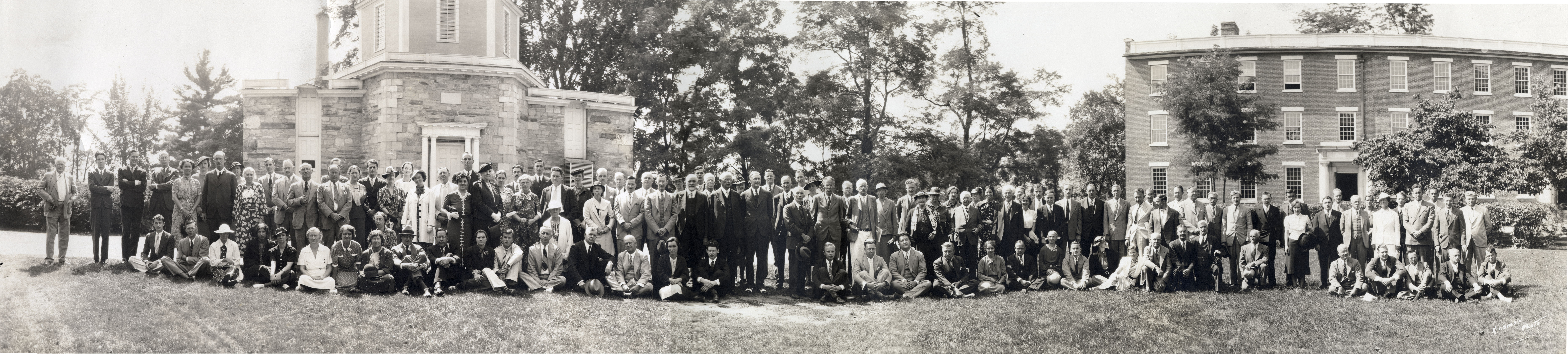
The following is reproduced from Willis I. Milham, Early American Observatories: Which Was the First Astronomical Observatory in America? (Williamstown, Massachusetts: Williams College, 1938), pp. 38-44:
In 1828 Albert Hopkins came to Williams College as tutor and in 1829 he was made Professor of Mathematics and Natural Philosophy. He was the youngest of the three children of Archibald and Mary Curtis Hopkins, and was born in Stockbridge, Massachusetts, on July 14, 1807. His early boyhood was spent on his father's farm and in attending the district school. His later education was at the Stockbridge Academy, and from there he entered the sophomore class at Williams College in 1824. He was graduated with the class of 1826 when only 19 years of age, and at commencement delivered the Philosophical Oration entitled "Caloric." After graduation young Hopkins did surveying for a while and considered entering the ministry. In 1828 he was invited to become a tutor in the college, and in 1829 he was made professor, and held this position forty-three years, until his death on May 24, 1872. He was a brother of Mark Hopkins who was president of Williams College from 1836 to 1872.
In June, 1834, it was decided that Albert Hopkins should visit Europe to study the methods of scientific instruction and to secure apparatus for this instruction. The minutes of the Board of Trustees for August, 1834, contain this "Report of Standing Committee":
.... the sum of four thousand dollars has been raised by subscription by the Alumni of the college and other liberal patrons of the institution, to be applied to the purchase of Philosophical and Chemical apparatus for the use of the institution and that it will be necessary to send an Agent to Europe to purchase the same, recommended to the Board that Professor Albert Hopkins have permission to be absent for that purpose from the 1st day of September next to the first day of May following and that during that time he be allowed his salary as usual he paying all his expenses during his absence.
He sailed in September on the packet-ship Hibernia for Liverpool and returned the following May. He brought with him quite a little apparatus, particularly astronomical equipment. It is likely that the older sidereal clock, the Troughton and Simms* transit instrument and the Herschelian reflector of ten feet focus were purchased at this time. These were not, however, the first astronomical instruments to be possessed by Williams College. The minutes of the Trustees for September 1, 1802, contain this: ". . . to procure a telescope for the college apparatus." This was presumably a small portable telescope to be used in the open for gazing purposes.
The next thing was to have a real astronomical observatory. In the autumn of 1836 the quarrying of stone for the observatory commenced, and if the work lagged, it is said that the professor himself worked at stone-cutting with his own hands. In his diary for November 30, 1836, occurs this entry: "Went this afternoon to N. E. Mountain to quarry stone for my observatory." He raised some of the money for the observatory and paid for part of it out of his own pocket. To be exact and prosaic, the records of the trustees show that the observatory cost $2,075, that $1,200 was voted by the trustees, that $400 was contributed by friends, and that Professor Hopkins himself gave $475. The students too helped and in those days they often turned out almost in a body to help build the observatory which was to mean so much to them and the College. Such were the strenuous days of 1837!
The stone-work of the building was well along in the spring of 1837. An entry in his diary for June 29, 1837, reads: "Finished the stonework of my building today. Felt solemn as the masons left. Felt as though I had not done my duty by them." In the spring of 1838 the observatory was nearly finished and it was formally opened with an address by Professor Hopkins on June 12, 1838. A woodcut of the observatory adorns the cover of the college catalogue for 1838-39. Albert Hopkins' title becomes Professor of Natural Philosophy and Astronomy and under observatory, apparatus, etc., appears this modest statement: "The lectures in Astronomy are accompanied by celestial observations and instruction in the use of instruments. An observatory has been completed the past season supplying important facilities for these purposes."
The Hopkins Observatory was built of native stone and consists of a central rotunda with two wings. It is surmounted by a revolving dome. The building is 48 feet long and the wings are nearly 14 feet wide. These are outside measurements. The central rotunda is octagonal on the outside and circular on the inside. It has a vaulted ceiling in the form of a hemisphere. This is painted blue and on it gold stars are grouped to form the constellations, and the circles of the celestial sphere are also represented. This is a unique and original idea and reminds one of what is now projected on the inside of a modern planetarium dome. [Note: The original ceiling has since been painted over and converted into the Milham Planetarium, named in honor of the author of this piece.] The wings have openings in the walls north and south and roof shutters. In the east wing the Troughton and Simms transit instrument, procured in 1834, turned between two white marble piers. It had a focal length of 50 inches, and an aperture of three and a half inches. The Molyneux sidereal clock was placed nearby. The transit instrument continued in position until the building was moved in 1908. What is left of it is now an "antique" and in the "museum" in the rotunda. [Note: The wings of the observatory now house the Mehlin Museum of Astronomy, which displays the original instruments more formally.] As far as is known nothing was ever mounted in the west wing. Under the revolving dome was placed a Herschelian reflector of 10 feet focus equatorially mounted. The circle for hour angle was a foot in diameter and the declination semi-circle was 30 inches in diameter. In 1852 the Herschelian reflector was replaced by a seven inch refractor. This instrument was procured through the generosity of Amos Lawrence of Boston and has an object glass by Alvan Clark, Sr., and a mounting by Phelps of Troy, New York. Although this was one of Alvan Clark's first object glasses, the instrument was considered at the time a very excellent one. The sidereal clock carries the name Molyneux and Cope, London, across the dial. This firm was in business in London from about 1820 to 1840, and nearly all of the sidereal clocks which came to America during this period were made by them. It is a grandfather clock with a brass movement, a mercury compensation pendulum, and an anchor escapement. The hour hand moves over a small dial and the hours are numbered from 1 to 24. It is an excellent clock, still running after a hundred years, and giving a good account of itself.
* Some accredit this instrument to Troughton and some to Simms and the spelling is not always the same. A recent apparatus catalogue of Cooke, Troughton & Simms contains these historical statements:
"Of the three names represented in the title of the firm, that of Troughton is the earliest, his business dating back to the latter part of the seventeenth century. .... In 1826 the instrument business of William Simms was amalgamated with that of Troughton. .... Thomas Cooke first began to manufacture refracting telescopes at York in 1836."The Herschelian was made right here in Massachusetts, by Amasa Holcomb of Southwick (see http://www.reflector.org/holcomb.htm for a quick history). A secondary source (Holcomb's great granddaughter's 1950 paper on Holcomb) lists his ledger, and a sale to Prof. Hopkins of a 10' telescope is prominent.